
Listen to this article
Estimated 5 minutes
The audio version of this article is generated by AI-based technology. Mispronunciations can occur. We are working with our partners to continually review and improve the results.
Osee Podolsky, general manager at Podolski Honey Farms, says the vast majority of honey produced at the family-run business in Ethelbert, Man., is shipped to customers across the United States.
Now he’s worried that the farm his grandfather started more than seven decades ago could risk bankruptcy after the U.S. slapped 50 per cent tariffs on $28 billion worth of Canadian goods — including natural honey — just after midnight on Saturday.
“It’s non-viable for us to ship to our usual customers that buy honey from us,” said Podolsky, stressing that about 90 per cent of the Ethelbert company’s honey is sold to the U.S.
“Effectively, we’re out of business. We can try to find more Canadian market share, but if many other beekeepers are trying to do the same, it may be a race to the bottom,” he said.
 Prime Minister Mark Carney said Canada walked away from trade negotiations with the United States after the Americans ‘asked for too much and offered too little.’ (Patrick Doyle/The Canadian Press)
Washington’s new tariffs came down early Saturday after Canadian and American negotiators couldn’t reach an agreement following days of trade talks.
At a Saturday morning news conference, Prime Minister Mark Carney said that the two neighbouring nations had been moving toward a “mutually beneficial agreement” until the U.S. later proposed new terms that were “uneconomic, unfair, and undermined the net benefits to Canada.”
The prime minister said U.S. negotiators raised issues with Canada’s French language protections — including bilingual labeling requirements on products sold in Canada — and even floated restrictions on Canada’s ability to make trade deals with other countries, among other last-minute demands.
Carney said the U.S. had “asked for too much and offered too little” and Canada is “walking away from a bad deal” as a result.
“There were some things we wouldn’t do. We were not prepared to compromise Canada’s sovereignty or undermine our key industries,” the prime minister said.
Canada will fight back with retaliatory dollar-for-dollar tariffs expected to come into effect after Labour Day, Carney said.
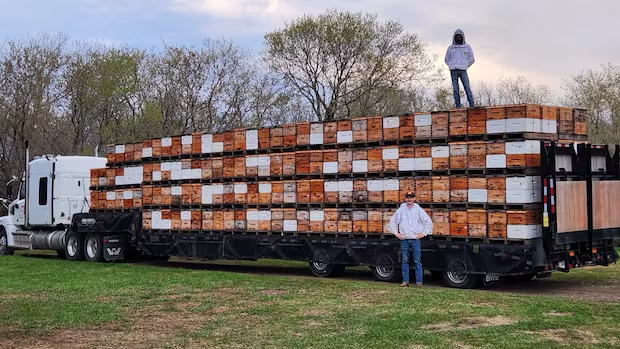
 Podolski Honey Farms in Ethelbert, Man., sells about 90 per cent of its honey to customers in the United States. (Submitted by Osee Podolsky)
Podolsky said small businesses like his family’s honey farm are essentially “collateral damage” in the cross-border tariff battle, with some entrepreneurs left feeling “helpless” right now.
Annual summer honey production typically wraps up around August, with staff quickly buzzing to package the golden liquid into barrels and ship them off to customers.
But the new tariffs will sting the company’s bottom line this year, as sales usually kick off starting in September and last into the fall.
“It was a mad dash to get as much stock as we had in barrels, shipped to customers before the threat of tariffs,” Podolsky said.
“If the tariffs aren’t lifted, I can’t afford to sell with this kind of a tariff. I would go bankrupt.”
The farm will try to fulfill its Canadian contracts with the remaining barrels of honey, then Podolsky says they’ll sit down with an accountant to lay out a plan for the coming months.
 Loren Remillard, president and CEO of the Winnipeg Chamber of Commerce, says Canadian negotiators should hold out until they reach the right trade deal with the U.S. (John Einarson/CBC)
Loren Remillard, president and CEO of the Winnipeg Chamber of Commerce, felt disappointed and shocked after the U.S. tariffs kicked in.
Some business owners in Manitoba’s largest city had been hopeful that negotiators were just ironing out minor details. But that optimism waned as the weekend crept closer, Remillard said.
“As the negotiations went later and later, my conversations turned to a little bit more of anxiety,” Remillard said of his discussions with Winnipeg-based business owners.
Despite the bracing for “substantial economic pain,” he said the chamber supports Canada’s decision to walk away from trade talks after new terms by the U.S. raised “much larger sovereignty-based questions.”
“It’s important that we stand firm and we rally to the Team Canada message,” Remillard said, encouraging local consumers to buy Canadian-made products where possible.
“Let’s get the right deal for Canada. But it still cannot be any deal, it has to be the right deal for Canada,” he said.
Selkirk Mayor Larry Johannson he’s disappointed but not surprised to see the tariffs also dent the steel industry, which is one of the city’s largest employers.
While the U.S. remains “unpredictable” to do business with, Johannson said he would like to see more trade open up between the provinces and with other countries looking to buy Selkirk steel.
“Let’s care about Canadian business. Let’s put our provincial barriers aside and let’s get down to business,” he said.
 Podolski Honey Farms general manager Osee Podolsky says beekeepers on both sides of the border benefit from Canada-U.S. trade. The U.S. is a net importer of honey, while Canadians often by beekeeping supplies from American manufacturers, he said. (Submitted by Osee Podolsky)
Podolsky said beekeepers on both sides of the border benefit from Canada-U.S. trade, with the Americans buying our surplus honey, while Canadians purchase beekeeping supplies manufactured in the U.S.
He wants to see the tariffs dropped.
“I hope that we can find that our governments can reach an agreement and have these tariffs removed,” Podolsky said.
“I think this is something that’s going to take a little more time on both sides to reach some kind of an agreement or resolution. I just hope it’s sooner rather than later.”