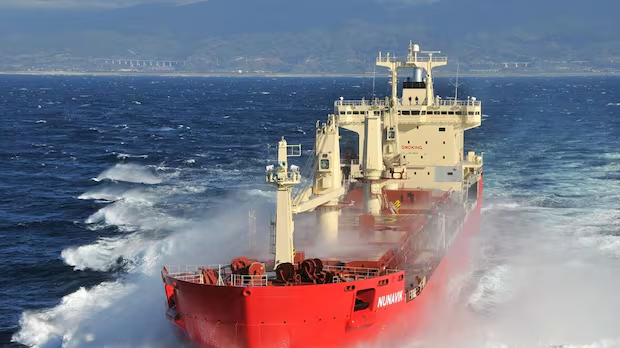
Premier Wab Kinew says it will cost $70 to $80 billion to build a Port of Churchill expansion that includes an offshore liquefied natural gas terminal in Hudson Bay.
A series of studies suggests freighters hardened against ice can safely navigate Hudson Bay outside of the existing four-month Port of Churchill shipping season — but warn fully laden natural gas tankers hardened to withstand the force of sea ice can not manoeuvre within the shallow and narrow entrance to the existing port.
“Significant dredging, infrastructure modifications or development of an offshore loading facility would be required before such vessels could be employed at Churchill,” concluded a feasibility study commissioned by Arctic Gateway Group, which owns the port and Hudson Bay Railway.
It cost $40 billion over 12 years to build a liquefied natural gas terminal at Kitimat, B.C., which is situated at the end of a long, protected inlet that drains into the Pacific Ocean.
An offshore terminal in Hudson Bay would be open to the prevailing northeastern winds on Hudson Bay.
Kinew said he is heartened by new studies suggesting shipping liquefied natural gas through icy waters is possible and dismissed the idea Inuit, First Nations and other Arctic residents would be as opposed to gas shipments as they would to oil travelling through Hudson Bay.
“LNG, people think about it like propane that we all use in our backyards when we’re barbecuing,” the premier said during a news conference at the University of Manitoba’s Fort Garry campus Friday.
“So, the idea of a leak or spill and the impacts on the environment, it’s not really the same level of concern.”
 Manitoba’s premier says liquefied natural gas shipments don’t provoke the same concerns as oil. (Prabhjot Singh Lotey/CBC)
Kinew spoke after the publication of three studies that bolstered the hopes of extending Churchill’s shipping season from the current average of roughly four and a half months.
The studies concluded year-round shipping could commence right now with the use of the third-toughest class of vessels hardened against sea ice, even as some ice is expected to remain in the bay and pose challenges in the coming decades under global-warming scenarios.
Kinew said the results of the studies provide Manitoba’s government with some certainty as it tries to pitch investors on a multibillion-dollar proposal to expand the Port of Churchill and upgrade the Hudson Bay Railway.
“Churchill could be a year-round port right now with current technology, and using icebreakers and ships that are a lot cheaper and a lot more affordable than we previously thought,” he said.
The text of the reports, however, suggest the continued presence of sea ice and varying ice conditions from year to year demands further study.
Arctic Gateway Group, which owns the port and railway, partnered with shipping company Fednav to determine what’s required to make year-round shipping possible in and out of the Port of Churchill.
This study concluded it is feasible to extend Churchill’s shipping season today using ice-hardened freighters and that year-round access is possible in the future.
Fednav, however, warned this is subject to “the highly dynamic ice environment of Hudson Bay” and challenges of navigating the shallow and narrow approach to the Port of Churchill within the Hudson Bay estuary.
“Field studies, probe voyages, and simulation-based assessments would help reduce these uncertainties and support future decisions regarding extended-season or year-round shipping operations,” Fednav said in its report.
Arctic Research Foundation estimated the cost of purchasing the third-toughest class of ice-hardened vessel to be in a range of $280 million to $410 million, while the fourth-toughest class of ice-hardened vessel would cost $100 million to $130 million.
Both would cost significantly less than multibillion-dollar icebreakers that can traverse the thickest multi-year ice in the Arctic Ocean.
A third study conducted by a group of academics, including University of Manitoba sea ice expert Feiyue Wang, concluded there will still be ice on Hudson Bay if the average global temperature rises five degrees Celsius above pre-industrial levels by the latter part of this century.
Atmospheric scientists currently expect the average global temperature to rise 3.4 degrees Celsius in this time frame.
Kinew plans to travel to Toronto in September to pitch investors on the Port of Churchill expansion.
Churchill Mayor Mike Spence, the chair of Arctic Gateway Group, said he believes investors should get on board and dismissed the idea the risks involved in Arctic shipping could spook the insurance industry.
“It’s time that we, as business folks, are starting to challenge the underwriters,” he said.
“We are saying, ‘Look, climate change is upon us, and things are different.’ And it’s time that they accept the fact that change is happening, and they need to be realistic as well.”
Churchill-Keewatinook Aski MP Rebecca Chartrand, the sole Manitoba member of Prime Minister Mark Carney’s cabinet, said it’s too soon to say how much money Ottawa will contribute to the Port of Churchill expansion or when Churchill will be added to the list of projects of national importance.
The commission of icebreakers and the construction of a gas terminal are only two of several components of the proposed expansion of the port. It currently operates during a roughly four-month ice-free season that runs from mid-July to late October or early November.
Arctic Gateway Group, which is made up of 29 First Nations and 12 remote northern Manitoba communities, also plans to rebuild the Hudson Bay Railway so it can withstand higher payloads and improve both storage and loading facilities at the Port of Churchill.
WATCH | Kinew heartened by studies suggesting shipping LNG through icy waters possible:
Manitoba premier floats $80B offshore LNG terminal at Churchill
Manitoba Premier Wab Kinew says it will cost $70 billion to $80 billion to build a Port of Churchill expansion that includes an offshore liquefied natural gas terminal in Hudson Bay.
Chartrand would not commit to publishing the results of a federal study to determine the market for the proposed expansion.
Manitoba Opposition Leader Obby Khan said Friday’s announcement by Kinew was dismissive of the concerns of northern Manitobans. He also said the same warming temperatures that will make ice scarce in Hudson Bay might create more disruptions on the Hudson Bay Railway due to melting permafrost.
“He makes a big announcement today about a study, another study that says it might be likely, plausible, potentially with no investors, no federal government at the table, no buy-in from the Indigenous communities in Manitoba,” Khan said.
“I think all Manitobans and Canadians and the world wants to see the Port of Churchill developed, but he’s not being serious and setting realistic expectations or timelines or a price tag on any of the real work that has to go into developing a project like this.”