
Open this photo in gallery:
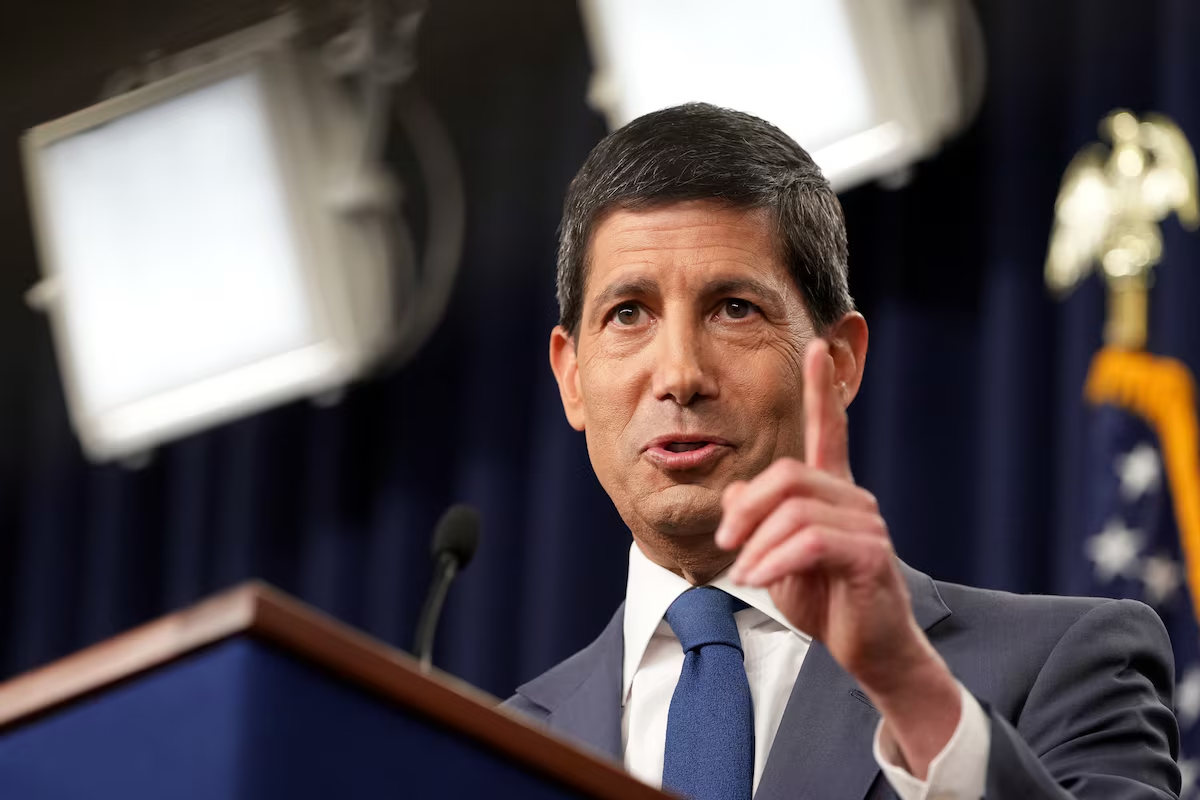
Kevin Warsh speaks during a news conference at the Federal Reserve in Washington on July 29.Mark Schiefelbein/The Associated Press
Kevin Yin is a contributing columnist for The Globe and Mail and an economics doctoral student at the University of California, Berkeley.
In the latest Federal Reserve press conference in July, the new chair Kevin Warsh screwed up. He was uncommunicative about the Fed’s thinking, and financial markets have reacted poorly. Long-term yields jumped, and Wall Street economists remain divided about the timing of the next interest rate adjustment.
The problem with Mr. Warsh’s approach is that he has confused forward guidance, a specific policy tool which he does not believe in, with the general guidance about central bank thinking that remains crucial.
Forward guidance has a very precise definition in monetary policy – it is the unconditional commitment of the central bank to keep interest rates at a particular level (what is known as Odyssean forward guidance), or a conditional commitment paired with the Fed’s own forecasts of future conditions (Delphic forward guidance). In essence, it is a commitment to, or prediction about, future rates.
Fed Chair Warsh considers reducing the frequency of policy meetings
Many economists would agree with Mr. Warsh that forward guidance can be excessively constraining for the central bank under some circumstances. If the Federal Reserve commits unconditionally to a path for interest rates, or states directly that rates will stay low because inflation is not expected to rise, for example, unexpected conditions can force the bank to deviate, or stay at a suboptimal policy rate. Deviating from a stated policy undermines its inflation-fighting credibility, while setting the wrong rate must either show up in higher inflation or higher unemployment.
That is why forward guidance is best used at the zero lower bound where interest rates cannot go much lower (for example, during the 2008 financial crisis), when the central bank can only stimulate the economy by promising better financing conditions in the future.
However, ruling out forward guidance does not mean reducing communication of the Fed’s “reaction function,” i.e., how the Fed weighs different data in the present, what it thinks are the main drivers of inflation and unemployment, and how it would respond to a variety of possible conditions in the future (without taking a stance on the likelihood of those conditions). In throwing out the latter with the first, Mr. Warsh has confused forward guidance for standard central bank communication, and left markets baffled.
Compare his communications strategy with that of his predecessor, Jerome Powell. Mr. Powell was notable for walking the press through granular data underlying trends in Consumer Price Index and labour market, diving into the dull but important details about who was working, why, and differentiating between price pressures in goods, housing and services.
Rate hikes may be a blunt tool, but they’re all the Fed has to cool inflation
Mr. Warsh, by contrast, gave the shortest policy statement in two decades in June. The new chair has avoided commenting on the components of our aggregate measures of inflation and labour market health, despite being pushed to do so by reporters. He has expressed skepticism about the Phillips Curve, which relates high employment to high inflation, but has not provided a clear sense of what kind of alternative framework he is using to evaluate these phenomena. While Mr. Warsh reiterated his commitment to a 2-per-cent inflation target, he refused to clarify how this would be accomplished and insisted that markets themselves take some responsibility for fighting inflation.
Underpinning all of this is Mr. Warsh’s belief that investors already have all the requisite information to price assets, and that excess Federal Reserve communication only serves to distort their behaviour in inefficient ways. Setting aside for a second that investors themselves seem displeased with this strategy, Mr. Warsh has failed to recognize that economic data is not the only thing that matters in determining inflation and asset prices – the Fed’s own policy rate matters as well. Uncertainty in how the Federal Reserve sets the rate is unnecessary and wasteful.
The consequences of this vagueness are higher inflation expectations, weaker monetary policy effectiveness, and higher risk-premiums. U.S. 10-year and 30-year bond yields rose upon his latest press conference and have remained elevated since, showing that investors now want to be compensated for what they see as higher inflation risk. Future hikes become less effective because markets cannot infer policy from economic data, and thus become slower to react. Uncertainty in Fed policy rewards investors who are better at guessing the thinking of the rate-setting Federal Open Market Committee, rather than those who determine where capital is best allocated.
We can argue about whether forward guidance was used in excess by Mr. Powell’s Federal Reserve. But in his refusal to provide any guidance on the Fed’s thinking, Mr. Warsh is throwing out the baby with the bathwater.