
Listen to this article
Estimated 5 minutes
The audio version of this article is generated by AI-based technology. Mispronunciations can occur. We are working with our partners to continually review and improve the results.
It’s been just over a week since cars and trucks began making their way across the Gordie Howe International Bridge.
On Wednesday, the bridge opens to active transportation.
It’s an opening that’s been eagerly anticipated by many cyclists, walkers and joggers.
Here’s what you need to know if you’re preparing to check it out.
What are the opening and closing times for the multi-use path?
The path is open seven days a week, but hours will vary throughout the year based on seasonal daylight hours, the Windsor-Detroit Bridge Authority told Radio-Canada.
Those hours are:
- April 1 to Oct. 31: 8:00 a.m. to 8:00 p.m.
- Nov. 1 to March 31: 8:00 a.m. to 4:00 p.m.
Access to the path will end an hour before closing to allow time for everyone to complete their journey within operating hours.
The multi-use path may close during poor weather or other conditions that affect safety, the bridge authority said.
It will post closure information on the Gordie Howe International Bridge website and social media channels.
 The pedestrian path leading onto the Gordie Howe International Bridge, before its opening. The path will open to the public on Wednesday, Aug. 5, 2026. (Ken Amlin/CBC)
How much does it cost?
It’s free.
Where can I park before walking or riding across?
There is no on-site parking at either port of entry.
People can park at the Malden Park trailhead in Windsor or the Clark Park trailhead in Detroit, the bridge authority advised.
Where should people queue while waiting to get on the bridge?
There are newly built paths on either side of the entrance to the bridge’s multi-use path where cyclists and pedestrians can avoid standing on the roadway. However, the bridge authority says queueing on the connecting paths prior to the daily opening of the bridge path is not permitted.
“People who arrive before the path opens will be asked not to queue on adjacent streets or connecting paths and should return closer to the scheduled opening time,” a spokesperson for the bridge authority told CBC.
The authority is also reminding path users not to stand or gather on nearby roadways, and people are asked to consider visiting later this summer or into the fall “to help ensure a safe and efficient crossing experience.”
How long is the path?
Three kilometres from border inspection booth to border inspection booth.
How steep is the path?
The path ascends and descends at approximately a five per cent incline. It reaches about a 2.86-degree slope at its steepest point.
How long does it take to cross the bridge on foot or by bike?
The bridge authority estimates it will take people approximately 45 minutes on foot or 20 minutes by bike.
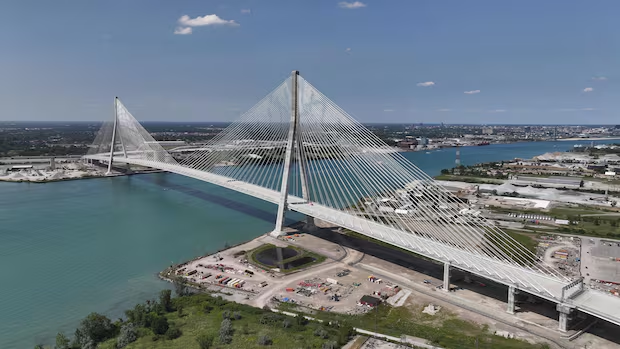
 The Gordie Howe International Bridge, pictured in June 2026. (Jacob Barker/CBC)
Is there a speed limit on the path?
Yes. It’s 20 km/hr.
Can I ride an e-bike?
Yes, but not for the first few weeks. And only e-bikes that meet the following criteria are allowed:
- The electric motor provides power only when the rider is actively pedaling.
- The bike does not include a throttle.
- The motor assistance automatically cuts off when the bike reaches 32 km/h.
What other vehicles are allowed on the path?
Bicycles, cargo bikes, folding bikes and — when the bridge authority authorizes them — pedal assist e-bikes that meet the above criteria. The path also permits mobility aids used by people with disabilities, including motorized wheelchairs and adaptive cycles.
What vehicles are not allowed on the path?
Rollerblades, skateboards, roller skates, segways, hoverboards, electric scooters and other motorized rideables. E-bikes with throttles and those that can travel faster than 32 km/hr are also prohibited.
Do I need to bring my passport or other travel documents if I don’t plan to cross the U.S. border?
Yes. If you choose to exit the bridge on the Canadian side, you will have to report to the Canada Border Services Agency.
Anyone who arrives at the port of entry without proper travel documents risks being held up and facing secondary inspections while officers verify their identity and status, the agency told CBC.
Will the CBSA be checking travel documents before people get on the bridge?
People do not need to systematically show their travel documents to the CBSA when entering the multi-use path, the agency said, but it has authority under the Customs Act to question anyone leaving the country and examine their goods. Officers may request travel documentation if they do so.
Can I bring marijuana on the bridge if I’m not planning to cross the U.S. border?
No.
“It is illegal to transport cannabis across the border in any form, whether on import or export,” the Canada Border Services Agency said, “unless a person has a permit or exception authorized by Health Canada. Travellers may also be subject to criminal charges if they attempt to travel to other countries with any amount of cannabis in their possession.”
What’s more, the consumption of cannabis, alcohol and illegal substances is prohibited on the bridge, as is smoking, the Windsor-Detroit Bridge Authority said.