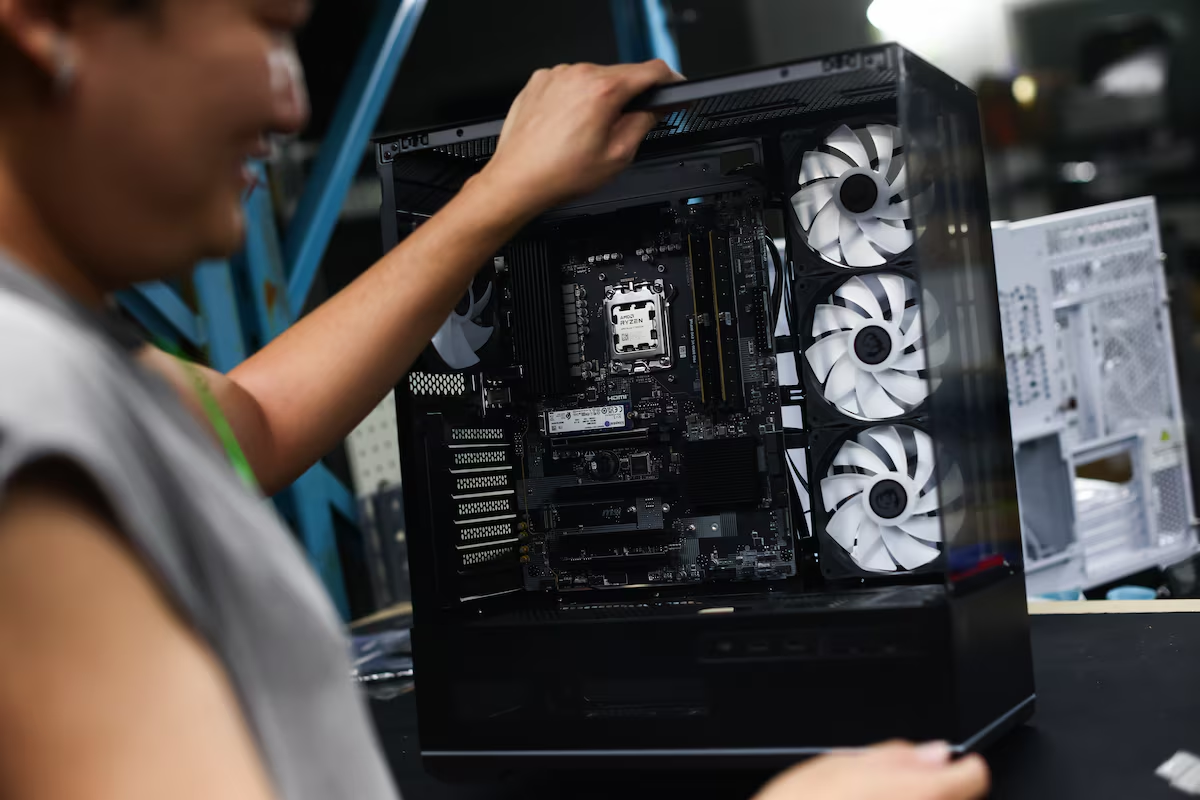

Open this photo in gallery:
Steven Wen installs components in a computer at the warehouse of Quoted Tech, a custom computer builder in Toronto, on Wednesdays, July 29, 2026. (Cole Burston/The Globe and Mail)Cole Burston/The Globe and Mail
When Stephen Jeffers started looking for the components to build a new gaming computer at the end of last year, the cost of digital storage gave him sticker shock.
“I had most of the parts except for RAM because I was like, ‘I could get that anywhere,’” said Mr. Jeffers, who has previously built two gaming computers, which require more memory than normal computers. Memory has historically been low cost and easy to source. But the price was climbing fast. “Once it doubled I hit the panic button and went to the secondary market,” he said.
He paid $200 for two 16-gigabyte sticks of RAM on the secondary market and $150 for a two-terabyte solid-state drive that he “swooped in” and got on sale around Christmas.
Just six months later, the same components are now selling for about $600 each, he said. Mr. Jeffers, who lives in St. John’s and works in project management, joked that his computer storage has become “one of my best-performing assets.”
How St. John’s has become an unlikely hub for tech startups
Consumer electronics from cellphones to gaming devices are rapidly becoming more expensive as massive demand from the data centres that power artificial intelligence drives up the cost of memory.
The price of random access memory, or RAM, and solid state drive storage – two types of memory that store data on cellphones, laptop and desktop computers, and gaming systems – has quadrupled since late 2025. A late June report from Jefferies Equity Research said RAM prices will continue to increase between 40 and 50 per cent in the third quarter of this year, and another 30 to 40 per cent in the fourth quarter.
Open this photo in gallery:
Kevin Jia, the chief executive officer of Quoted Tech, a custom computer builder says has also had to raise prices due to what he calls the ‘AI tax.’Cole Burston/The Globe and Mail
Kevin Jia, co-founder and chief executive officer of Quoted Tech, a Canadian PC builder, called the price hikes an “AI tax” on consumers buying a new device or looking to build their own. Mr. Jia’s company makes computers for high-end and entry-level gaming as well as professional workstations.
AI data centres use types of memory that are far more powerful than what goes into a desktop computer or a game console. But the big three memory chip makers – Micron Technology, SK Hynix and Samsung Electronics – have been allocating more of their capacity toward those enterprise clients, said Willy Shih, a professor at the Harvard Business School. That’s leaving little room for traditional RAM and flash memory manufacturing for consumer devices.
Micron, which reported record quarterly revenue of US$41.46-billion at the end of June, closed its consumer brand entirely in December last year.
Technology makers are now passing the higher costs onto consumers. Apple raised its prices across the board in late June: a budget Neo laptop now retails for US$699, up from US$599; a MacBook Air goes for US$1,299, up from US$1,099; and an iPad Air is US$749, up from US$599.
“The consumer electronics industry is facing an unprecedented challenge,” Apple said in a statement, adding that the rapid expansion of AI data centres had created an “extraordinary” surge in the demand for memory and storage. “We have never seen a component price increase this much, this quickly.”
AI data centres are the future. Canada must overcome the backlash
Dell, Microsoft, Motorola, Sony, Nintendo and smart ring-maker Oura have also hiked prices on their products.
“As a company that builds computers, we have to explain to people what’s happening all the time,” said Mr. Jia. Quoted Tech has also had to raise prices. “We want computing to be as affordable as possible. Unfortunately, we have to cover the costs of our supply. We can’t eat $400 to $500 of memory. No company can.”
Open this photo in gallery:
Mr. Jia holding sticks of RAM in the warehouse of his Toronto business. Since 2025, the price of RAM and solid state drive storage has quadrupled.Cole Burston/The Globe and Mail
Mr. Shih said the price spike is “highly unusual” relative to the past 50 years of electronics development. “We have been on this trend of every year, you get more performance and more memory for the same price,” he said. “What’s really quite extraordinary is seeing retail prices like this increase by a factor of four.”
Analysts at Counterpoint Research, a global firm, estimated the price hikes will depress smartphone shipments by 2.1 per cent in 2026, and IDC tech intelligence analysts forecasted an 11.3-per-cent decline in the personal computer market.
Across Canada, the fight against artificial intelligence goes offline
Memory costs have also hit Canadians who build or upgrade their own computers. For people looking to run powerful video games, building a computer from scratch with the components of their choosing has historically been less expensive and better than buying a pre-built gaming computer.
“It’s a price to performance thing,” said Vamsi Kolluru, 33, an avid gamer who lives in Toronto and works in science. “I’ve had pre-built computers before and they’re always lacking; they don’t have the best specs and it’s cheaper to build it yourself.”
Mr. Kolluru, who has built two computers, estimates in the past he’s saved a couple hundred dollars each time relative to the price of a pre-built gaming rig.
But not any more. Mr. Kolluru was planning to upgrade his PC this year to keep up with the current generation of games. The eye-popping cost of RAM and SSD has caused him to reconsider. When he last upgraded in 2022 the cost of 32 gigabytes of RAM was $150; now it’s retailing for about $370. If he upgraded to the newest type of RAM, he said he’d be looking at a $500 spend.
Open this photo in gallery:
Workers assemble machines in the warehouse of Quoted Tech, a custom computer builder in Toronto, on July 29.Cole Burston/The Globe and Mail
Chip makers are looking to add more capacity, but Mr. Shih said that new factories take about two years to come to market.
In addition to his computer, Mr. Jeffers has been building his own storage space for personal photos, videos and files, rather than paying companies such as Google or Microsoft monthly for cloud storage. He’s faced higher prices for the memory for this storage project, too, and said he’s growing concerned that control is “slipping away” from consumers.
Mr. Jeffers, a lifelong physical collector who still has video games from his childhood tucked away in his basement, said that higher prices could contribute to what’s been so far a gradual transition toward consumers not truly owning their physical devices, and having to rent storage or electronics themselves from tech companies.
“We’re losing control of the very things we’re spending money on,” he said. “It’s hard to visualize when you see prices going up, but at the end of the day the price of admission for asset ownership is increasing as these things get consolidated, and it is concerning.”