
Listen to this article
Estimated 4 minutes
The audio version of this article is generated by AI-based technology. Mispronunciations can occur. We are working with our partners to continually review and improve the results.
Elements of British Columbia’s involuntary care regime that allow forced psychiatric treatment, regardless of a person’s capacity to make health care decisions, are unconstitutional, the B.C. Supreme Court has ruled.
In a decision published Thursday, Justice Lauren Blake ruled provisions in the Mental Health Act violated both patients’ Canadian Charter equality rights and rights to life, liberty and security of the person, and gave the province a six-month window to amend the legislation.
In her ruling, Blake found that under B.C.’s system, instead of narrowly-defined intrusions into patient’s rights, mental health facility directors are “automatically granted a blanket power to provide any psychiatric treatment they determine appropriate to any involuntary patient in any situation.”
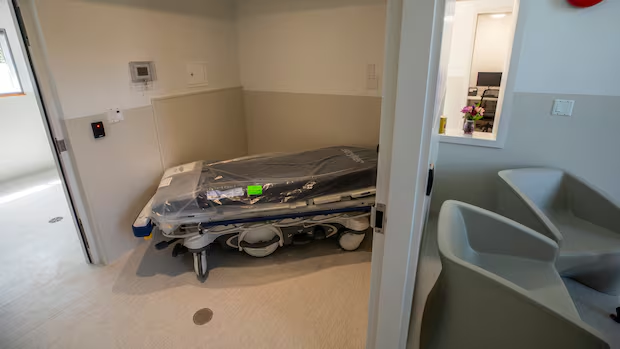
The ruling comes as B.C. seeks to ramp up involuntary treatment for people with severe mental health conditions, substance use disorders and brain injuries.
WATCH | B.C. launching new involuntary treatment facilities in Surrey, Prince George:
B.C. to create new involuntary care beds in Prince George and Surrey
B.C. Premier David Eby was in Prince George today to announce new involuntary care beds at two locations in the province. Eby says the new beds will help people and communities, but as the CBC’s Liam Britten reports, some advocates and critics are not so sure.
In a statement, B.C.’s Ministry of Attorney General said it would determine its next steps after reviewing the decision, but that mental health care delivery would continue “uninterrupted” for now.
“Involuntary care is an important part of mental health care systems across the country — and people experiencing mental illness deserve timely, high-quality care that respects their rights, dignity and autonomy while supporting their health and safety,” the ministry said.
B.C. system unique
The ruling caps a legal challenge launched 10 years ago by the Council of Canadians with Disabilities (CCD).
The CCD did not challenge B.C.’s involuntary admission, detention and treatment system at large. Instead, it focused on how under B.C. law, anyone who is involuntarily admitted is automatically deemed to have consented to psychiatric treatment.
The CCD argued B.C.’s system wrongly assumes all involuntary patients lack capacity to make treatment decisions and “obliterates completely an individual’s liberty and ability to choose” resulting in trauma and mistrust.
WATCH | New guidance for involuntary youth treatment in B.C.:
B.C. physicians given expanded guidance for involuntary treatment of youth
B.C. doctors and other health-care workers have been given updated guidance on involuntary care for youth when they can’t or won’t get care themselves. Parents of children who’ve died from illicit drugs say the change is needed to save more lives. But as Pinki Wong explains, others worry it may drive young people away from help.
The province argued that assigning “substitute consent” power to facility directors is a common practice and is centered on a “treatment first” model.
But in her ruling, Blake found B.C. was an “outlier” in Canada as the only jurisdiction not to require an assessment of a patient’s capacity to make treatment decisions and to allow the unfettered treatment of capable patients without their consent or with independent oversight.
“Every other province and territory has mental health legislation that impairs the health care consent rights of involuntarily admitted patients in a significantly less drastic manner,” she ruled.
‘Legal fiction’
Key to the ruling is paperwork the director of a mental health facility signs when admitting an involuntary patient in B.C., known as Form 5.
According to the decision, the form has only two options: either the patient signs, acknowledging the nature of their condition, treatment options and risk and gives consent, or the director signs on their behalf, concluding they are incapable of consenting for themselves.
Blake ruled that choice creates a “legal fiction” that patients either consent or are not mentally capable.
All but one of 14 mental health experts who testified agreed that though it was not common, some patients who meet the criteria for involuntary detention are capable of providing informed consent.
WATCH | Opposition to expansion of involuntary treatment:
Advocates gather to protest B.C. NDP’s involuntary treatment expansion
A coalition of advocates gathered Monday to protest the B.C. NDP’s involuntary treatment expansion. New legislation to strengthen involuntary care will be put forward at the legislature this week. As Michelle Gomez reports, the protesters say the proposed expansion infringes on human rights.
Several experts testified that many people who initially refuse treatment later agree to it, and that clinical outcomes were better if a patient participated in their treatment.
The court also heard testimony from patients who had undergone involuntary treatment and their families.
Witnesses raised concerns about coercion and physical force, the lack of procedural safeguards, lasting harms including the stigma of involuntary admission and that the system overrides the will of substitute decision-makers to act on behalf of an involuntarily detained person.
Along with the Mental Health Act, the ruling also struck down related provisions of B.C.’s Consent Act and Representation Agreement Act.