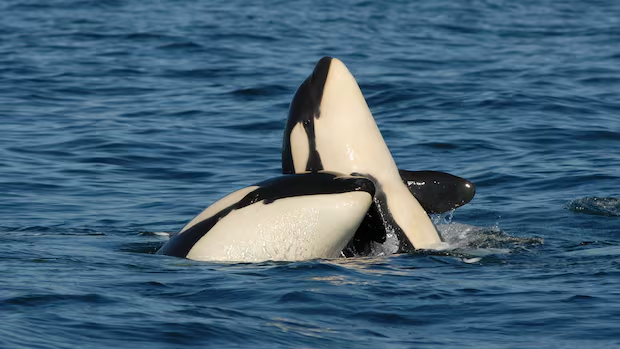
Environmental groups are voicing concerns about the impact the Alberta government’s proposed route for a new oil pipeline could have on an already endangered species of whale.
As of July 2025, there were 74 southern resident killer whales in the world, according to the Center for Whale Research.
The proposed pipeline would be “devastating” for the species, according to Anna Barford with the international non-profit environmental organization Stand.earth.
One spill would have “generations’ worth of impacts” on the marine population, she said.
 Alberta’s pipeline proposal currently includes two main routing options. Both would lead to an export terminal in southern B.C., increasing tanker traffic in the Salish Sea. (Province of Alberta)
But Barford says the project’s risks go far beyond a spill.
The proposed pipeline, now under consideration by the federal Major Projects Office, would carry approximately one million barrels of crude oil a day along roughly 1,250 kilometres using a corridor similar to the existing Trans Mountain pipeline, according to the Alberta government.
Those one million barrels would mean increased tanker traffic in an already crowded waterway.
The Westridge Marine Terminal, in Burnaby, B.C., where Trans Mountain loads crude from the pipeline onto tankers, loaded 380 vessels from mid-2024 to the end of 2025, according to a quarterly report.
Higher ship traffic means a multitude of risks, according to Barford.
 Trans Mountain loaded 380 vessels over a 17-month period from mid-2024 to the end of 2025, according to a report from the Crown corporation. (Ben Nelms/CBC)
“Underwater noise is the obvious pollution footprint, but there’s also air pollution,” Barford said. “There’s all sorts of contaminants and pollution that comes out of a vessel, even when it is operating perfectly normally.”
Whales use echolocation to communicate, socialize and to find their prey. Increased sound makes this more difficult, while polluted air damages natural habitats for their prey, Barford said.
Alberta’s government said in a statement to CBC News that “marine safety and species protection is not optional — it will be embedded in every aspect of the project’s design and operation.”
The proposed pipeline’s route could end up near the Fraser River Estuary, a primary feeding area for these whales, full of “incredible biodiversity and richness,” according to Beatrice Frank, executive director at the Georgia Strait Alliance.
Among that biodiversity is the Chinook salmon, a main food source of the southern resident killer whale.
“[Climate change] is warming the ocean. And the warmer ocean is killing the salmon that the southern residents depend on,” said Andrew Trites, director of the Marine Mammal Research Unit at the University of British Columbia.
“It’s not the boats per se, it’s what they’re carrying. We’re effectively the drug pusher.”
Salmon populations in the area are already suffering. The estuary has lost approximately 85 per cent of its salmon habitat due to development and infrastructure, according to a 2021 study.
 Chinook salmon are one of the southern resident killer whale’s main food sources. (Claudiane Samson/CBC/Radio-Canada)
It’s an issue the federal government has acknowledged, announcing in April it will spend $412.9 million over five years to as part of a strategy to protect and rebuild Pacific salmon populations.
The federal government last spring also proposed $258 million over five years for the protection of whales and their habitats, including $95 million over five years and $16.5 million annually thereafter to fund efforts specifically for the protection of southern resident killer whales.
Frank calls federal efforts like these “encouraging,” but, when coupled with new pipelines, part of a “confusing” overall message.
‘Worrying’ legislation: professor
The Liberals’ Bill C-5 allows projects deemed in the national interest to have their approval process, including environmental assessments, fast-tracked.
And in May, two federal discussion papers went further — proposing approval before review and exempting certain projects from the “jeopardy test” in the Species At Risk Act.
Roughly 600 species, including southern resident killer whales, are listed in the act.
The government is now considering amendments to the Species At Risk Act after the submission period for public feedback closed last week.
Kathryn Harrison, a professor at UBC who specializes in climate and energy politics, believes the changes set a concerning precedent.
“It’s very worrying. We have these laws for a reason,” she said.
The federal government faces an Oct. 1 deadline to decide whether to designate Alberta’s proposed pipeline as a project of national interest.
In an emailed statement to CBC News, the Major Projects Office said a referral “does not mean that it has been automatically approved, designated as a nation-building project under the Building Canada Act or exempted from applicable regulatory and consultation processes.”
But the industrialization of the Salish Sea doesn’t appear to be slowing down anytime soon, as the government considers expansion plans for Trans Mountain and prepares for a recently announced port expansion — one that could end up being the destination for this new pipeline, should it come to fruition.
Meanwhile, the southern resident killer whales continue a development of their own. A calf was born last winter, Frank revealed, putting the endangered population, at least for now, at 75.