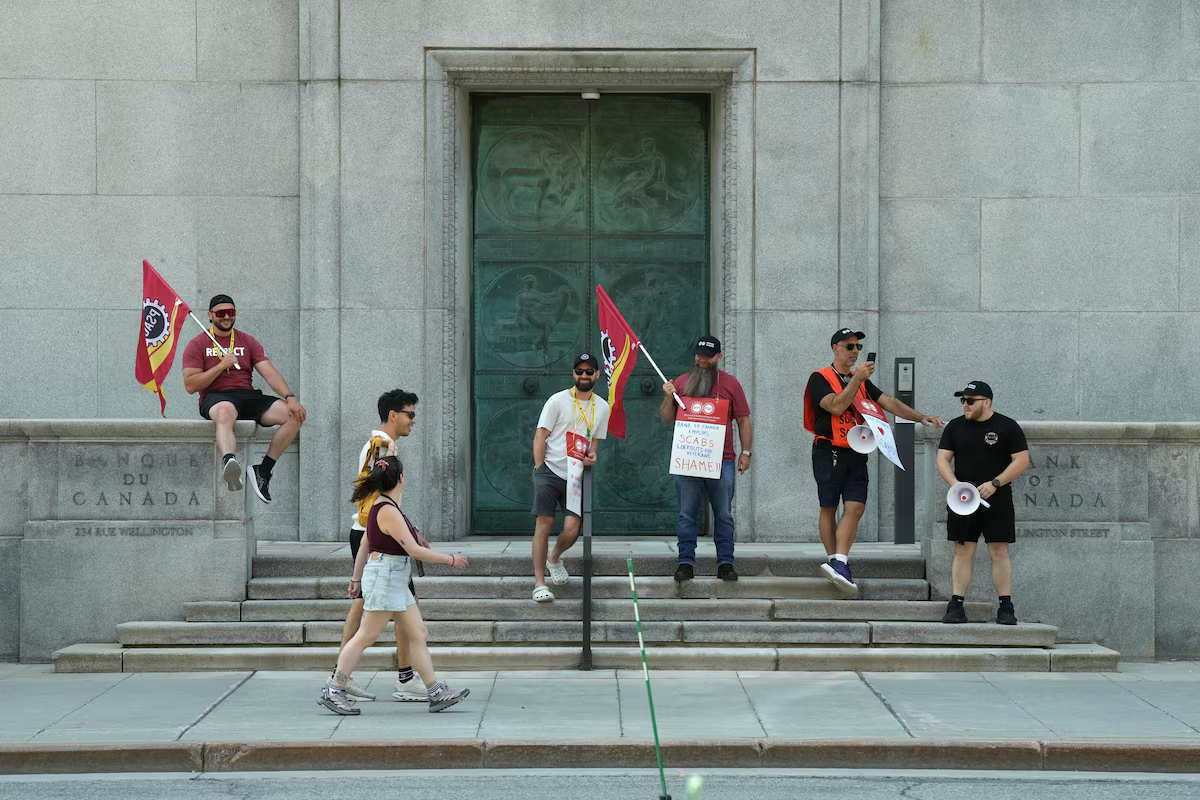

Open this photo in gallery:
People walk past Bank of Canada security officers striking outside the central bank’s headquarters in Ottawa on June 29.Adrian Wyld/The Canadian Press
The Bank of Canada has been ordered for the second time this month to stop using replacement workers for its striking security guards, a violation of federal labour laws.
The Canada Industrial Relations Board issued a ruling against the central bank on July 22, stating that it violated the Canada Labour Code by using the services of a third-party security contractor – Pinkerton Consulting & Investigations – two weeks after it was told by the board to stop using replacement workers.
At least 49 security guards represented by PSAC Local 71250 have been on strike since late June, after negotiations broke down over benefits. PSAC and the central bank have been negotiating for a new contract since December, 2024. The stoppage has forced all of the central bank’s employees to work from home.
The use of replacement workers during strikes became illegal under federal labour law in June, 2025, much to the chagrin of federally regulated employers that had campaigned for years against anti-scab legislation.
Even so, the Bank of Canada appears to be flouting the new laws. The CIRB first ruled that the bank had violated labour laws on July 7, after it found that it was using contractors from GardaWorld Security to perform work usually done by its own security guards.
Shortly after the ruling, Bank of Canada spokesperson Paul Badertscher told The Globe and Mail in a statement that the central bank had “complied fully with the CIRB ruling by the deadline,” and that it respects the collective bargaining process.
But representatives from the Public Service Alliance of Canada, the public sector union representing the striking security guards, alleged that the central bank was not complying.
On July 14, PSAC filed a second complaint with the board, saying that it had observed individuals who were not bank employees performing security checks around the perimeter of the Bank of Canada building in Ottawa.
The July 22 ruling from the CIRB was made after a hearing earlier this week in which both PSAC and the bank gave evidence about the allegations involving the use of third-party security guards. The CIRB’s decision states, once again, that the Bank of Canada has 48 hours to comply with the order.
In a statement to The Globe, Bank of Canada spokesperson Amélie Ferron-Craig said that the Bank is disappointed in the CIRB’s decision, and that it adhered to the Canada Labour Code and the previous CIRB ruling.
“After the first ruling, the Bank took alternative measures to secure the physical security of its facilities. The Bank is considering all of its legal options in response to the CIRB decision,” Ms. Ferron-Craig said.
In a statement issued on Thursday, PSAC called on the Bank of Canada to “abide by the ruling, stop using scabs, and come back to the table to negotiate a fair deal.” The union’s regional executive vice-president, Ruth Law MacDonald, had previously told The Globe that it was worker benefits, not wages, that were at the heart of the dispute.
Bea Bruske, the president of the Canada Labour Congress – an umbrella union PSAC is affiliated with that represents more than three million workers – called the Bank of Canada’s conduct “unacceptable” and said that it undermined confidence in Canada’s labour relations system.
“It is especially troubling that this conduct is coming from the Bank of Canada,” Bruske said in a statement on Thursday. “As one of Canada’s foremost public institutions, Canadians rightly expect it to demonstrate respect for the laws passed by Parliament.”
David Doorey, a professor of labour law at York University’s Osgoode Law School said there is an exception in the law that permits an employer to use replacement workers when there is a threat to the employer’s premises and there is no other means of protecting them.
The Bank could have also tested the idea that by using a different security company (Pinkerton instead of GardaWorld), it was technically complying with the first order which was about the use of Garda security guards, Michael Lynk, associate professor of labour and human rights law at the University of Western Ontario, said.
“The only possible reason to explain the Bank’s actions is that they believed – however implausibly – that there was a loophole or loose language in the first Board order which allowed them to continue to use contracted replacement workers during the strike,” he said.
Prof. Doorey noted that each time the Bank of Canada uses contractors and tests the boundaries of anti-scab law with a new argument, it buys itself time to use replacement workers because of the delay in the Board issuing the decision.