The little wetland in the wheat field went silent before it went dry.
It had beckoned flotillas of noisy ducks, swans and turtles for as long as anyone in Sherry Witzel-Prong’s family could recall – a collective memory that stretches back to 1856, when the Witzels arrived here with thousands of other German immigrants. The area felt familiar; the county seat was called Berlin and, like much of the old country, the region was rich in groundwater.
Generations of Witzels paddled in the wetland, skated there, hunted there to a soundtrack of birdsong and lusty frogs.
And then it went quiet.
Starting in 2021, the pond shrank from its historical shoreline as if a great drain plug had jiggled loose. Sherry and her husband, Dave, didn’t know what to think.
The Witzels learned they weren’t alone.
The farmer leasing their land told them of standing water drying up all over Wilmot Township, a largely rural community on the western edge of Waterloo Region, the fast-growing tech-and-education hub that encompasses the tri-cities of Kitchener, Waterloo and Cambridge.
Over the ensuing years, one by one, neighbours reported failing wells.
“Everybody thought they were on their own little island with their well issues,” said Ms. Witzel-Prong, leaning against her Kubota ATV in a sea of winter wheat that surrounds the dried-up wetland. “And then we realized it was all over.”
Looking back now, she and her neighbours see the wetland’s disappearance differently. Not as an isolated hydrological mystery, but as a warning sign.

Sherry Witzel-Prong lives near a wetland, or what’s left of one, in Southern Ontario’s Wilmot Township. The ring of patchy grass around the water was once submerged.
For the past seven months, all of Waterloo Region has been embroiled in a costly crisis of its own making. The crux of the problem: There isn’t enough water.
A combination of low aquifers, poorly maintained infrastructure, delayed water projects and a flawed formula for calculating supply forced the regional municipality to pause all water servicing agreements for proposed construction projects, effectively freezing development approvals. The unexpected announcement panicked lenders and developers, who pegged the loss at $500-million in frozen construction proposals, 1,500 jobs and 5,000 proposed homes – all while the province has been pressing the region to build more.
Residents needn’t worry, the region assured them: There was enough water to supply its current population of roughly 680,000. It was the expected growth it couldn’t account for. That was cold comfort for the Witzels and others in rural Wilmot, where private wells draw on the same aquifers the region has also been drawing on heavily to sustain growth.
Today, as the region slowly works its way out of the crisis and tries to rebuild broken trust, everyone involved still wants to understand what happened. How did Waterloo lose track of its water? And, with Canadian municipalities facing a $41-billion water infrastructure deficit, how can other jurisdictions avoid the same pitfalls?
While the regional government has hired a consultant to investigate how the problems arose, some residents want a more transparent review.
“What is really needed is an inquiry, a public commission, that can call witnesses who testify under oath,” said Bob Burtt, a retired Waterloo Region Record reporter who wrote a 2022 book on the area’s water challenges. Over his career, Mr. Burtt covered multiple water crises in Southern Ontario, including contamination scandals in Elmira and Walkerton. The latter killed seven people and sickened thousands. While there is no water quality problem in Waterloo, Mr. Burtt sees history repeating itself. “There appears to have been a serious breakdown in communications,” he said, “if not an abdication of responsibility.”
Water shortages also stalled plans to turn this vacant land on Northfield Drive – once the site of a carpet factory – into a high-rise housing complex.
It was not the first time the local government had miscalculated its water supply.
In 1871, Kitchener’s Fire and Water Committee set out to establish a water distribution system for a growing community of 2,700 people. They established a four-metre well that, in the committee’s esteemed opinion, would “hold out for all time.”
It did not.
Extraction efforts became more sophisticated as engineers came to understand the area’s geological good fortune.
The settlements sat atop the Waterloo moraine, a 400-square-kilometre deposit of sand, gravel and other glacial sediment dumped 10,000 to 23,000 years ago by three lobes of the Laurentide ice sheet that once covered most of present-day Canada.
Geologists often compare these strata to a layer cake. The Waterloo moraine is messier, more like a dropped lasagna, with glacial ingredients that never seem to follow a straight, predictable pattern. Rainwater moves swiftly through the moraine’s loose soils, creating vast aquifers and giving wells high recharge rates. Private wells that go dry can be ready to use again within a few hours.
Open this photo in gallery:
Wells like Ms. Bricker’s capture water from a complex layered structure of soil and sand, a legacy of the Ice Age.
The City of Waterloo leveraged the subterranean bounty to become the fastest-growing community in the country by 1950, before hitting a supply shortfall, forcing well-drillers to seek out new groundwater sources. They found what they needed in Wilmot Township, near the Witzel homestead, sparking immediate complaints of dry wells and ponds among the primarily agricultural settlement.
At the time, water shortages plagued many Southern Ontario municipalities reliant on groundwater. In 1956, the province set up the Ontario Water Resources Commission, which planned and financed pipelines to the Great Lakes for London and other water-scarce communities.
It recommended a Lake Erie pipeline for the Waterloo area, but locals objected to the potential cost and poor quality of Erie water, according to Mr. Burtt’s book, Water: Our Sacred Trust. Instead, local water managers continued to lean on Wilmot.
In 1973, the province established the Regional Municipality of Waterloo, an upper-tier government that provides broad, region-wide services, such as public transit, public health and garbage collection while seven lower-tier cities and townships look after libraries, parking, local road maintenance and other services. The tiers share responsibility for water: the region provides sufficient treated supply and the lower-level municipalities distribute it.
Open this photo in gallery:
Over more than 50 years, the City of Waterloo and neighbouring communities have shared responsibility for water with a larger regional government.Matthew Sherwood/The Globe and Mail
Sticking with groundwater to maintain that supply came with sacrifices: The regional government was forced to discourage Ford Motor Company and other water-intensive corporations from setting up in the area.
The region paused development in 1978, and again in 1989, while it sought out more water supply. Squeezing more flow from Wilmot was no longer an option; a 1980 agreement capped water transfers from the rural area. By the 2000s, regional staff had had enough of the shortages and made plans to build an Erie pipeline by 2035, at a cost of $700-million.
But then something unexpected happened. Water use plummeted. Per capita flows dropped from 374 litres a day in 2005 – roughly enough for five eight-minute showers – down to 244 litres a day in 2022, or three showers. The region had embarked on an aggressive conservation campaign, hiring a full-time conservation co-ordinator, protecting vital water recharge areas from development and bringing in periodic water-use restrictions. The timeline also coincides with a heavy drain on the local manufacturing base, which took B.F. Goodrich and other water-intensive businesses with it.
Just as demand plummeted, new supply came online. In 1992, the Mannheim Water Treatment Plant opened, drawing water from the Grand River. And an artificial recharge system started injecting treated river water into depleted aquifers. With a sudden water surplus, the region’s 2015 water master plan estimated that the still-unbuilt Erie pipeline could be postponed until at least 2051 – assuming adequate investment in existing infrastructure.
Today, Waterloo still eschews the Great Lakes, the nearest of which, Lake Ontario, is about 60 kilometres away. Instead, it has built the largest groundwater-based system in Canada, a network of more than 100 wells and 50 treatment facilities, most feeding into its Integrated Urban System, or IUS, which serves 620,000 people in the tri-cities and some outlying areas.
No one outside government knows exactly where the recent trouble began.
With little public notice, the region began pumping its rural Wilmot pumps harder starting in 2019, squeezing an extra 30 litres a second from the area – enough to fill a bathtub every five seconds, or supply about 5,400 more homes. The Witzels noticed the wetland drying up within a couple of years.
The region has pointed to climate change as a possible factor behind dry wells. But intense municipal pumping can’t be ruled out, say hydrogeologists. The water level in one well has dropped by more than 20 metres, said Hugh Simpson, a hydrogeologist with the University of Guelph’s Groundwater Research Institute who has worked with locals on the Wilmot well issue.
“Climate change wouldn’t cause that,” said Dr. Simpson. “That to me sounds like the aquifer has been drawn down by that much by extended pumping.”
Also in 2019, excess capacity in the IUS began declining. In 2019, there was enough water for 198,166 more residents. Within five years, that was down to capacity for an additional 129,855 people. That’s because total IUS supply had been recorded as flat while the population surged.
Since at least 2001, the maximum daily capacity of the IUS was reported as 250 million litres, enough to fill 100 Olympic-sized swimming pools, according to annual water monitoring reports reviewed by The Globe.
Meanwhile, the area’s population grew by 100,000 people, or 16.48 per cent, between 2021 and 2025, the fourth-fastest rate in the country.
Open this photo in gallery:
Ontario is in a hurry to build new homes, and supplying them with water is just one of the challenges municipal governments must tackle.Sean Kilpatrick/The Canadian Press
Ontario Premier Doug Ford expects that boom to continue. His government has assigned the region a target of 70,000 new homes between 2022 and 2031 and introduced measures that effectively bypass local government to prioritize construction.
He’s ushered in strong mayor powers, slashed fees municipalities collect from development, stripped some planning responsibilities from regional municipalities and made ample use of Minister’s Zoning Orders, which allow projects hand-picked by Queen’s Park to circumvent local zoning and consultations requirements.
The province fuelled the problem, but the region is left to deal with the consequences, said Dr. Simpson.
“A lot of development has occurred through Minister’s Zoning Orders or the Land Use Tribunal that was never anticipated 10 years ago, so we have this crisis, and this shortfall,” he said.
The province disputes that interpretation, saying that the region’s water shortage arose from a municipal infrastructure problem, not provincial housing or development policies.
“We remain a committed partner, but infrastructure must keep pace with growth so residents and developers can have confidence that reliable water systems and responsible housing development will continue without unnecessary delay,” Alexandru Cioban, a spokesman for environment minister Todd McCarthy, said in an e-mailed response.
Open this photo in gallery:
Under Premier Doug Ford, Ontario has overhauled zoning rules to speed up home construction.Peter Power/The Canadian Press
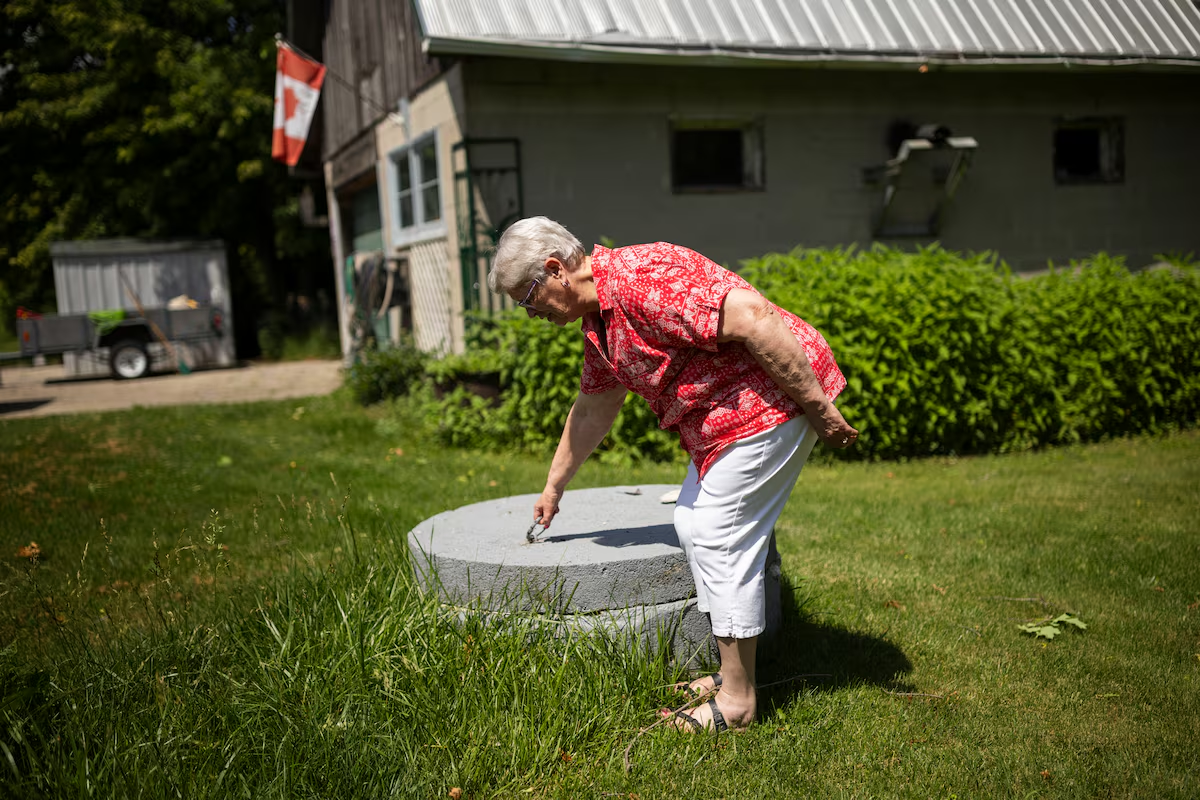
Martha and David Bricker live in a tidy Wilmot bungalow with a Canadian flag out front, one wheat field southeast of the Witzel homestead.
Every weekend, for many years, Ms. Bricker used to run three or four loads of laundry. Then one Saturday last year, the washing machine conked out on the second load. She could hear the well pump humming, but no water was coming up. It was a sporadic occurrence at first. Now it happens every weekend.
“When you turn the tap and nothing comes out, it just sputters, it gives your heart a jump,” she said.
While Ms. Bricker and others live with their erratic water supplies, locals in Wilmot Township have been organizing against developments that they fear could make the problem worse.
Beyond Wilmot, there were few other portents of crisis until Dec. 4, 2025, when the regional government alerted residents to a “water capacity issue” within its Mannheim Service Area, and blamed “aging infrastructure, lower levels of water in the system and the pressures of rapid growth.” The drinking water remained safe, a press release assured, but a third-party review was under way to confirm the extent of the problem.
The Mannheim Service Area is a water supply zone serving nearly 500,000 people, mostly in Kitchener, Waterloo and parts of Cambridge. The region’s other major zone, the Middleton Service Area, which serves about 150,000 people in Cambridge and other areas, still had a healthy surplus.
But that disparity between the two zones served as a wake-up call that seemed to contradict long-held beliefs.
For years, staff and politicians in both levels of government had operated under the assumption that the water system was fully integrated, that water would be transferred from one area to the other. Yearly water monitoring reports recorded the zones as a single entity, the IUS.
The two zones are indeed connected. Water can flow downhill from the Mannheim zone to the lower-elevation Middleton zone. But it can’t move in the opposite direction without a pump.
Despite sitting on recommendations to install such a pump since at least 2015, the region deferred the expense and remains without that vital piece of infrastructure to this day.
“We always thought [the system] was integrated,” said Waterloo Region Chair Karen Redman in an interview. “The reality is it’s semi-integrated, but not totally integrated.”
Open this photo in gallery:
Kitchener gets its water from the Mannheim Service Area, which has an easier time sending water to the neighbouring Middleton zone than receiving it in return.Glenn Lowson/The Globe and Mail
The two zones were also calculated as one on paper, which meant Middleton’s surplus was being counted toward capacity that Mannheim couldn’t actually use. Staff working on a 10-year capital plan found the error last year, Ms. Redman said.
“That’s when they started saying, ‘We don’t see the water here that we think should be here,’” she said.
After correcting the error, they found that Mannheim was operating at a deficit – using more water than it could sustainably supply. Staff sent the finding to the province and an infrastructure consultancy, Cambridge-based Agile Infrastructure, for verification.
Their report, released earlier this year, confirmed the shortfall and added a few worrying observations.
The 250 million litres of capacity recorded in the region’s water monitoring reports was about 20 million litres too optimistic, Agile found.
The Mannheim zone’s sustainable supply had actually shrunk by 12 per cent since 2015, largely owing to problems at the Mannheim Water Treatment Plant. In 2022, a routine inspection had discovered significant damage to the facility’s plate settlers, which are integral for removing sediment. Staff decided upon a partial remedy last year, and repairs are expected to be complete in 2032. In the meantime, the plant has been operating at 60 per cent capacity.
When the consultants factored in population growth, they found that Mannheim’s average daily demands had exceeded sustainable capacity – by 11 million litres a day in 2024, a surplus of enough water for around 30,000 people – and had done so for the previous three years.
“They weren’t as diligent maintaining the system as they should have been,” said local hydrogeologist Michael Frind.
Open this photo in gallery:
Waterloo’s challenges with water are not unique, as Montreal could attest when this pipe broke in 2024. Aging infrastructure and increasing demand can create a costly backlog of maintenance.Graham Hughes/The Canadian Press
The problem goes well beyond the tricity area.
Across the country, about $41-billion worth of aging drinking water infrastructure is considered to be in poor or very poor condition and needs to be replaced, according to 2022 Statistics Canada figures. Actual capital spending on waterworks by local and regional governments accounts for less than one-10th of that estimate.
The recent blowout of a key water main in Calgary is a cautionary tale. Its rupture in 2024 led to severe citywide water restrictions that lasted for months. Despite years of warnings that the Bearspaw South Feeder Main – a pipe supplying about two-thirds of Calgary’s water – was susceptible to failure, the city deferred inspections and repairs to save on costs and failed to build in adequate buffers and redundancies.
Waterloo Region has an opportunity to avoid the same fate.
At an early July press conference, Ms. Redman stood before reporters and announced that the crisis was over.
After 214 days, staff had managed to find 30 litres a second of additional water capacity, roughly enough to supply 5,400 homes. Developers would soon be able to go ahead with all planned construction.
Staff found 10 L/s by optimizing existing wells. An additional 20 L/s will come from installing temporary filtration units at the Mannheim plant, to bring some of its capacity back online. The shipping container-sized units take on some of the bottlenecked water, run it through ultrafiltration, and then introduce it back into the system. With four of the units expected to be in operation by next summer, the plant will near its original capacity.
Just as they did in the 1950s, staff are also leaning more heavily on the Wilmot wells. Earlier this year, regional council voted to terminate the 1980 agreement limiting water-taking from Wilmot to help address the Mannheim shortfall.
“It’s like we don’t matter,” said Mr. Bricker, a retired firefighter. “Don’t we have a right to have water and sustain a household out here?”
Staff are working on at least six other major infrastructure projects to add to the water supply, including the long-awaited pump to integrate Mannheim and Middleton zones, due for completion in 2031. In total, the work is expected to bring in another 602 L/s by 2032, enough for 210,000 people.
The extra pumping creates obvious concerns about the long-term sustainability of local aquifers, but regional staff say they have done extensive hydrogeological work to ensure they remain intact.
Open this photo in gallery:
Thanks to the water shortages in the region, the vacant land on Northfield Drive will stay that way for now.
Developers and Wilmot residents are not ready to declare mission accomplished.
On a recent weekday, Larry Kotseff, carrying a white hard hat and blueprints, arrived at a former carpet factory property where his company intends to build 3,300 housing units in a dozen towers.
A former planning commissioner for the region and now vice-president at Solowave, a development firm, he can see the crisis from a few angles.
Solowave demolished the old factory in 2024, with construction scheduled to start early this summer.
Instead, the property remains an expanse of dirt, shrubs and hedgehog holes, all progress frozen by the region’s water shortage.
“This has taken considerable capital investment,” said Mr. Kotseff, surveying the 32-acre property. “Buildings had to come down, the demolition, the approvals – so at this point in time in the development, there’s a lot of money going out, and yet there’s no return on investment yet.”
Open this photo in gallery:
Developer Larry Kotseff, at right with Tito Calcaneo, had been expecting to start construction at Northfield Drive earlier this summer.
A survey of Waterloo Region Home Builders’ Association members earlier this year pegged the broader financial impact at a minimum of half a billion dollars, as capital left the region because of the water issue.
Respondents to the survey told a variety of financial horror stories: an institutional equity partner withdrew from a 264-unit project because of the freeze; a local builder was unable to proceed with $110-million in home sales after spending $30-million on roads and infrastructure; a small developer folded his excavation, heating and electrician companies amid the delay.
“The region at the staff level doesn’t have a good understanding of the damage done to the home-builder industry,” said Chris Gerrits, a water engineer, former well-driller and small-town mayor who’s been working with a coalition of developers called ReOpen Waterloo to work with regional council on the issue.
“Lenders need to assess the risk and get some level of assurance that the region is actually on stable footing again before they start lending to the developers again,” he added.
And, in his opinion, the risk is still there, despite the declaration that the problem has been solved. The region isn’t really generating any new water, he says. While it’s made a temporary fix to the ailing Mannheim plant and developed a better understanding of existing wells, all of this is ultimately a Band-Aid solution, he argued.
“It shouldn’t be called new capacity,” he said. “They are just restoring capacity lost due to infrastructure degrading.”
As mayor of the Township of Amaranth, about 60 kilometres northeast of Waterloo, Mr. Gerrits has come to realize that the Waterloo problem is a national problem. “A lot of municipalities are one piece of infrastructure away from not being able to provide water or wastewater services,” he said. “That’s just the situation the country is in. And much of the problem is invisible because it’s underground.”
Open this photo in gallery:
Martha Bricker’s bottled water is for emergencies. She and her husband have not yet found a more lasting solution to shortages in their well.
For Martha and Dave Bricker, the crisis is decidedly not over.
They maintain an emergency cache of bottled water because of their frequent well outages. The region looked into their report of well interference and found that the Brickers’ water level had dropped a metre and a half since 2019. It did not accept responsibility, but did offer $4,000 because the property sits in an area with a documented history of groundwater interference from municipal pumps. The Brickers have priced out a new well at closer to $40,000.
“The main thing that bothers me is the lack of responsibility being taken by people elected to look after us,” Ms. Bricker said on a sweltering July day in her backyard, where she ruefully noted the lack of colour.
“No flowers this year,” she said. “They need water.”
Open this photo in gallery:
Liquid assets: More from The Globe and Mail
The Decibel podcast
AI data centres can be water-hungry, and as Canada plans to build more of them, some are balking at the environmental cost. Reporter Joe Friesen spoke with The Decibel about projects under way and the backlash so far. Subscribe for more episodes.
Drinking water in depth
Ottawa won’t set deadline to lift all First Nations drinking water advisories
Family sues PEI over ‘forever chemicals’ in their water
U.S. allows mining near Minnesota wilderness, with water flowing into Canada