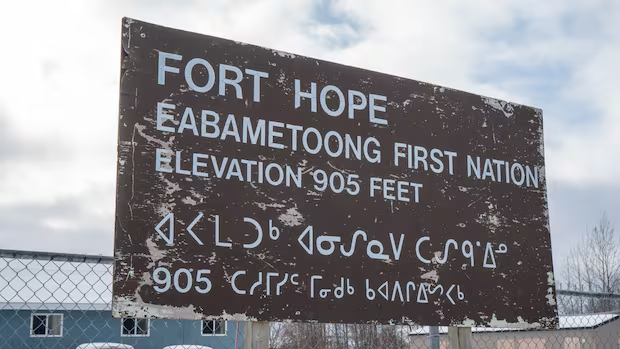
With about 600 Eabametoong First Nation members at the centre of another evacuation due to northern Ontario wildfires, community leaders are speaking out about the conditions that make First Nations more vulnerable to such crises.
“The conditions in which they [First Nations] are dealing with, just in terms of air quality, are already poor — and there’s very little fire support there, too,” says Riley Yesno, a member of Eabametoong First Nation, also known as Fort Hope, and a distinguished fellow at the Yellowhead Institute.
The remote Ojibway community, located about 360 kilometres north of Thunder Bay, declared a state of emergency on Wednesday. More than 1,600 people live in Eabametoong; about 600 of them are being flown out by military aircraft, with help from the Royal Canadian Air Force and Canadian Rangers.
Evacuation flights began over the weekend, after the federal minister of emergency management and community resilience, Eleanor Olszewski, approved a request from Ontario Regional Chief Abram Benedict for assistance from the Canadian Armed Forces. Some 460 evacuees have already arrived in Niagara Falls.
CBC News has contacted Eabametoong’s Chief Solomon Atlookan for more details and is awaiting his availability for an interview.
Most of the nearly 190 wildfires burning across the province are in northwestern Ontario. There are about 1,800 evacuees from the region from well over a dozen communities.
Amid all this, there have been more calls for government action, including from First Nations themselves.
WATCH | Ford warns people refusing to evacuate are hindering wildfire response:
Ford warns people refusing to evacuate are hindering wildfire response
A new evacuation centre has opened in Thunder Bay for people displaced by northern Ontario wildfires. Premier Doug Ford warned that people refusing evacuation orders are hindering firefighting efforts.
Yesno has been in close contact with her friends and family amid the Eabametoong evacuation and has been helping sort donations for evacuees in Thunder Bay.
It’s not the only challenge faced by the First Nation. It has been under a boil-water advisory since 2001 that’s been considered as long term since 2002.
“It’s always just so difficult when the infrastructure that we have there, like in so many remote northern communities, is just so insufficient to deal with the level of crisis that they are experiencing or could very soon be experiencing,” Yesno said regarding the wildfires.
“The conditions in which they are dealing with, just in terms of air quality, are already poor — and there’s very little fire support there, too.”
According to Indigenous Services Canada (ISC), about 80 per cent of Indigenous communities in Canada are in areas susceptible to wildland fire, spokesperson Jacinthe Goulet said in an email to CBC News on Saturday.
“Indigenous communities are also more vulnerable due to factors like remoteness, community size, inadequate infrastructure, socio-economic conditions, limited access to emergency management resources and community capacity,” they wrote.
 About 600 wildfire evacuees from Eabametoong First Nation, also known as Fort Hope, in northwestern Ontario are being transported out of the community by the Canadian Armed Forces. They will be staying in Niagara Falls. (Eabametoong First Nation/Facebook)
“They are also significantly more likely to be evacuated than those off-reserve and take longer to recover due to their location and remoteness. Emergencies like this highlight the critical need for equitable and co-ordinated support.”
Goulet said the federal department “is working closely with First Nations leadership, Ontario and emergency management partners to support the immediate and evolving needs of impacted communities.”
However, First Nation leaders, including from Nishnawbe Aski Nation (NAN) and Anishinabek Nation, have criticized the provincial and federal governments for not responding to the wildfire situation quickly enough. Namaygoosisagagun First Nation (Collins First Nation) completely burned to the ground Monday and leaders say they weren’t warned of the wildfire in advance.
WATCH | Thunder Bay wildfire evacuees receive urgent housing and essential relief:
Thunder Bay wildfire evacuees receive urgent housing and essential relief
Vicky Woodbeck of the Ontario Native Women’s Association (ONWA) discusses the wildfire situation in Thunder Bay, Ont. She outlines how the fires are affecting local residents, their anxieties about returning home and the ONWA’s efforts to support evacuees with critical needs such as housing, food and baby supplies.
NAN Grand Chief Alvin Fiddler said First Nation leaders were not told about Ontario Premier Doug Ford’s visit to Thunder Bay on Saturday ahead of time and that he did not schedule meetings with them.
“The premier came up to meet local people co-ordinating Ontario’s wildfire response. That’s fine, but he also needs to engage with First Nations leadership managing this situation,” Fiddler wrote on Facebook on Saturday.
“I would like to remind Doug Ford that it’s our people that are being impacted the most by these wildland fires. If you are going to make the effort to come up, it can’t just be for a photo-op.”
It’s very shameful that we are living in a country where Indigenous people are made to be climate refugees in their own homelands.– Riley Yesno, Eabametoong First Nation member
Yesno said the lack of engagement speaks to “a colonial legacy that essentially sets Indigenous communities up to be disposable.”
“I’m really extremely angry with not just this government, but all levels of government, and the generations of underfunding that communities like mine have experienced, that emergency services have experienced,” Yesno said.
“It’s very shameful that we are living in a country where Indigenous people are made to be climate refugees in their own homelands.”
Yesno said remote communities need more long-term, sustainable funding for emergency management services.
As well, she wants the federal government to set more ambitious climate targets to prevent Canada’s wildfire seasons from becoming increasingly severe.
“That’s a big ask and it feels like an insurmountable one, but if our summers are only going to get hotter, then the fires that have always happened are only ever going to get bigger.”
The Hope for Wellness Help Line provides immediate, toll-free telephone and online-chat based emotional support and crisis intervention to all Indigenous people in Canada. This service is available 24/7 in English and French, and upon request in Cree, Ojibway, and Inuktitut.