
Open this photo in gallery:
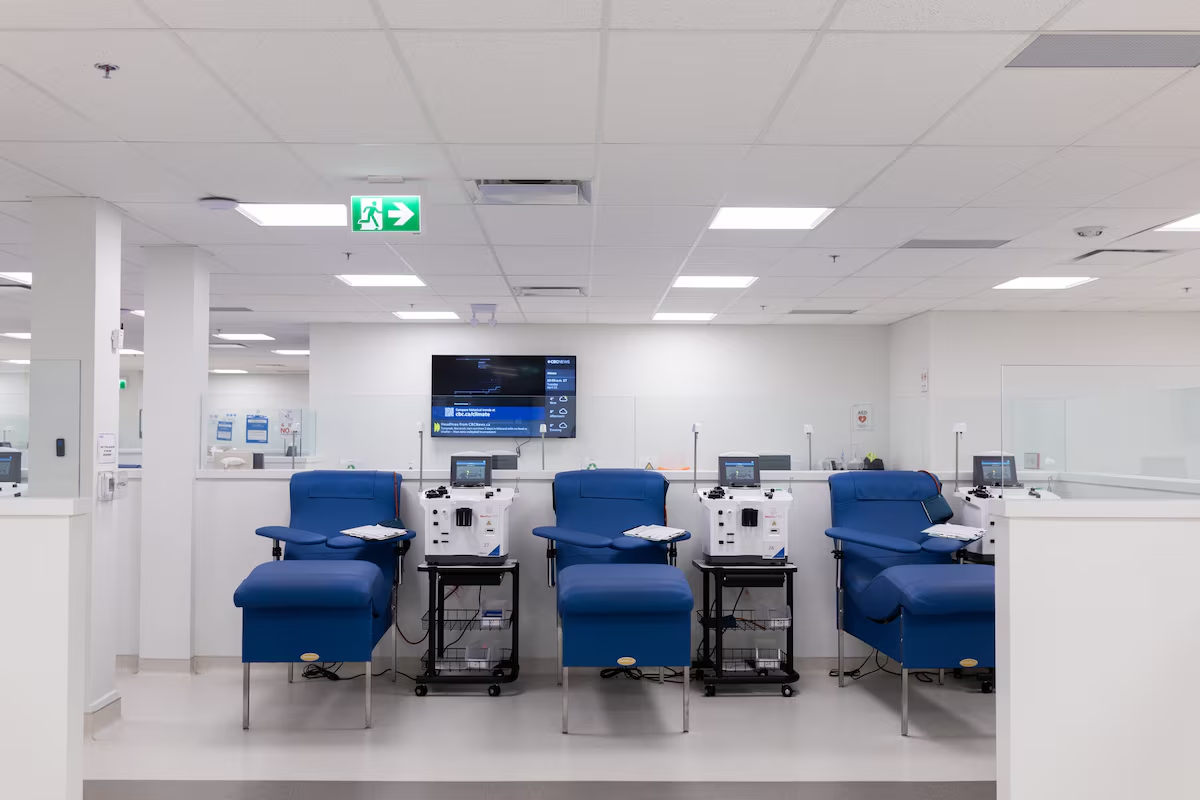
Plasma donation beds at a Grifols clinic in Whitby, Ont. Grifols is Canada’s only major commercial collector of the golden-coloured fluid found in blood that is manufactured into high-demand medicines.Shay Conroy/The Globe and Mail
Private blood-plasma collector Grifols said it did not collect plasma from donors who Health Canada said were inappropriately made eligible to donate because of disease concerns.
The Globe and Mail reported last week that a March 30 report from Health Canada found multiple concerns during an inspection of Grifols’ head office, including internal documents that showed some individuals were inappropriately cleared to donate plasma despite risks associated with the fatal brain disorder Creutzfeldt-Jakob Disease (CJD) and its variant that is linked to mad cow disease.
Grifols had told The Globe the deficiencies noted by Health Canada inspectors did not meet the Barcelona-based company’s standards and it was taking corrective action. The company did not respond to a question about what happened to the plasma of the donors flagged by Health Canada.
After publication of The Globe’s story, Grifols provided more information, including that the people at issue did not ultimately donate plasma.
“No plasma was collected from donors with CJD risk factors that would have made them ineligible to donate, and no donor or patient was placed at risk,” the company said in an unsigned statement on Tuesday.
Grifols is Canada’s only major commercial collector of plasma, a golden-coloured fluid found in blood that is manufactured into high-demand medicines such as immunoglobulin, which can be used for patients with immune deficiencies.
As demand for plasma-derived immunoglobulin treatments soars, experts call for better oversight
Grifols operates in Canada as part of a partnership signed with Canadian Blood Services. Grifols pays donors, while CBS does not.
Plasma collected by both Grifols and CBS is shipped to a Grifols manufacturing facility in North Carolina, where it is used to produce medicines that are bought by CBS and distributed to Canadian hospitals. CBS spends more than $1-billion a year on plasma-derived drugs and related pharmaceutical products.
The Health Canada inspection of Grifols’ head office in Oakville, Ont., earlier this year was triggered by concerns found by inspectors at some of the company’s donation centres, and by the deaths of two donors in Winnipeg in the past year.
The report also details concerns with Grifols’ plasma collection centres not always having physicians on site and operating with an overcapacity of donors relative to the number of key staff present.
The concerns in the report led Health Canada to impose terms and conditions on Grifols’ licence, covering 16 of the company’s 17 locations, requiring more staff supervision and limiting the number of donors present in its locations at a time.
Health Canada did not respond to The Globe’s questions last week.
On Wednesday, the regulator said part of the issue outlined in its report based on the Grifols head office inspection stemmed from changing criteria for donors who lived in certain countries that have a history of mad cow disease.
The mad cow scare of the 1990s and widespread worry about the diseases spreading through blood led many blood operators around the world to create restrictions, such as not accepting donations from people who lived in the United Kingdom, Ireland or France for long periods of time in the 1980s and 1990s.
Editorial: The deaths of two plasma donors need scrutiny – from Parliament
Health Canada said in 2023 it authorized CBS and Héma-Québec, the blood supply management organization in Quebec, to remove the restriction on donors who lived in those three countries during those time periods, because evidence showed the risk of CJD from those donors was now “virtually non-existent.”
Health Canada said in 2024 Grifols applied for and was approved to remove the geographic exclusion criteria for CJD, but the company maintained a ban on donors who lived or travelled in the United Kingdom.
The March 30 Health Canada inspection report, obtained by The Globe under access to information law, also said Grifols did not appropriately bar donors who had a family history of CJD.
“Health Canada will request regular updates from the establishment as required and has the authority to conduct subsequent follow-up inspections at any time to assess compliance with the Blood Regulations, including the implementation of the corrective and preventive actions submitted,” spokesperson Mark Johnson said in a statement.
The agency said in its statement that “deficiencies noted during an inspection are based on Health Canada’s observations at a particular point in time. No plasma was collected from those donors.”
Grifols said it has safeguards in its manufacturing process to ensure “non-conforming plasma units” are not used to make medicine.