
Open this photo in gallery:
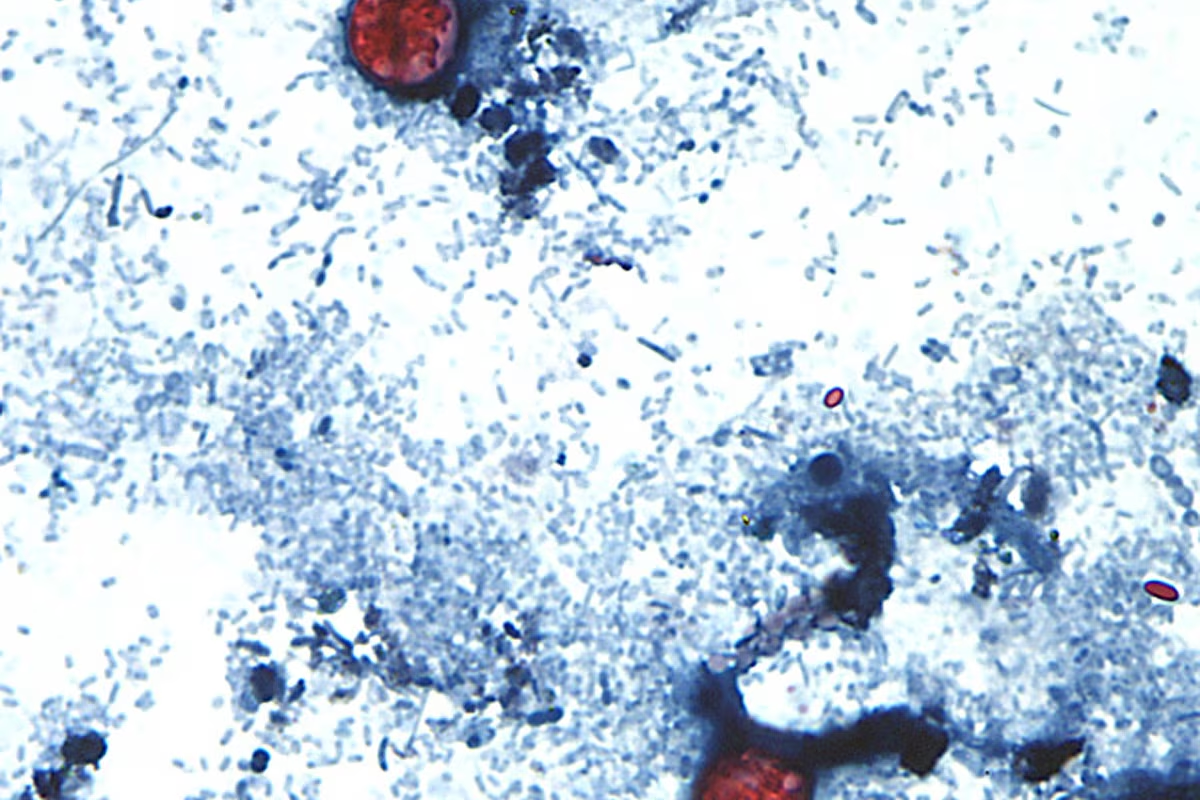
This undated photo taken through a microscope provided by the CDC shows Cyclospora cayetanensis oocysts found in a fresh stool sample.Melanie Moser/The Associated Press
Canada has so far avoided the explosive outbreak of cyclosporiasis experienced in the United States, which has sickened hundreds and sent dozens to hospital. However, there remains a risk of the diarrhea-causing parasite moving north.
Cyclosporiasis is a gastrointestinal disease caused by the microscopic parasite cyclospora and is often characterized by frequent, watery and sometimes explosive diarrhea. People can become infected by ingesting contaminated food or water.
There has not been a widespread outbreak of cyclospora infections in Canada since 2017, when 164 cases were reported in the provinces of British Columbia, Ontario, Quebec and Nova Scotia. The source of that outbreak was not identified but previous flares have been linked to imported fresh produce.
The Public Health Agency of Canada said in a statement on Monday that it is not currently investigating any cyclospora outbreaks.
Across the border, 843 cases of cyclosporiasis have been confirmed to the U.S. Centers for Disease Control and Prevention across 31 states. The agency is also aware of more than 1,500 possible cases requiring further analysis.
What is cyclospora? Outbreak of diarrhea-causing infection in U.S. grows to more than 1,000 cases
But the national data, which lags behind state data, obscures a more severe, real-time picture of the outbreak. In Michigan – the hardest-hit state – 3,309 cases have been identified by its Department of Health and Human Services, with 44 people sent to hospital.
No deaths have been reported.
Susy Hota, medical director for infection prevention and control with University Health Network in Toronto, spoke to The Globe and Mail about the U.S. outbreak and whether Canadians should be concerned.
What is cyclospora and how do people get infected?
Cyclosporiasis is caused by a very tiny parasite that’s not visible to the naked eye, but it can infect humans and cause a diarrheal or gastrointestinal infection. The parasite itself circulates in different parts of the world but it’s not something that you commonly see in North America. It’s actually more common in Latin America, some parts of Africa, the Indian subcontinent and parts of Southeast Asia, for example.
One of the reasons why it is more common in these areas is because their sanitation systems are not as well developed and human wastewater can end up contaminating crops. If you consume that crop, then you can get infected. It can contaminate our food supply, our water supply or just be in soil.
Considering it’s not very common in North America, what explains the U.S. outbreak?
It really does imply that there is some sort of food contamination source and we don’t know what that is yet. In previous outbreaks, in North America, in Canada for example, our cases of cyclospora are usually related to outbreaks where food sources or crops have been contaminated, or sporadic cases that are related to travel.
The U.S. has good sanitation systems and, in theory, there couldn’t be that kind of contamination of crops. It sounds to be more like there are crops that got contaminated [elsewhere] and dispersed through a large part of the U.S. that’s causing the infections.
Are there fruits and vegetables coming from Guatemala and other parts of Latin America where we commonly get some of our food sources? That would be more of the risk.
Can it spread from person to person?
It’s not typically something that goes from human to human directly.
What symptoms should people watch for? How is it diagnosed and treated?
It can be anywhere from two to 14 days, on average, after you’ve been exposed and you’ve consumed something that is contaminated before the diarrhea and the cramps can start up. You may feel nauseous. You might feel very weakened. You might have fevers.
It might feel like any other sort of flu-like illness at first or food poisoning or viral gastroenteritis. It’s not really so different in how it presents but it can go on for weeks, whereas normally when you get a viral infection that causes diarrhea, that gets better within two to three days.
Now, the diagnosis is a little bit trickier because we don’t typically send off everyone’s stool who presents with fever, diarrhea and cramps for parasitic testing. But, we do have tests that will detect it. And it can be treated with a fairly standard antibiotic that is readily available here.
How can Canadians limit their risk of contracting cyclospora?
You should wash your produce well with some friction under water. If you’re buying lettuce, which has been implicated in previous outbreaks, remove those outer layers that have more of a chance of being exposed to things and then wash each of the leaves very thoroughly.
I never trust when I buy pre-washed, packaged lettuce or even pre-mixed salads. I wash that too. But, while washing does reduce the risk, it may not entirely eliminate the risk.
If I lived in an area where there’s an ongoing outbreak and we hadn’t found a source yet, I’d probably be switching to cooked vegetables at this time just to reduce my risk and preparing my own food as well.
Is Canada at serious risk of an outbreak resulting from the U.S. cyclospora surge?
It is something to be aware of because it’s possible it might become a problem here, but it’s not a guarantee. It really comes down to trying to figure out as quickly as possible what is contaminated and what the source is.
This interview has been edited and condensed.