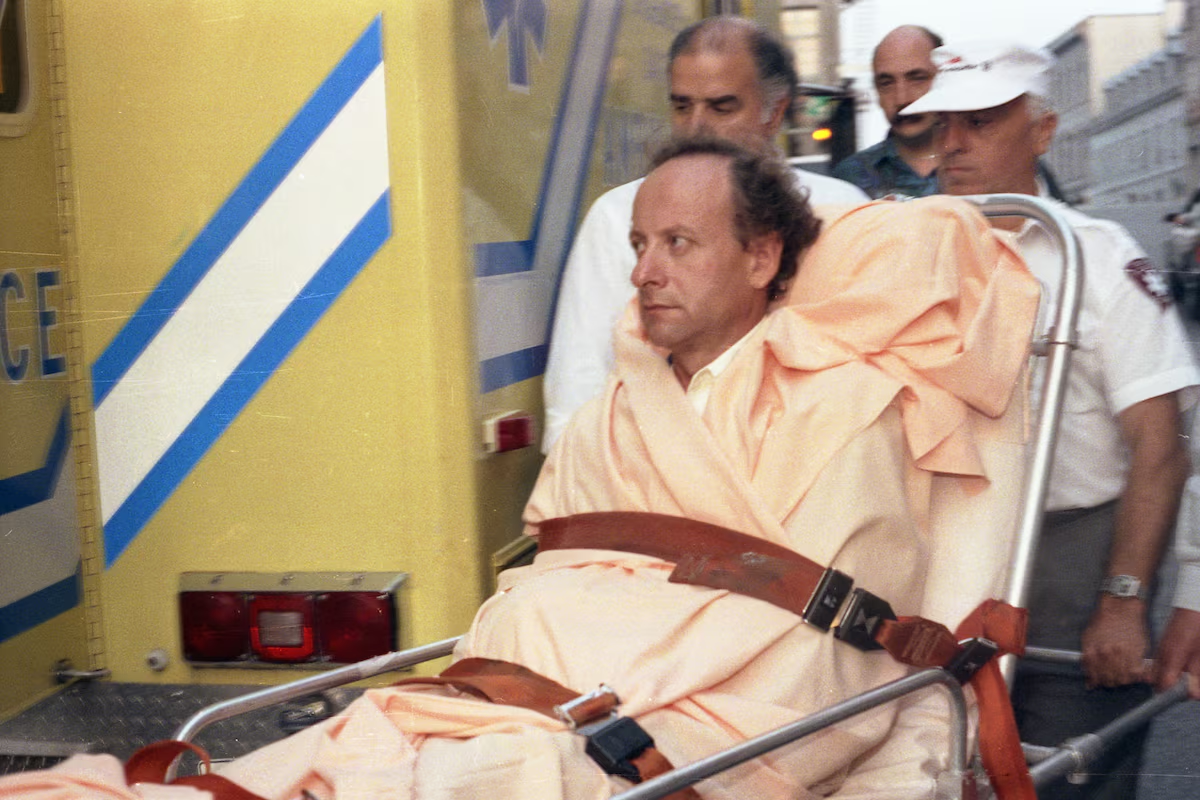

Open this photo in gallery:
Valery Fabrikant is taken to an ambulance by paramedics following the Concordia University shooting, Aug. 24, 1992.Jean Goupil/La Presse/Archives
In April, at the Quebec penitentiary where 86-year-old Valery Fabrikant was serving a life sentence for murdering four colleagues in a shooting spree at Concordia University in 1992, the former professor lashed out for a final time. From his prison cell, he sued his son Isaac in small claims court.
Dr. Fabrikant, who died at the Archambault Institution on June 27 “of apparent natural causes,” according to Corrections Canada, never stopped believing that the world was out to get him. An émigré from the Soviet Union who arrived in Montreal in 1979, he spent a dozen years at Concordia teaching and conducting research and 33 years incarcerated, never to be released.
Valery Fabrikant, professor who killed four colleagues at Concordia, dies in prison
Dr. Fabrikant was born on Jan. 28, 1940 in Minsk in the Soviet Union (now Belarus) the second of two sons of Isaac Fabrikant, a physician specializing in tuberculosis, and Pesya Yudelevna, a bookkeeper. The family was Jewish. As an officer in the Red Army during the Second World War, his father moved often, ending the war in Berlin. Fleeing the Nazis, young Valery spent much of the war with his mother and brother in Kyrgyzstan in Central Asia.
When he decided to leave the Soviet Union in the 1970s along with other Russian Jews, Dr. Fabrikant portrayed himself as a political dissident. After the murders of his colleagues, the Montreal Gazette retraced his career in the Soviet Union and discovered that he had been fired from a series of academic jobs because of his threatening and disruptive behavior.
“It was difficult to discuss things with Fabrikant because he quickly lost his temper and would hurl things like books,” a former Soviet colleague told the Gazette.
When he arrived in Montreal, he talked his way into a $7,000 a year research assistant’s job in the mechanical engineering department. A small man with a domineering personality, he continued to be promoted due to his prolific academic output and his talents as a mathematician. But Dr. Fabrikant also engaged in conflict with everyone he encountered. He launched grievances and lawsuits against his colleagues and later, after he was convicted, he claimed that the university teamed up with police and the legal system to frame him for the murders.
As Dr. Fabrikant’s career progressed, his behavior became ever more disturbing. In early 1989, according to findings of an inquiry into his actions, he told people that he understood how things worked in North America: “I know how people get what they want. They shoot a lot of people.” In 1990, police denied him a gun permit for self-protection, but he later obtained permission to buy a handgun for target practice. Some officials were so frightened of him, that the university installed panic buttons in their offices in case Dr. Fabrikant went off the rails.
In 1991, he went to hospital convinced he had a heart attack. “I had no doubt that the heart attack was inflicted on me deliberately,” he later wrote in a self-published memoir. The following April, with his chances of getting a tenured position gone and his current job fragile, Dr. Fabrikant sued five colleagues, accusing them of claiming co-authorship on scientific papers he had written but to which they had contributed nothing.
On Aug. 24, 1992, Dr. Fabrikant walked into Concordia’s Henry F. Hall Building carrying three guns and shot five people in different locations. He killed four of them, professors Michael Hogben, Jaan Saber, Phoivos Ziogas and Matthew Douglass. A university secretary, Elizabeth Horwood, was shot but survived. The shooting spree only ended after Dr. Fabrikant seized two hostages who managed to free themselves.
In his self-published memoir, he claimed he had no choice. “I decided to take all my guns to the university, to show the guns to all of the conspirators and to tell them that unless they leave me alone, I would have no choice but to shoot them all dead,” he wrote.
After a trial lasting four-and-a-half months, in which Dr. Fabrikant acted as his own defence lawyer, a jury found him guilty of four counts of first-degree murder, plus attempted murder and forcible confinement. He was sentenced to life imprisonment with no possibility of parole before 25 years.
Judge Fraser Martin of Quebec Superior Court was trenchant in his analysis of the accused’s personality. “Your actions that day defy comprehension,” he said. “You are a warped, twisted and deeply troubled man.” During the trial, Dr. Fabrikant had called the judge a “little low crook” and a “fat pig.” His disruptive behavior led to six charges of contempt.
Morris Wolfe, a journalist who followed the case for Saturday Night magazine, called Dr. Fabrikant a “pathetic, deranged, clever, horrible man.”
Donna Whittaker was a receptionist in Concordia’s history department and worked with a professor who was the Concordia Faculty Association’s grievance officer. On the day of the shootings, she was in her office when a graduate student ran in, looking as white as a sheet, and announced that somebody with a gun was in the Hall Building shooting people. Ms. Whittaker looked at a colleague and said, “’Oh my God, it’s Fabrikant.’ I knew it was him.”
“It was a devastating, horrible time,” Ms. Whittaker told The Globe. “No university should have to go through this.”
Following the murders, Concordia commissioned two independent inquiries into the case. One criticized the university for its repeated failures to manage Dr. Fabrikant’s threatening behavior. Another concluded that there was some legitimacy to Dr. Fabrikant’s allegations about conflicts of interest and improper appropriation of credit for authorship of publications in the mechanical engineering department.
Once in prison, Dr. Fabrikant continued his fight against authority. He was put into isolation at times to protect himself from fellow prisoners. He continued suing people, so much so that the Quebec Superior Court declared him a “vexatious litigant” in 2000, limiting his ability to file lawsuits.
The National Parole Board never released him, even when he qualified for full parole after serving 25 years of his sentence. In a 2020 ruling, it noted that a psychological risk assessment pointed to Dr. Fabrikant having “a paranoid personality organization” and was a man who he still saw himself as a victim.
“Your case management team assesses that you present a high level of risk, in particular in a situation where you feel attacked or in danger. Your re-integration potential is considered low,” the board wrote in 2020.
“He was a great father before prison,” said his son Isaac, a Montreal engineer, in an email interview. “He did the usual fatherly things.” After his conviction, Isaac said he initially helped his father, allowing him to use his e-mail address to continue to make allegations against those who had presumably wronged him.
He stopped helping his father in 2019. His mother, Maya Tyker, a Russian-born woman 18 years his junior, also supported her husband for many years but eventually stopped. According to Isaac, “he threatened to divorce her if she didn’t continue to do it. She didn’t and they got divorced in 2024.”
Dr. Fabrikant is survived by his son Isaac and daughter Beata. His first marriage in the Soviet Union also ended in divorce.
Asked to describe his father’s personality, Isaac said that his dad was a big fan of the TV series Big Bang Theory and the fictional character Sheldon Cooper, a child prodigy with a huge ego but is socially awkward and lacks empathy. “If you look at all the bad qualities of the Sheldon Cooper character, my father is very similar to him,” he said.
Asked if he thought his father had been changed by prison, Isaac responded that Dr. Fabrikant had such a big personality that it was more likely that he changed the prisons where he was held than the other way around.
You can find more obituaries from The Globe and Mail here.
To submit a memory about someone we have recently profiled on the Obituaries page, e-mail us at obit@globeandmail.com.