
Listen to this article
Estimated 5 minutes
The audio version of this article is generated by AI-based technology. Mispronunciations can occur. We are working with our partners to continually review and improve the results.
After people in parts of the province living through a chilly, rainy “Juneuary,” it’s only natural for some to wonder how Newfoundland and Labrador has already come to the point of all-hands wildfire response in Western Labrador and a provincewide fire ban.
At least part of the explanation requires a look back to 2025, to drought conditions. It was noticeable at the time in everything from the exposure of sunken logs in Deer Lake, as water levels in the lake dropped, to community reservoirs running low and some private wells running dry.
In studio for The Signal on Thursday, Memorial University biogeography professor Carissa Brown acknowledged dry weather into the fall of 2025 was followed by a lot of snow over winter and good amount of rain.
“Even though we had snow melt, even though we had rainfall, there was just a real moisture deficit in the system,” Brown said.
“So it’s going to take a lot of moisture to get us back to kind of our normal levels that would make the vegetation the trees and everything moist enough that we wouldn’t be as worried about them igniting really quickly.”
WATCH | Increased wildfire risk, especially for Labrador:
Provincewide fire ban is back amid dozens of wildfires in Labrador
There are 25 active wildfires in Labrador as of Thursday. And as the weather heats up this week, the whole province remains under a fire ban. The CBC’s Laura Howells has more.
‘Severe’ and ‘extreme’ drought levels in Labrador
The federal department’s National Agroclimate Information Service keeps track of drought conditions. It is mapping for this year shows the Burin Peninsula and eastern Newfoundland coming onto “abnormally dry” and the slightly more concerning “moderate drought” conditions by the end of June.
In the same period, conditions in almost all of Labrador deteriorated, with swaths landing reaching “severe” and even “extreme drought” levels.
At a press conference in Ottawa Thursday, speaking to the latest on wildfire conditions across Canada, federal Minister of Emergency Management Eleanor Olszewski noted an increase in the number of fires over the past couple of weeks.
She also spoke to the outlook for conditions for the rest of summer. The situation may change, she said, but at this point there is reason for Newfoundland and Labrador to remain vigilant. Both Labrador and the island are forecast to have well above normal risk for wildfires in July.
 Minister of Emergency Management Eleanor Olszewski takes questions on forecasting for wildfire conditions. (CBC)
In August, it’s a similar story for Labrador and for most of the island. The south coast and Burin Peninsula are forecast to see something closer to normal severity levels — if forecasts hold.
“It’s my understanding that, Labrador in particular, we’re expecting to see some increased wildfire activity over the next couple of months,” Olszewski said.
104 wildfires to date in N.L. in 2026
Canada has recorded 3,127 wildfires in 2026 so far. As of Thursday afternoon, there were 796 active wildfires, including 60 deemed out of control.
In Newfoundland and Labrador, the province has recorded 104 wildfires so far in 2026. As of Thursday evening, the provincial government wildfire map showed 25 active fires, all in Labrador. Four of the fires were listed as being held and another four were marked as under control, leaving 17 out of control fires.
 Government of Canada, Department of Natural Resources outlook for August 2026, showing an anomaly forecast, comparing forecast conditions for this year to conditions in 2025. (Government of Canada)
In Canada, there was a lower total number of fires at this point last year, but with a much larger total area burned. Zooming in just to Newfoundland and Labrador, the comparison year-to-year changes. In this province, there is more area burned now versus the same point last year.
In Newfoundland and Labrador, an estimated 44,600 hectares have burned to date in 2026. That’s compared to roughly just 2,700 hectares at this point a year ago.
Wildfires ‘a different beast’ says Torbay fire chief
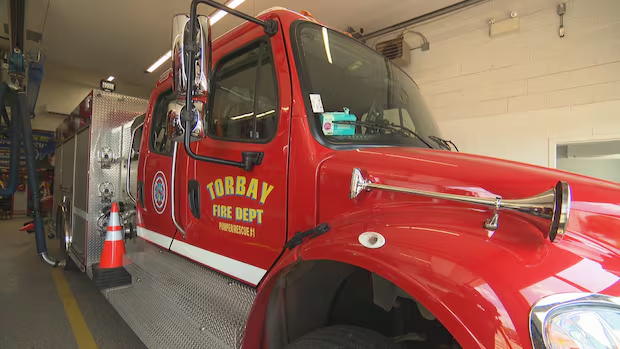
Looking ahead, Torbay Volunteer Fire Department chief Rodney Gaudet and many other firefighters are hoping people pay attention to environmental conditions and follow the rules of the provincewide fire ban now in effect.
“But we’ve seen situations too where people have a small bonfire, they think it’s completely out and they leave it and then that smouldering fire under the ground grows into something bigger later on,” he told CBC News.
 Torbay Volunteer Fire Department Chief Rodney Gaudet speaks with the CBC’s Laura Howells about wildfire risk and the provincewide fire ban. (Darryl Murphy/CBC)
Gaudet said resources for trying to tackle emerging wildfires are limited, when it comes down to what’s available in individual municipalities.
“We have, obviously, fire trucks here that are built to fight fires but forestry wildfires are a different beast altogether,” he said.
The provincial fire ban is in place until at least July 17.
Regardless of the fire hazard risk rating in your area, all permits to burn grass, brush or other materials are cancelled. Fireworks and sky lanterns are banned. No camp fires are allowed. No wood-fuelled fires are permitted in backyard areas.
Gas or propane-fueled barbecues may be used, if operated safely. That means without anything flammable nearby and extinguisher on standby.
Download our free CBC News app to sign up for push alerts for CBC Newfoundland and Labrador. Sign up for our daily headlines newsletter here. Click here to visit our landing page.