
Listen to this article
Estimated 4 minutes
The audio version of this article is generated by AI-based technology. Mispronunciations can occur. We are working with our partners to continually review and improve the results.
Quebec City Mayor Bruno Marchand is receiving pushback from local community groups following a series of comments he made about homelessness and his administration’s position on encampments.
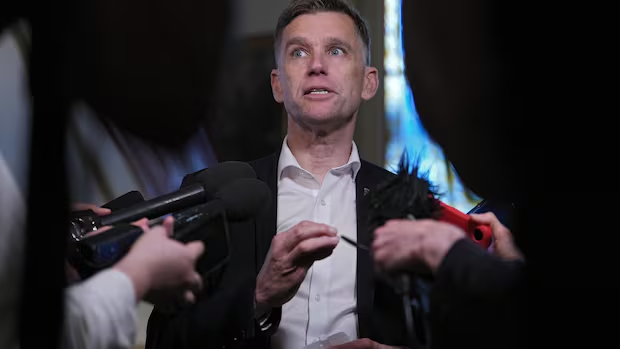
On Tuesday, at a news scrum, Marchand reiterated his administration’s zero-tolerance approach to encampments and said just because “someone is homeless doesn’t mean they have the right to do whatever they want.”
He said he’s witnessed residents’ routines being flipped upside down.
“Who is thinking about those neighbours? Who is thinking about the neighbourhood?” he asked.
Several organizations spoke out on Wednesday to denounce the comments. One highlighted the importance of refraining from promoting generalizations “that fuel prejudice and polarization,” as the city continues to deal with a surge of homelessness, particularly felt in the city’s Saint-Roch neighbourhood.
The Regroupement pour l’aide aux itinérants et itinérantes de Québec (RAIIQ), which represents member organizations in the capital region, said the choice of words matters.
“People experiencing homelessness already face severe stigmatization,” read a statement sent to Radio-Canada.
“No one argues that people experiencing homelessness have the ‘right to do whatever they want.’”
But housing resources work at full capacity and several people don’t find an approach adapted to their needs, according to the organization.
“The real issue is therefore not being for or against encampments, but recognizing that people currently have to sleep outside due to a lack of sufficient and adequate solutions,” read the RAIIQ statement.
Mayor says alternatives exist, groups say not enough
On Tuesday, Marchand said several alternatives already exist to tackle homelessness — including a newly opened respite centre and shelters including Lauberivière shelter, located in Saint-Roch.
“Are you able to give me one example of a city where an encampment has helped people experiencing homelessness to get off the street with humanity? I can’t,” he said.
While the 30 spaces added to the shelter this summer will help, community groups say it will not solve the broader issue.
RAIIQ says organizations on the ground are noticing the limits of the current approach.
 People experiencing homelessness gather in the Université-du-Québec Park, a green space located in the neighbourhood of Saint-Roch. (Radio-Canada)
As part of the government’s annual homelessness count, the Quebec City region’s estimate of people experiencing homelessness increased by 20 per cent in 2025 compared to 2022.
Ariane Desharnais, general co-ordinator for the Répit Basse-Ville, says the respite shelter and community organization received 60,000 visits between April 2025 to March 2026. The year before, the organization only saw 30,000 visits.
“Every day we see people who are impacted by politics like the ones that are happening right now around the cleanliness of the city,” she said.
“We cannot treat this as us against them because it’s not that. Both sides are us,” she said. “People have no idea how close they are to homelessness.”
No proper response to ‘basic need’
In the past few months, Desharnais says, community organizations and businesses have worked together with Quebec City officials for a campaign to offer possible solutions covering housing, revenue, health and services ahead of the upcoming provincial election.
Over the years, some residents and businesses in Saint-Roch have alerted the city to problems caused by the presence of people experiencing homelessness — including vandalism, alleged drug dealing and safety concerns.
“It’s valid people are scared,” Desharnais said. “People who are homeless are probably super scared too, and they’re probably living something that we cannot imagine.”
But she noted she doesn’t agree with describing the situation in some areas of Quebec City as being “encampments.”
“I’ve not seen a lot of tents go up in Quebec City. Right now, what we’re treating as encampments is anywhere that a homeless person is sitting and their stuff gathered all around them,” she said.
“These are people that are sleeping outside and that are not getting a proper response to a basic need.”
On Thursday, in a statement to Radio-Canada, Marchand said he is going to continue efforts to reduce homelessness with all the groups currently working on the ground. He reiterated that he doesn’t think encampments are part of the solution for anyone.
He said a meeting has been scheduled with RAIIQ.