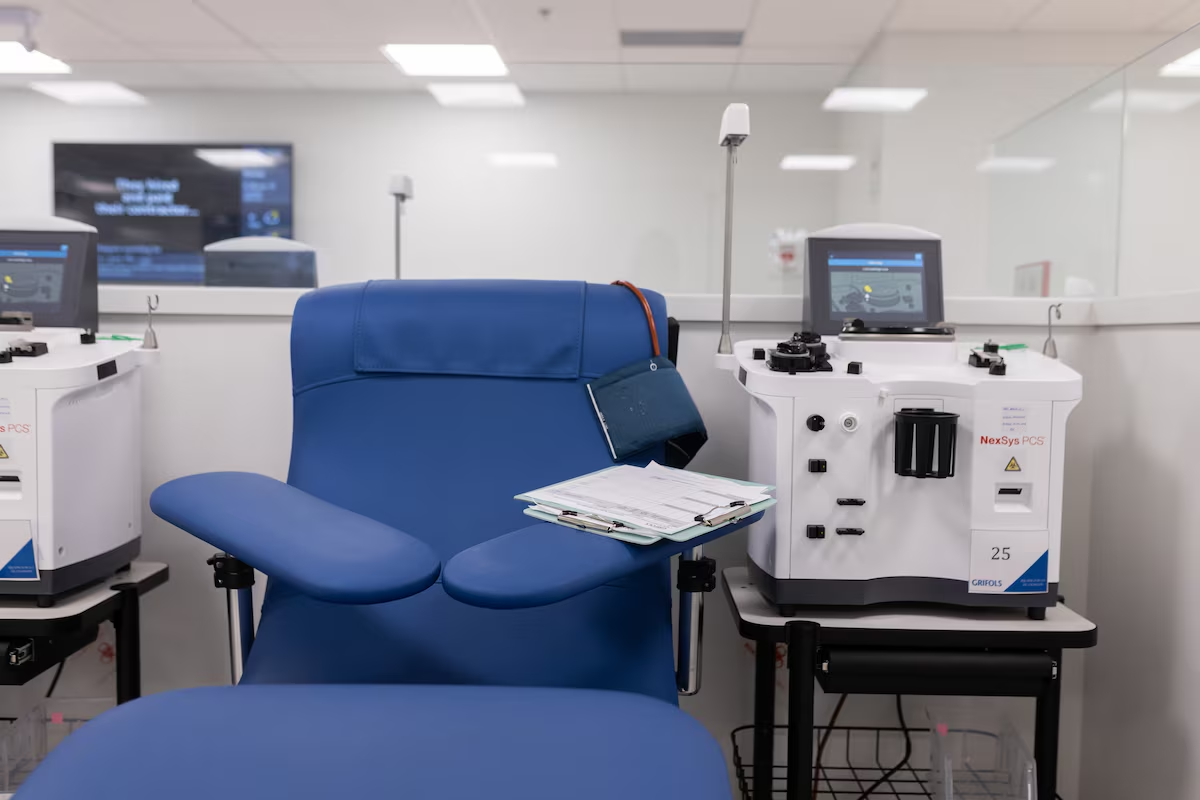

Open this photo in gallery:
A plasma donation bed set up at a Grifols Plasma Donation Centre in Whitby, Ont.Shay Conroy/The Globe and Mail
Private blood-plasma collector Grifols allowed some donors to give plasma who should have been ineligible to do so because of concerns about disease that could have compromised the safety of the donated blood, according to a Health Canada inspection report.
Inspectors found multiple cases of Grifols allowing people to donate plasma who should have been denied because of risks associated with the fatal brain disorder Creutzfeldt-Jakob Disease (CJD) and its variant that is linked to mad cow disease.
Health Canada’s report, dated March 30 and obtained by The Globe and Mail under access to information law, also details concerns with Grifols’ plasma collection centres not always having physicians on site and operating with an overcapacity of donors relative to the number of key staff present.
Canadian Blood Services CEO defends Grifols partnership after deaths of two donors
The concerns in the report led Health Canada to impose terms and conditions on Grifols’ licence, requiring more staff supervision and limiting the number of donors present in its locations at a time.
Health Canada announced the terms on April 1, but the specific compliance issues that led to that decision have not been made public until now.
Grifols said in a statement that the deficiencies noted by Health Canada inspectors did not meet the company’s standards and it is taking corrective action.
Barcelona-based Grifols is Canada’s only major commercial collector of plasma, a golden-coloured fluid found in blood that is manufactured into high-demand medicines such as immunoglobulin.
Grifols, with 17 locations in six provinces and a factory in Montreal, operates in Canada through a partnership with Canadian Blood Services that was signed in 2022 with the goal of boosting domestic plasma supply. Grifols pays donors, while CBS does not.
Grifols has come under scrutiny in recent months after the deaths of two donors in Winnipeg. Health Canada has said there is “no linkage” between the deaths and the plasma donation process, a finding that the family of one deceased donor disputes and wants investigated.
Open this photo in gallery:
A Grifols Plasma Donation Centre on Taylor Ave. in Winnipeg.Shannon VanRaes/The Globe and Mail
Plasma machine at Grifols collection centre issued five alerts before Winnipeg donor’s death
Health Canada officials have also found deficiencies during inspections of multiple Grifols collection sites, including concerns about how staff respond to alerts on plasma donation machines.
Those concerns led Health Canada to begin an inspection of Grifols’ head office in Oakville, Ont., on Jan. 28 that lasted until Feb. 24.
During the head office inspection, Health Canada inspectors examined the company’s internal documents, leading to a report from the department’s regulatory operations and enforcement branch that rated Grifols as “non-compliant” with blood regulations and outlined seven concerns.
The first two concerns are about assessing donor eligibility, in particular related to CJD and variant CJD, which are types of prion disease that cause dementia and death. CJD can be inherited or occur for unspecified reasons, which is called “sporadic” CJD. Variant CJD is caused by consuming tainted beef.
The mad cow scare of the 1990s and widespread worry about the diseases spreading through blood led many blood operators around the world, including CBS, to create restrictions, such as not accepting donations from people who lived in the United Kingdom or France during certain time periods. Many of those restrictions have been lifted in recent years.
However, Health Canada’s report said Grifols collected plasma from donors who still should have been barred from donating because of CJD concerns, and from donors who had a family history of CJD.
“As a result, unsuitable donors were eligible to donate, which could compromise the safety of the blood,” the inspectors wrote.
Grifols donors not informed their plasma is used for drugs sold overseas, MPs hear
The report cited Section 42 of Canada’s blood regulations, which pertains to unsuitable donors possibly affecting the safety of blood. A search of Health Canada’s database for blood-establishment licences could not identify any other Section 42 violations in the past four years, including among CBS locations.
The inspectors also cite the example of a donor who had been initially disallowed from donating because they were “taking too many medications.” That ban was later lifted by another staff member without documenting the number and nature of the medications being taken, the report said.
The report also documented instances when Grifols did not have sufficient personnel in its collection centres with the appropriate education, training or experience.
It cited an example at one of the company’s Winnipeg locations, which on Jan. 3, 2025, had 119 donors present to give plasma, while only one physician substitute was on site to review their eligibility. The report says the maximum capacity was 100 donors per physician substitute.
(According to Health Canada’s regulations, a “physician substitute” is a person who acts under the general direction of a physician.)
The next day, Jan. 4, 2025, no physician substitute was on site at all, according to the report.
The inspection also found physicians were not always present for required hours, and during some periods of time there was no documentation that the physicians were reviewing and signing off on the work of the physician substitutes.
Staff training and orientation was also flagged as a concern. As an example, the report says that after an unspecified incident at one location, Grifols noticed errors in protocol and initiated training and assessments for the staff involved. Those staff subsequently failed two consecutive assessments, on April 21 and May 21, 2025, but “they continued to work without onsite supervision by qualified staff until re-training was completed in July 2025.”
Health Canada did not respond to questions before deadline.
Grifols said in a statement it immediately implemented corrective action plans after the Health Canada inspections, although the company did not say how it had improved screening related to donors at risk of CJD.
The company said it has safeguards in place to identify and discard “non-conforming” plasma donations before they enter the manufacturing process.
“Plasma-derived medicines are subject to multiple additional layers of safety and quality controls throughout fractionation and manufacturing,” the statement said.
To produce medicines like immunoglobulin, which is given to patients with immune disorders, plasma from multiple donors is pooled together in a manufacturing process called fractionation.
Neither Grifols nor Health Canada said whether the plasma from the donations flagged by inspectors was ultimately used in products given to patients.