
Open this photo in gallery:
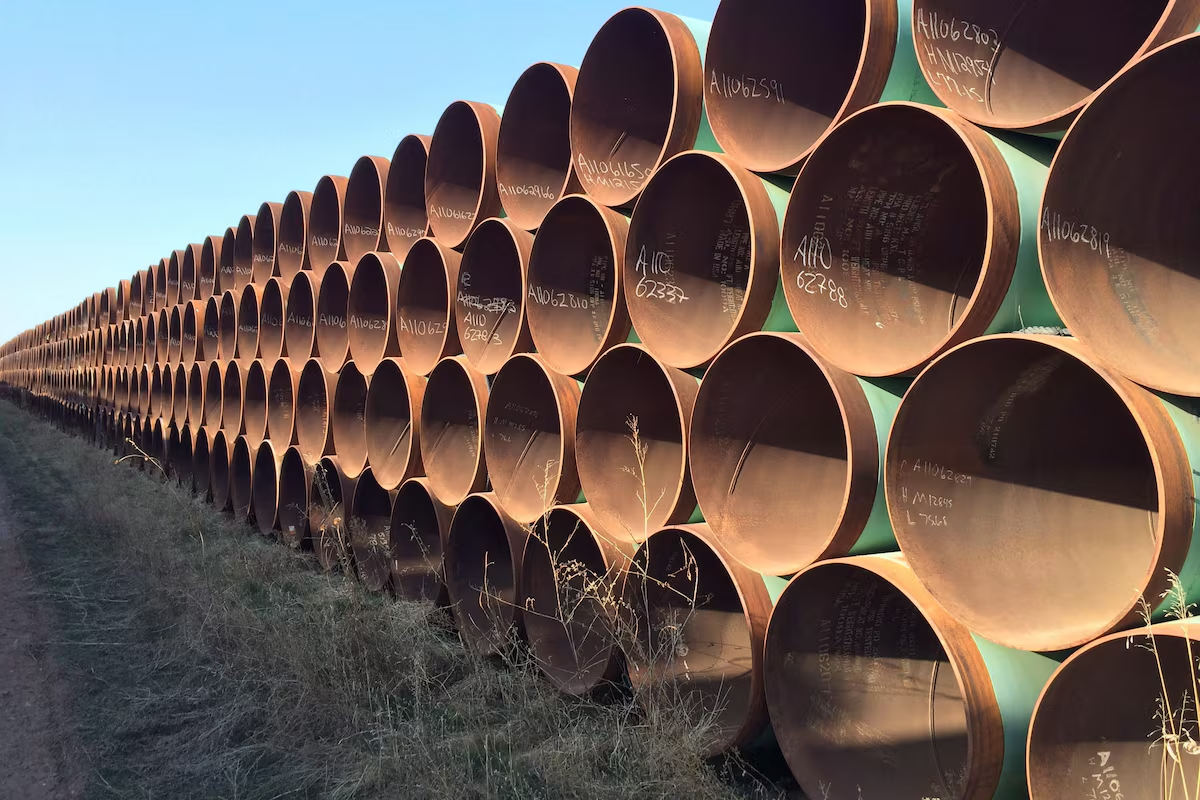
Pipes meant for the defunct Keystone XL project are stacked at a yard in Gascoyne, N.D., in 2015.Alex Panetta/The Canadian Press
In an ideal world, taxpayer dollars would not be building oil pipelines. That’s not because there’s anything inherently wrong with pipelines. It’s because it’s normally best to leave these things to the market.
If private investors do their sums and conclude they can turn a profit by sinking tens of billions of dollars into hydrocarbon transportation infrastructure, they will. If they decide it doesn’t make sense, they won’t invest.
In theory, either decision would be the right one – for investors, the economy and the national interest. Whatever the invisible hand of the market delivers is for the best.
In theory.
Taxpayers asked to foot the bill for another pipeline
In practice, it’s been some time since Canadian oil moved according to Econ 101 principles. The visible hands of governments have visibly blocked pipelines.
The amount of oil Canada could ship to our main customer was effectively limited after Keystone XL was killed by one American president, resurrected by another and killed again by a third. At the same time, Canadian politics made it impossible to export oil from northern British Columbia, or Canada’s East Coast.
And in 2018, the last remaining road to the sea, the expansion of the 1950s-era Trans Mountain Pipeline from Alberta to Burnaby, B.C., had its private proponent pull out, forcing Ottawa to take over.
Years of roadblocks to the export of Canadian oil put downward pressure on the price it fetched. That took a bite out of corporate profits, and government royalty and tax revenues. By discouraging investment in the oil patch, it also blocked a path to higher oil output, higher levels of economic activity and higher government revenues.
Opinion: Finally, Canada steps up as the energy superpower the world needs it to be
In the first decade and a half of the 21st century, tens of billions of dollars flowed into building oil sands projects, turning Canada into the world’s fourth-largest oil producer. The upstream investments assumed that pipelines to move all that oil downstream would follow. The assumption was only partly borne out.
The result was that landlocked Alberta oil sold at a deep discount. Things got so bad in 2019 that a desperate provincial government resorted to trying to boost prices by forcing oil producers to produce less.
Would you invest in pumping more oil under those conditions?
One final piece of history: After the Trudeau government bought the Trans Mountain pipeline, and sank $34-billion into tripling its capacity to 890,000 barrels a day, the price discount largely unwound.
In 2025, economist Charles St-Arnaud estimated that Canadian oil revenues rose by $13-billion due to the narrowing of the price gap delivered by the new pipe – the equivalent of producing 12 months of oil output but getting paid for 13. Alberta earned an extra $4.4-billion in oil royalties, while Ottawa and Alberta took in additional corporate tax revenues of $2-billion and $1-billion, respectively.
The Alberta-Ottawa plan to build a one-million barrel a day pipeline from Bruderheim, north of Edmonton, to Roberts Bank, south of Vancouver, is largely a rerun of that Trans Mountain expansion story.
Opinion: An Alberta-Ontario pipeline is a great idea. Let’s get one through Quebec as well
It borrows the existing TMX corridor. It is expected to be paid for by taxpayers. And it aims to replicate what TMX accomplished, and then some.
The big price discount that Alberta oil endured was largely eliminated by TMX. However, it would return if Albertan oil production was to increase majorly, and was not matched by equivalent pipeline capacity.
The goal of the Alberta-to-Roberts Bank pipeline is not to move oil that Alberta is already producing. It is to spur private investors to finance expanding output and produce more Canadian oil. That’s the prize.
The Carney government may not want to say it too loudly, given the sensitivities of some progressive voters.
But most Canadians appear to be on board. That’s because a pipeline to Roberts Bank, in addition to giving us some independence from the U.S. market, is likely to deliver long-term economic and fiscal benefits through higher investment in the oil sands, and the resulting higher oil output.
The good news is that there are now several pipeline projects at various stages of development.
Opinion: Why the proposal for a major new pipeline should be a cause for celebration
Enbridge is working on the multistage Mainline optimization program, which could move an additional 430,000 barrels a day of Alberta oil to the U.S. Potential improvements to the existing TMX pipeline could add 300,000 barrels a day. Pipeline operator South Bow Corporation has also put forward a sequel to Keystone XL, called Prairie Connector, that could move 550,000 barrels a day to the U.S.
And on Monday, Ontario and Alberta unveiled a concept called Northern Shield, a plan for an West-to-East pipeline of up to 800,000 barrels a day. It’s at the prefeasibility study phase, with costs unknown.
On balance, the idea of taxpayers building a pipeline from Alberta to the Pacific makes sense. (As for a taxpayer-funded pipeline to Ontario, be open-minded, but skeptical.) It is almost certain to be able to pay for itself through tolls, and is highly likely to deliver lasting fiscal and economic returns through the oil sands facilities it should spur the private sector to invest in, and the decades of oil those would produce.
Details on the Roberts Bank proposal have to be sweated, budgets have to be managed, costs have to be controlled. But to the extent they are: Build it, and the oil will come.