
Good morning. Canada has selected Germany’s TKMS to build 12 submarines for the country’s first significant underwater fleet. More on that below, along with an Alberta-Ontario pipeline proposal and the volunteer drivers of Saskatchewan.
Programming note
We’re making some changes to this newsletter and would love to hear what you think. Please send your feedback to morningupdate@globeandmail.com.Open this photo in gallery:
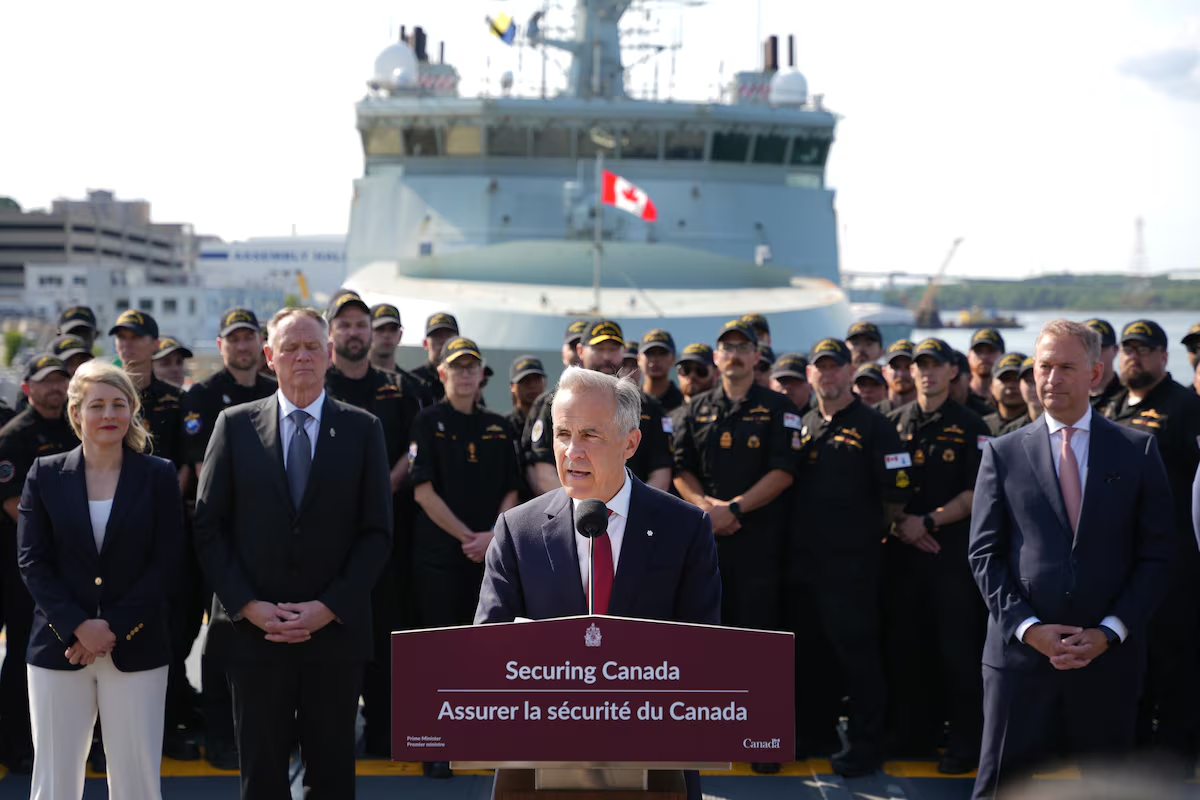
Prime Minister Mark Carney makes the sub announcement in Halifax yesterday.Darren Calabrese/The Canadian Press
TOP STORIES
Germany wins the submarine sweepstakes
The latest: The Canadian government has picked Germany’s TKMS to build the country’s first significant submarine fleet, siding with NATO allies and Europe over South Korean defence contractor Hanwha.
The fleet: Prime Minister Mark Carney said the purchase of up to 12 subs will be the largest defence procurement in Canadian history. Currently the country has four second-hand subs, of which only one is typically operational.
More about TKMS: The company has about 22 publicly disclosed agreements and memorandums of understanding, mostly with Canadian companies. The Globe mapped out its partnerships.
What’s next: The decision means that TKMS is the preferred bidder to build the submarines, and Carney said the company has pledged to deliver the first four by 2034. But this is still an early step in a long procurement process – one that experts say could face major hurdles.
Open this photo in gallery:
Alberta Premier Danielle Smith and Ontario Premier Doug Ford announce a pipeline proposal.Jeff McIntosh/The Canadian Press
Alberta and Ontario’s pipeline proposal
The plan: Alberta and Ontario are proposing a new 3,300-kilometre pipeline route to carry crude oil across the country in a bid to reduce Canada’s reliance on foreign markets. The proposed route, called the Northern Shield Energy Corridor, would travel across four provinces and would be able to move about 500,000 barrels of oil per day, the governments say.
The details: The price tag for such a project – and who would pay for it – remain a mystery. Ontario Premier Doug Ford said the province is examining potential costs and planning to complete a feasibility study by the end of the year. Alberta, Ontario and Saskatchewan signed a memorandum of understanding last year that committed the provinces to new energy and trade infrastructure. But it excluded Manitoba, which is part of the proposed route.
Open this photo in gallery:
Firefighters evacuate people from the scene of a Russian missile attack in Kyiv yesterday.Paula Bronstein/Getty Images
A Russian missile and drone attack
The attack: Russia unleashed scores of missiles and drones at Ukraine early Monday, killing at least 26 people. Moscow has stepped up its assaults in retaliation for Ukraine’s recent strikes, which have caused severe fuel shortages and put domestic pressure on Russian President Vladimir Putin.
Exposed gaps: All of the ballistic missiles launched by Russia struck their targets, demonstrating a vulnerability in Ukraine’s air defences. The country remains reliant on U.S.-made Patriot interceptor missiles, and the supply has been strained by the war in Iran. Ukrainian President Volodymyr Zelensky urged U.S. and European partners to bolster Ukraine’s air defences ahead of this week’s NATO summit in Turkey.
Open this photo in gallery:
Rogers struck a deal to buy the remaining stake in MLSE.Gregory Shamus/Getty Images
Rogers takes control of Toronto’s sports teams
The latest: Rogers Communications has signed a deal to buy the final 25-per-cent stake in Maple Leaf Sports & Entertainment from Kilmer Sports for $4.35-billion. The acquisition would give Rogers complete ownership of the Toronto Maple Leafs, Toronto Raptors, Toronto FC and Toronto Argonauts. Its existing holdings include the Toronto Blue Jays, the Rogers Centre and Sportsnet.
What’s next: The deal is expected to close in the fourth quarter of 2026 and is still subject to league approvals. Rogers may not hold onto the full stake for long: the company reiterated plans to sell a minority stake in its consolidated sports, media and entertainment assets over the course of the next year.
Open this photo in gallery:
AFC Toronto’s Victoria Pickett and Montreal Roses FC’s Tanya Boychuk during a Northern Super League game.Arlyn McAdorey/The Canadian Press
An investment in Canadian women’s soccer
The latest: London- and Portugal-based private equity firm Apex Capital is investing up to $30-million in Canada’s first professional women’s soccer league. The Northern Super League, the brainchild of Olympic bronze medalist Diana Matheson, kicked off last year with six teams.
What it means for the sport: The move comes amid a wave of optimism about the economics of women’s sports across the globe, and serves as a vote of confidence in the Canadian market at a time when domestic interest in soccer may be at its highest level ever.
World Cup Q&A: Where does Canada go after its historic run? On Wednesday at 1 p.m. ET, sports writers Cathal Kelly, Paul Attfield, Neil Davidson and David Ebner will be live answering your questions about the tournament and our home team’s showing. Submit your questions here or e-mail audience@globeandmaill.com.
The Take
If our commitment to rights and equity is real, then people with disabilities, young and old alike, need to be full citizens, not second-class ones begging for crumbs to survive.
— André Picard
Disability support programs across the country badly need updating, André Picard writes, or else they will continue to fail people with disabilities.
The Shot
Open this photo in gallery:
Al Sutherland, a volunteer with the Gravelbourg Cares Shuttle Service, drives Margaret Vail to her medical appointment in Moose Jaw, Sask., yesterday.Liam Richards/The Globe and Mail
Transportation can be a major barrier to accessing health care in remote areas. In Saskatchewan, volunteer drivers are bridging the gap with a door-to-door pickup service that helps residents get to medical appointments.
The Wrap
What else we’re following
At home: Equinor will acquire BP’s stake in the Bay du Nord oil project off the coast of St. John’s.
Abroad: China test-fired an intercontinental missile from a submarine in the southern Pacific Ocean, drawing international condemnation.
On the field: FIFA dismissed Belgium’s appeal of a decision to clear U.S. forward Folarin Balogun to play yesterday after an intervention by President Donald Trump, but Belgium triumphed on the field.
On the street: Vendors are treading carefully as FIFA cracks down on World Cup merch.
At work: Federal public servants marked the first day of a return-to-office mandate with a small protest outside the Prime Minister’s Office.
Off duty: Astronaut Jeremy Hansen says he’s leaving the Canadian Space Agency.