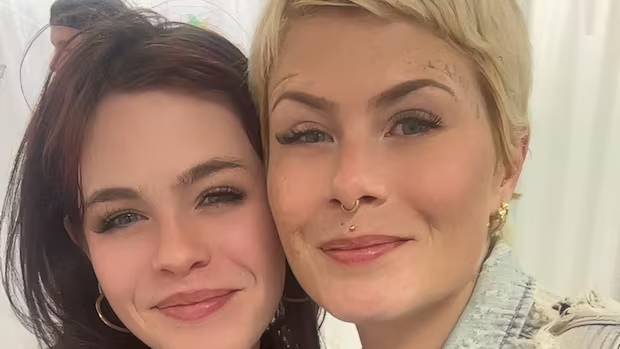
This First Person column is written by Melissa MacMillan, who lives in Sudbury, Ont. For more information about CBC’s First Person stories, please see the FAQ.
When I got sober in 2021, I thought the hardest part would be staying clean.
It wasn’t.
The hardest part was learning how to be a mother.
Eden was four years old when she went to live with my parents. At the time, I was struggling with addiction and trapped in an abusive relationship. What I thought would be temporary became most of her childhood. My parents raised her. They packed school lunches, attended parent-teacher interviews, enforced curfews, sat beside hospital beds, and did all the ordinary things parents do every day.
In fact, in some ways, Eden was the parent in our relationship. She learned very early that I was someone she loved, but not someone she could depend on.
In high school, she would meet me at the methadone clinic almost every day on her lunch break. She would take me to Subway and buy me the only meal I would eat all day because getting high always came before food.
When other kids her age were worried about crushes, homework and Grade 9 exams, Eden was worried about whether her mother was alive.
I couldn’t change that with an apology. I couldn’t change it by getting sober. And I couldn’t change it by telling her I was different. The only way to change it was to prove I could be there for her.
By the time I got sober, Eden was 15 years old and didn’t really see me as a parent, and honestly, why would she? I wasn’t the one who raised her. I wasn’t the one making the rules or grounding her when she broke them. I was the cool older sister, the black sheep of the family, the person she called when she was frustrated with my parents and wanted someone to take her side. The person she stayed connected to because I represented rebellion against Grandma and Grandpa.
 MacMillan with Eden when she was a newborn. (Submitted by Melissa MacMillan)
People often talk about rebuilding relationships after addiction, but Eden and I didn’t have a traditional mother-daughter relationship to rebuild. When I finally got custody of her again in 2023 and we moved into our own home together, that reality became impossible to ignore. I thought I was finally bringing my daughter home. Instead, I found myself living with a teenager who wasn’t entirely sure I was her mother. Suddenly, I was enforcing rules, setting boundaries, and telling her no. The role I had occupied for most of her life was gone, and neither of us really knew what was supposed to replace it.
She stayed out all night. She experimented with drugs. She treated the house more like a friend’s place than a parent’s home. Part of me understood her behaviour because for years I had occupied the role of ally, not a parent.
But I also had two younger daughters watching everything, and for the first time in my life, I had to choose between being liked and being a mother.
When I told her she needed to go to detox or leave our home, every instinct in me wanted to take back those words. I wanted to chase after her, rescue her, and protect her from the consequences of her choices. But I knew exactly where that road led because I had walked it myself. Loving her meant holding the line, even when it broke my heart.
She left, and letting her go was one of the hardest decisions I’ve ever made.
Looking back now, that was the turning point. Nothing changed overnight — she was still angry, and I was terrified for her — but it was the first time our relationship wasn’t built around me trying to stay her friend instead of her mom. For the first time, I stopped worrying about whether she liked me and started worrying about what she needed from me.
 From left, sisters Ariyah MacMillan, 11, Eden Wilcox, 18, and Emily Blackwood, 10, pose with MacMillan, their mother. (Submitted by Melissa MacMillan)
Two years later, she is sober. She has her own place. She’s building a life she can be proud of. Ironically, it wasn’t until she moved out that our mother-daughter relationship truly began.
Recently she had foot surgery, and when she needed medication, I picked it up. When she needed groceries, I brought them. When she needed help, she called me. Those moments might sound ordinary, but for us they’re everything.
For most of her life, I wasn’t the person she called. My parents were.
The trust didn’t come back because of one big conversation or emotional breakthrough. It came back slowly through hundreds of small moments. Answering the phone. Keeping my word. Showing up when I said I would. Bringing groceries. Picking up medication. Being reliable for long enough that she finally believed I wasn’t going anywhere.
Our relationship isn’t perfect, and I don’t think either of us expects it to be. We missed too many years for that. There are things we can never get back and wounds that don’t disappear simply because time passes. But healing isn’t about pretending the past didn’t happen. It’s about choosing each other anyway.
Today, when Eden needs her mom, she calls me.
And she gets her mom in return.
Not a mother who’s high.
Not a mother choosing addiction over her children.
Not a mother disappearing for days at a time.
She gets a real mother.
Not a perfect one, but a present one.
A mother who stays.
And after everything we’ve been through, that alone feels like a miracle.
If you or someone you know is struggling with substance use, here’s where to look for help:
Do you have a compelling personal story that can bring understanding or help others? We want to hear from you. Here’s more info on how to pitch to us.