
Open this photo in gallery:
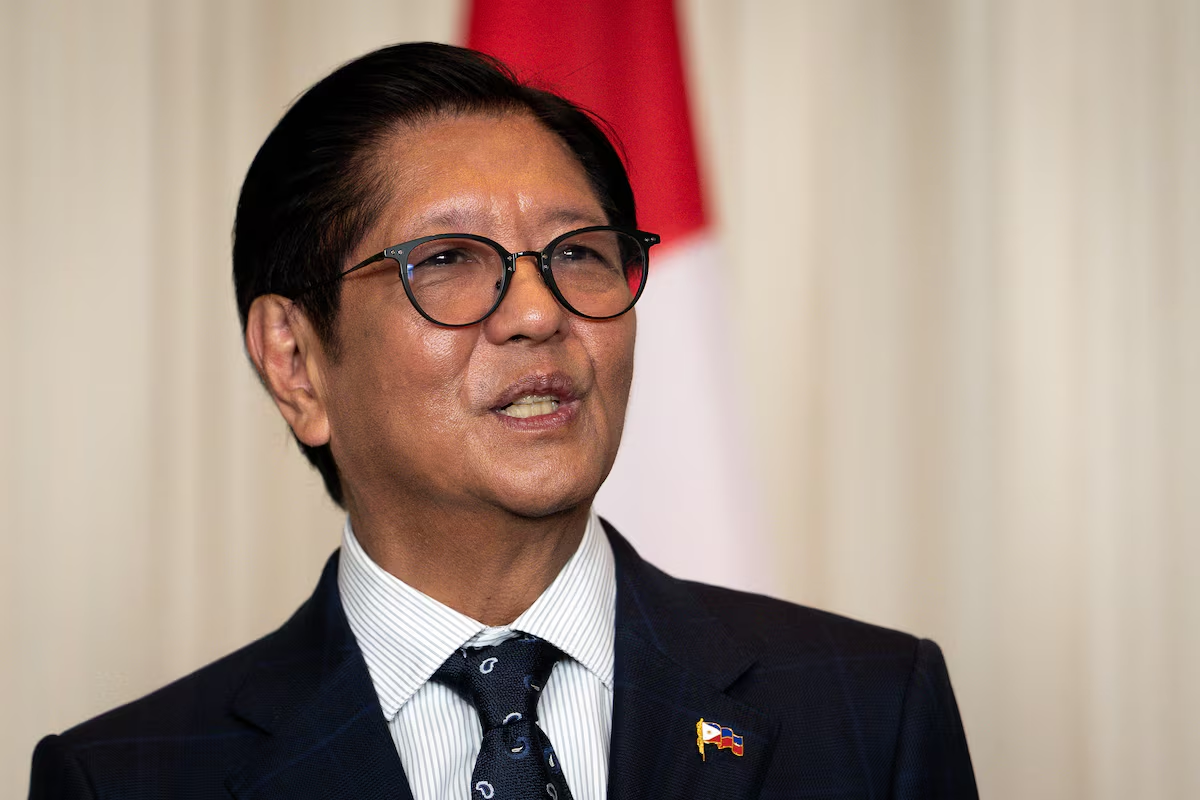
Philippines President Ferdinand Marcos Jr. speaks before a meeting with Prime Minister Mark Carney in Vancouver, on Thursday.ETHAN CAIRNS/The Canadian Press
The leaders of Canada and the Philippines signed agreements Thursday on energy, natural resources, labour and tourism, as the countries reinforced their shared priorities and hope for a trade deal.
“We share the same aspirations, in terms of what we would want to achieve in the world,” Philippine President Ferdinand Marcos Jr. told reporters in Vancouver, during the first visit to Canada by the Philippines’ head of government in more than a decade.
Prime Minister Mark Carney had invited Marcos to visit Canada as the two countries aim to have a bilateral trade agreement concluded by the time Mr. Carney heads to Manila for a November summit.
Mr. Marcos will be chairing the summit of the Association of Southeast Asian Nations, a bloc with whom Canada is also undergoing trade negotiations.
Carney, Philippines President to discuss energy and trade
On Thursday, Mr. Marcos and Mr. Carney oversaw the signing of agreements meant to boost economic activity between the two countries, including a memorandum that seeks more protection for Filipino workers in Canada and more labour mobility.
“Filipino workers make extraordinary contributions to communities,” Mr. Carney said, giving the example of care-workers and nurses. “We will make sure they are treated fairly, can work safely and have their rights respected.”
Mr. Marcos said there are already strong people-to-people ties, and both countries can craft “a mutually beneficial talent pipeline for the future” involving more sectors of the economy.
“To unleash this full potential, it is essential that Filipino professionals are able to practice their professions in Canada. In this regard, we will convey our hope that Canada’s federal and provincial governments will continue working together,” Mr. Marcos said.
Mr. Carney says Filipino-Canadians are “at the very heart” of Canada, and both countries can benefit in energy security and critical minerals through a strategic partnership.
Who does Mark Carney think we are, anyway?
Nearly one million people in Canada identified as Filipino in the 2021 census.
He said the countries have shared values and “self-reinforcing momentum” in the relationship, with the two already having signed a series of agreements involving defence.
Asia Pacific Foundation vice-president Vina Nadjibulla wrote in an analysis that the Marcos visit demonstrates Canada’s four-year-old Indo-Pacific strategy is starting to yield results.
“Since the strategy was launched in 2022, a relationship once anchored primarily in deep people-to-people connections has broadened into a more consequential partnership spanning trade, investment, energy, maritime security, cybersecurity and defence,” Ms. Nadjibulla wrote this week in Policy Magazine.
Open this photo in gallery:
Prime Minister Mark Carney, right, and Philippines President Ferdinand Marcos Jr. leave a news conference in Vancouver on Thursday.ETHAN CAIRNS/The Canadian Press
Canada’s work in dark vessel detection is helping the Philippines identify vessels engaged in illegal or unreported activity, she said, while Manila has appreciated Canada’s repeated endorsement of a UN tribunal that ruled against Beijing’s territorial claims in waters widely understood as Philippine jurisdiction.
The Philippines is now looking to Canada for oil, gas and nuclear technology to shore up mineral processing, data centres and advanced manufacturing, she wrote, particularly as the Iran war hits Asian countries hard.
Ms. Nadjibulla wrote that Mr. Carney and his predecessor Justin Trudeau had visited Asian leaders abroad, but having them come to Canada shows a real interest from those countries. She noted recent Canadian invitations to Japan and India’s leaders.
“Canada’s strategic relevance also depends on whether other leaders are prepared to invest political capital by coming here,” Ms. Nadjibulla wrote.