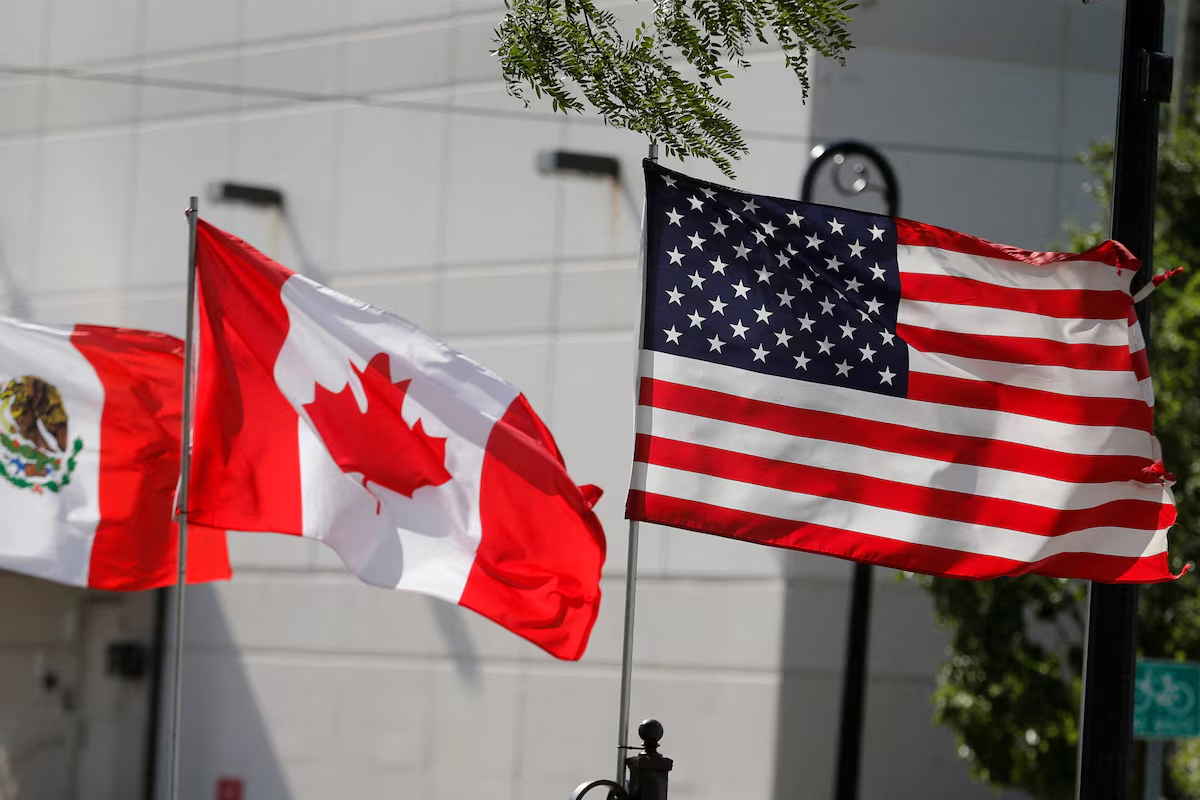

Open this photo in gallery:
U.S. Trade Representative Jamieson Greer said in a statement that Washington will not renew the United States-Mexico-Canada Agreement in its current form.Rebecca Cook/Reuters
The Trump administration has declined to renew the United States-Mexico-Canada Agreement, extending uncertainty for businesses across North America and setting the stage for protracted negotiations over the future of continental trade.
Officials from the three countries met virtually on Wednesday for a mandated six-year review of the trade pact, which was negotiated during President Donald Trump’s first term in office, and which governs some $2.5-trillion worth of trade across the continent.
USMCA wasn’t renewed. What’s next for the North American trade deal?
Dominic LeBlanc, the minister responsible for Canada-U.S. trade, and Mexican Economy Secretary Marcelo Ebrard advocated for a 16-year extension to the deal. U.S. Trade Representative Jamieson Greer said in a statement that Washington had decided not to renew the agreement “in its current form.”
The decision was widely anticipated, and it does not mean the trade pact will expire any time soon. Under the terms of the USMCA, non-renewal means the treaty remains in effect but moves into a period of annual reviews for the next 10 years.
Trade negotiations are expected to continue through the summer, and a 16-year extension agreement could be struck any time at a later date. If no agreement is reached by 2036, the deal expires. Any of the parties can also withdraw from the treaty with six months’ notice.
“The United States will continue to engage with Mexico and Canada to address the Agreement’s shortcomings and our trade deficits with these countries,” Mr. Greer said in a statement on Wednesday. “However, the Agreement remains in force pending resolution of these issues or until the Agreement’s termination.”
The fate of the USMCA is one of the most pressing issues for Prime Minister Mark Carney’s government. Uncertainty about access to the U.S. market is strangling business investment while American tariffs are putting key Canadian manufacturing industries in jeopardy.
Mr. Carney has promised to diversify trade away from the United States but can’t escape the fact that it’s Canada’s most important trading partner, by dint of geography and decades of economic integration.
In some ways, nothing changed on Wednesday. U.S. tariffs on important sectors, including automobiles, industrial metals and wood products, remain in place. As does the broad-based tariff carve-out for goods that comply with USMCA rules of origin, which has allowed most Canadian and Mexican exports to dodge America’s global tariff regime and continue entering the U.S. duty-free.
Still, the Trump administration’s refusal to renew the agreement that the President once called the “fairest, most balanced and beneficial trade agreement” ever, marks the beginning of a new phase for North American trade.
Trade experts expect this phase will be defined by bilateral deal-making, increased pressure from Washington to align against China, and tough conversations about the future of Canada’s battered auto industry and manufacturing base – all without a clear path forward or timeline to strike a deal.
“There’s a bit of a window around the U.S. midterms [in November] where the U.S. administration may be looking for some kind of win,” Steve Verheul, who was Canada’s chief negotiator for the 2017-2018 USMCA negotiations, said on a conference call earlier this week.
Open this photo in gallery:
U.S. Trade Representative Jamieson Greer, right, talks with Mexico’s Economy Minister Marcelo Ebrard amid USMCA talks in Mexico City on April 20.Raquel Cunha/Reuters
“But I think it’s more likely that the discussions will continue beyond the midterms and possibly even into next year,” Mr. Verheul said.
Ultimately, Mexico City and Ottawa are not in control of the negotiating timeline and any decision to strike a deal, even if the U.S. trade team advocates for it, will be up to the mercurial Mr. Trump.
The July 1 review date was part of a “sunset clause” that was added when the USMCA replaced the North American free-trade agreement, or NAFTA, in 2020. Washington had demanded a six-year review process to give it opportunities to rejig trade rules and to put pressure on Mexico and Canada to deliver additional concessions.
Now that the review date has arrived, the Trump administration is demanding a number of significant changes to the deal as a condition for potentially renewing it.
Negotiations began late, and have so far progressed bilaterally, as Washington has dealt with Mexico City and left Ottawa on the sidelines. The Mexicans and Americans have held two formal negotiating rounds over the past six weeks and have scheduled a third for later this month.
Mr. Ebrard, who leads Mexico’s trade team, said in a social-media video on Wednesday that he hoped to conclude the USMCA review in a “reasonable period of time.”
“We’re not in a rush but neither are we interested in there being uncertainty,” he said. “Our objective will be that, each year, that review has fewer outstanding issues.”
Canada’s trade team, led by Mr. LeBlanc and chief negotiator Janice Charette, have met with Mr. Greer and his team at the Office of the United States Trade Representative (USTR) several times in recent months but have not begun formal negotiations about potential changes to the USMCA.
“We agreed on the importance of continuing our discussions and identifying ways to ensure trade and investment frameworks between Canada, the United States and Mexico continue to support North American prosperity and competitiveness,” Mr. LeBlanc said in a statement on Wednesday, after the virtual meeting with Mr. Greer and Mr. Ebrard.
“For Canada, this includes substantive discussions with the United States on addressing sectoral tariffs on Canadian steel, aluminum, autos and lumber.”
Mr. Greer has said that he’s looking to negotiate separate bilateral “protocols” with Canada and Mexico that would be layered on top of the existing trilateral agreement. This could allow the Trump administration to make changes to trade rules without having to go back to Congress for approval.
Washington’s demands essentially fall into two buckets: it wants Canada and Mexico to change certain rules in the USMCA, with the goal of boosting U.S. manufacturing and keeping Chinese products out of sensitive North American supply chains. And it wants both countries to change a number of domestic policies that it says disadvantage American companies.
USTR is pushing for tighter rules of origin – which define how much of a product must come from North America to get preferential tariff treatment – for automobiles and other “strategic” industrial goods. It’s looking to increase the North American content requirement in automobiles to 82 per cent from 75 per cent and to add a new requirement that 50 per cent of a vehicle must be made of U.S. parts.
Opinion: In ‘Fortress North America’ the U.S. wants its tariffs and for us to eat it, too
Washington also wants Ottawa and Mexico City to align with U.S. tariffs on Chinese products and other restrictions on Chinese goods, technology and investment.
In the second bucket, the Trump administration has repeatedly complained about Ottawa’s digital streaming regulations and its approach to allocating dairy quotas as part of the country’s supply management system.
It also wants the federal government and provinces to back down on retaliatory measures taken in response to U.S. tariffs, including new Buy Canadian policies and the removal of U.S. alcohol from many provincial liquor store shelves.
“The U.S. government has quite a few issues it wants addressed and has already come forward with some fairly aggressive negotiating positions,” said Patrick Childress, a partner with the U.S. law firm Holland & Knight and a former assistant general counsel at USTR.
“The question for Canada and Mexico will be which of these proposals from the U.S. government is it willing to accept in order to convince the United States government that the USMCA is still a treaty worth having, and to prevent the U.S. government from withdrawing from the treaty altogether,” Mr. Childress said.
Open this photo in gallery:
Prime Minister Mark Carney shakes hands with Mexico’s President Claudia Sheinbaum after a joint press conference at the National Palace in Mexico City on Sept. 18, 2025.YURI CORTEZ/AFP/Getty Images
For much of the past year, Mexico has appeared more willing to bow to U.S. demands, while Ottawa has held back concessions as leverage in future trade talks. But this strategy appears to be shifting.
Over the past month, Ottawa ordered a review of a decision that would have made U.S. streaming companies pay more for Canadian content and rushed out legislation to address U.S. concerns about forced labour in supply chains.
Mr. Carney also offered a conciliatory message during a speech in New York in May, where he said Canada wanted deeper integration with the U.S. in key sectors as part of a “Fortress North America” strategy.
In an interview with Bloomberg on Wednesday, Mr. Greer said that Canada is sending “mixed messages.” He pointed to the Prime Minister’s attempts to court Chinese investment for the Canadian auto industry while saying his country wanted to help America reindustrialize.
Goldy Hyder, president and chief executive of the Business Council of Canada, said he’s “cautiously optimistic” that some sort of deal between the three countries could be reached “inside 12 months, if not sooner.”
“Something has to give at some point in time,” Mr. Hyder said. “The Canadian, Mexican and American business communities are unified on their message, which is, ‘We would like to see a trilateral, timely and tariff-exempt-on-compliant-goods review and renewal of the USMCA.’
“And the sooner that happens, the better for all.”