
Good morning – and also, a quick goodbye. After more than two years and 300 newsletters, this is my final Morning Update. I’m moving to another beat at The Globe, and some new and some familiar faces will take over the newsletter this summer. Thank you so much for reading; it’s a huge privilege to land in your inbox each day. Before I go, though, let’s look up: Earth’s orbit is getting cluttered with satellites and all manner of space junk. But first:
Today’s headlines
Sign up for Morning Update:
Reading this online? Start your morning with context and insight on the day’s biggest stories, in your inbox every weekday.
Open this photo in gallery:
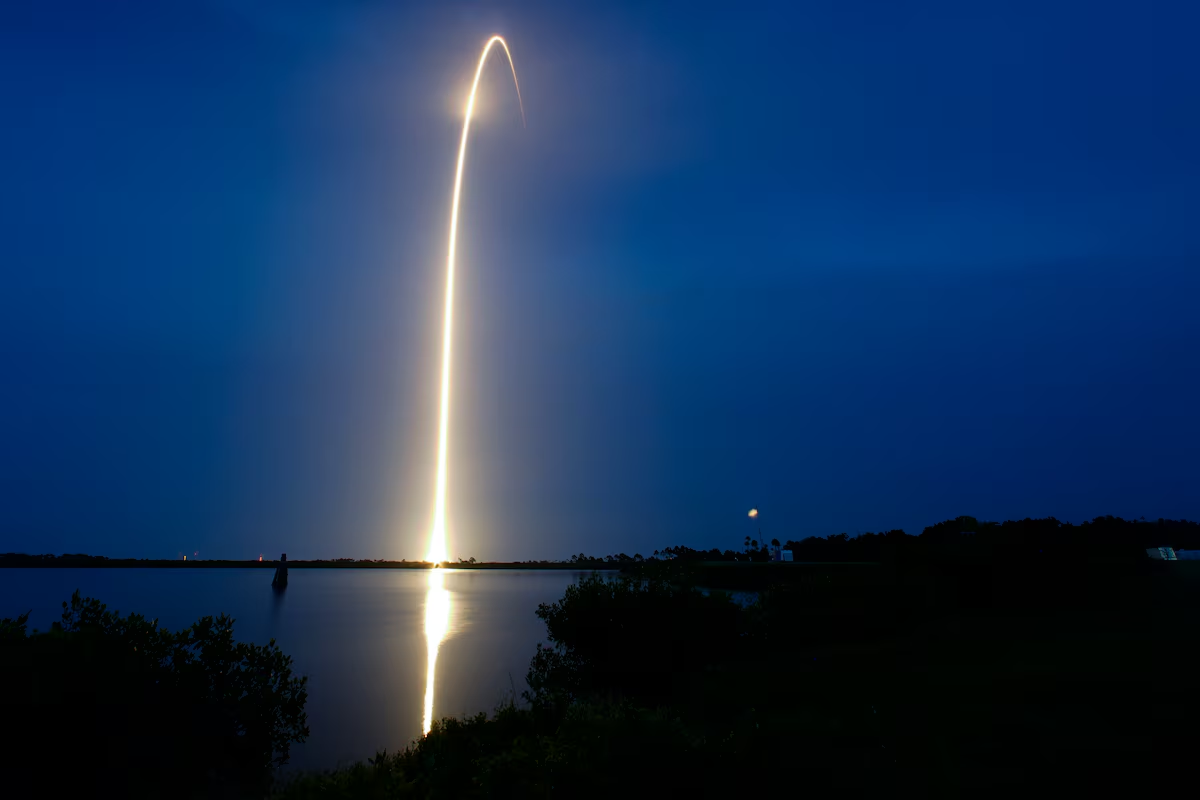
A SpaceX rocket bearing Starlink satellites lifts off from Florida in 2023.John Raoux/The Associated Press
Tech
Space jam
On Sunday, SpaceX launched 24 Starlink satellites into low-Earth orbit, each one about 1,250 kilograms and the length of a Ford F-150 truck. Last night, it sent up two dozen more. Tomorrow, it will launch another 29 satellites, then another 53 the following week. They join the 10,000 Starlink satellites already whizzing around Earth at seven kilometres a second – and the company plans to put a total of 42,000 into orbit in the coming years. Wait, scratch that: Elon Musk, SpaceX’s trillionaire owner, is now asking the Trump administration for permission to launch one million satellites.
If that sounds like an awful lot to you, Musk doesn’t think you should worry about it. In a recent video posted on his social-media site, X, he assured viewers that “you got plenty of room to move around up there. Space is really big.”
Okay, but that’s not quite the point. Starlink’s internet satellites aren’t spread out all over the cosmos. They’re instead mostly corralled into a dense band 550 kilometres above us, moving at many times the speed of a bullet, on a path that roughly aligns with southern Canada and the 50th parallel.
“We’re talking about this very narrow usable shell of orbits around the Earth,” said Samantha Lawler, a professor of astronomy at the University of Regina. She’s unpersuaded by Musk’s insistence that his satellites aren’t at risk of collisions since they occupy a tiny sliver of space. “It’s like saying Formula 1 drivers don’t need to worry about crashing, because their race cars take up such a small area of the track,” Lawler told me. “It doesn’t make sense.”
What goes up …
Before humans started hurling objects into orbit, nothing much circled our planet beyond the odd asteroid caught by Earth’s gravity. But after Sputnik blasted off in 1957, the Soviet Union and United States – later joined by other countries – sent more and more military and scientific spacecraft into the skies. By the turn of the 21st century, some 20,000 objects were in orbit, including weather, navigation and communications satellites.
Once private companies got involved, however, Earth’s backyard became vastly more congested. SpaceX has been the biggest player in low orbit since 2019, but it’s jostling for room alongside 5,000 other active satellites – plus an unholy amount of space junk. There are now tens of thousands of pieces of debris zipping around above us, such as jettisoned rocket boosters, defunct satellites and various tools dropped by astronauts out on a space walk. And that’s just the stuff we know about for sure. Researchers estimate another 100 million pieces of space junk are up there, too small to be tracked.
Open this photo in gallery:
Barry Sawchuk, Samantha Lawler and a giant hunk of SpaceX debris in 2024. Stay with me: I’ll explain.HO/The Canadian Press
So forget Musk’s grand vision of one million Starlink satellites in orbit: His current fleet of 10,000 is already tied up trying to avoid a crash. SpaceX informed the U.S. government it made roughly 300,000 manoeuvres in 2025 to skirt debris or other satellites. That’s a 50-per-cent increase from the year before. It works out to an unplanned space dodge every two minutes.
“It just shows how completely dependent we are on SpaceX to operate perfectly,” Lawler said. “If something gets really screwed up – if there’s a big solar storm, or Starlink gets hacked, or there’s a bad software update – we don’t have much time to recover before a chain of collisions occurs.”
… must come down
To its credit, SpaceX has managed to operate perfectly so far. (“Keep it up, Elon!” Lawler encouraged.) But giant hunks of satellites and rockets keep crashing onto Earth, and that isn’t as great.
Starlink’s satellites only have a five-year lifespan; after that, they’re meant to burn up from the friction of re-entering Earth’s atmosphere at speed. The trouble is some parts are too dense – and thus too slow – to burn up completely. That’s why a smouldering piece of cargo trunk landed on an Australian sheep field in 2022. And why charred rocket remains dropped behind a Polish warehouse in early 2025. And why a weirdly hairy space capsule smashed into Argentina last September. It did not take me long to find these examples! In fact, in 2024 alone, hunks from two separate SpaceX launches fell onto rural Saskatchewan. One 80-pound piece surfaced on a farm in Ituna, not at all far from where Lawler lives.
“This is going to keep happening,” she said. Existing space laws are outdated for the scale of commercial launches. The Trump administration killed a rule forcing companies to safely remove their celestial trash. And outer-space recycling centres or giant inflatable bags that catch debris, while quaint, won’t cut it. “We really need to be launching fewer satellites with longer lifespans,” Lawler told me. “We also need a strong push at the international level to govern satellite operators.”
In the meantime, SpaceX just seems to be doling out cash to civilians inconvenienced by its junk. Barry Sawchuk, the farmer in Ituna, netted somewhere around $5,000 “for the retrieval and storage of spacecraft components,” which two SpaceX staffers ultimately came to collect. Sawchuk donated the money to the construction of a new skating rink.
The Shot
‘Today, we celebrate each other.’
Open this photo in gallery:
A sea of Canadian flags at Ottawa’s LeBreton Flats.Justin Tang/The Canadian Press
Prime Minister Mark Carney emphasized national unity in his Canada Day speeches yesterday, as the country gears up for its first provincial referendum on separation in more than 30 years. Read more about the events here.
The Wrap
What else we’re following
At home: The Trump administration declined to renew the United States-Mexico-Canada Agreement. This is what’s next for North American free trade.
Abroad: Speaking of Trump (and I’m looking forward to speaking less of Trump), the U.S. Supreme Court struck down his effort to end birthright citizenship.
Party: It seems more and more likely that Taylor Swift will celebrate her wedding to Travis Kelce at Madison Square Garden tomorrow night.
PARTY: Toronto will be positively thumping when Portugal plays Croatia in the World Cup round of 32 later today.
Hero: Harry Kane scored twice in the final 15 minutes to get England past a determined Democratic Republic of the Congo and into the last 16.
Villains: Rabid raccoons have been sneaking north across the border into Quebec – but crack teams of technicians are now on the case.