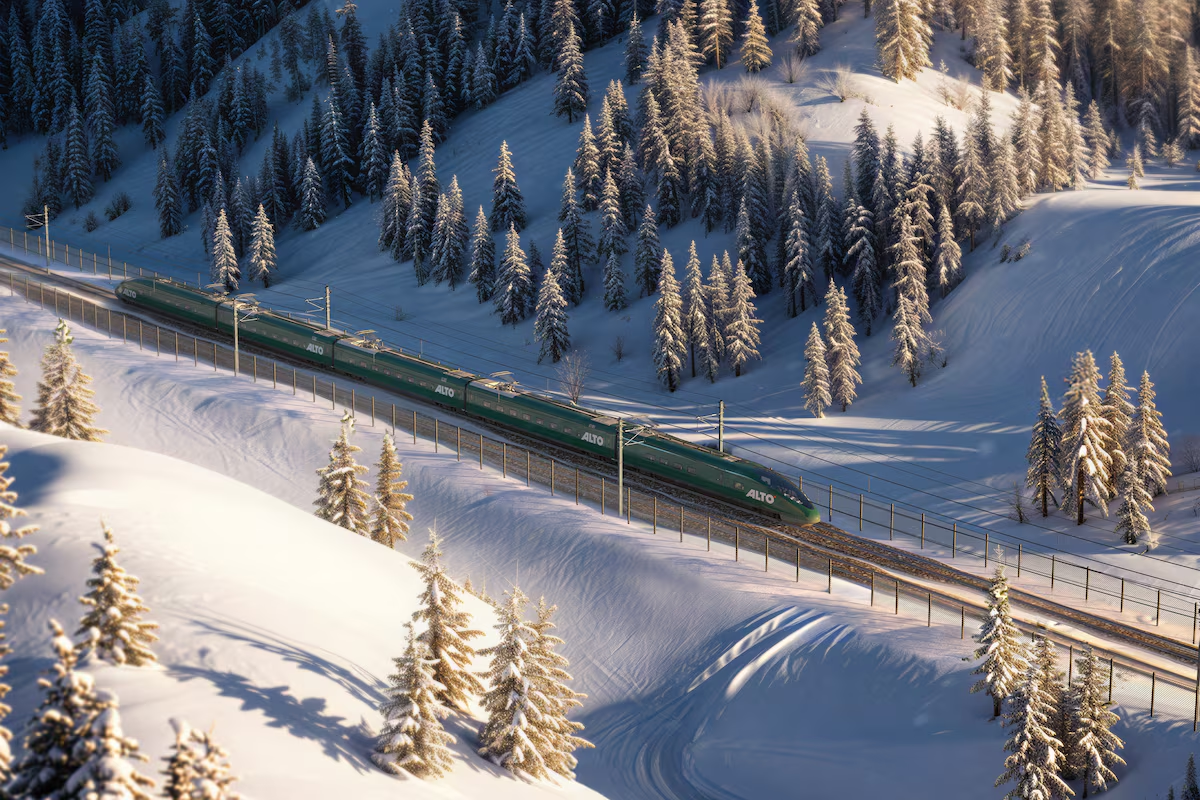

Open this photo in gallery:
A rendering of the Alto high-speed rail project.Supplied
On Monday, federal Transportation Minister Steven MacKinnon announced that he’d like to see a change in the proposed route for Toronto-to-Quebec City high-speed rail. He called for a detour through, and stop in, Kingston.
It would only add a few minutes to the journey, he told The Globe and Mail.
The chief executive officer of Alto, the Crown corporation planning the line, echoed his political master. “It may add a couple of minutes,” Martin Imbleau told the Ottawa Citizen. “It would be marginal.”
Marginal? How many extra billions of dollars would it cost? How many riders would it gain? How many would it lose?
It’s still unknown how much high-speed rail will cost. Alto spitballs the price at $60-billion to $90-billion, but cautions the figure is “for planning purposes only and should not be considered as a project budget.”
No matter; this train has an Ottawa wind at its back. Touting it as the most expensive megaproject in modern Canadian history has only added to its momentum.
Opinion: High-speed rail is the right idea, done wrong
Government by Goldman – sorry, I mean the Carney government – shouldn’t need a refresher on the fundamentals of valuing an investment. But apparently it does. So here goes:
In the private sector, where money is finite, risk-averse and choosy, you can’t make an investment decision based on a cost-benefit analysis consisting entirely of a blueskying of benefits. You have to measure costs.
Sorry, let me rephrase: You must obsess over costs. Obsessively. You must bake cost obsession into every project.
Failing to do so is how a project goes from profitability to unprofitability, and its backers go from solvency to insolvency.
In the public sector, projects always run the risk of derailment, both because of distraction by political benefits and, often, failure to ask basic questions about a project’s goals. The nightmare scenario, which should be top of mind in Ottawa, is California high-speed rail.
In 2008, voters said yes to a fast train between Los Angeles and San Francisco. Eighteen years later, only a tiny stretch of track has been laid and most of the line is still in the planning stage. But at least US$13.8-billion has already been spent.
The current goal is to complete a small section of the project by 2032, at a cost of US$36.8-billion, connecting the cities of Merced and Bakersfield.
Opinion: Canada’s high-speed train from 50 years ago has lessons for today
Where’s that? Imagine Alto announcing in 2040 that it’s only a few years and a few billion dollars away from the national dream of speedy travel between Peterborough and Napanee.
Building to Los Angeles and San Francisco will cost tens of billions of dollars more, and that’s money the state doesn’t have.
California arrived at this dead end through a combination of crushing environmental challenges, mismanagement and “it’ll only add a few minutes” political meddling.
The positive for Canada is that the barriers here are not technological. High-speed rail is old tech.
The distance between Paris and Lyon is slightly less than that between Toronto and Montreal, yet you can travel between the two French cities on the TGV in two hours flat. The train between Beijing and Shanghai, covering more than 1,300 kilometres, can make the trip in just over four hours.
Wouldn’t it be wonderful to have that in Canada? Sure. But it won’t happen unless we figure out how to do the opposite of California.
However, even with the most competent project management, Canadian high-speed rail will almost certainly need extremely large public subsidies to build, and a continuing subsidy to operate.
Alto’s $60-billion to $90-billion could be the cost even if everything goes right.
Which should leave you wondering: If you’ve got $90-billion worth of taxpayer money to spend on infrastructure, is this the best place to spend it?
Millions of travellers currently fly between the cities on the high-speed rail route. How many public dollars subsidize their flights? None. Our airlines, airports and air traffic control system all operate on user pay. Airports even pay rent to Ottawa.
How many taxpayer dollars should we spend to shift some of those travellers to trains? That’s not a rhetorical question.
Last year, Via Rail carried 4.4 million passengers. Is the benefit of moving them faster, and enticing several million more people to do intercity travel by train, worth $90-billion?
Every weekday in Toronto, 2.5 million trips are made on the Toronto Transit Commission. Montreal’s main transit agency delivers 1.7 million trips a day. In Greater Vancouver, Translink delivers 1.2 million rides a day.
If we want to deliver the greatest benefits to the greatest number of people, wouldn’t urban public transit be a better place to invest $90-billion? The economic returns would surely be higher. Ditto the political returns.