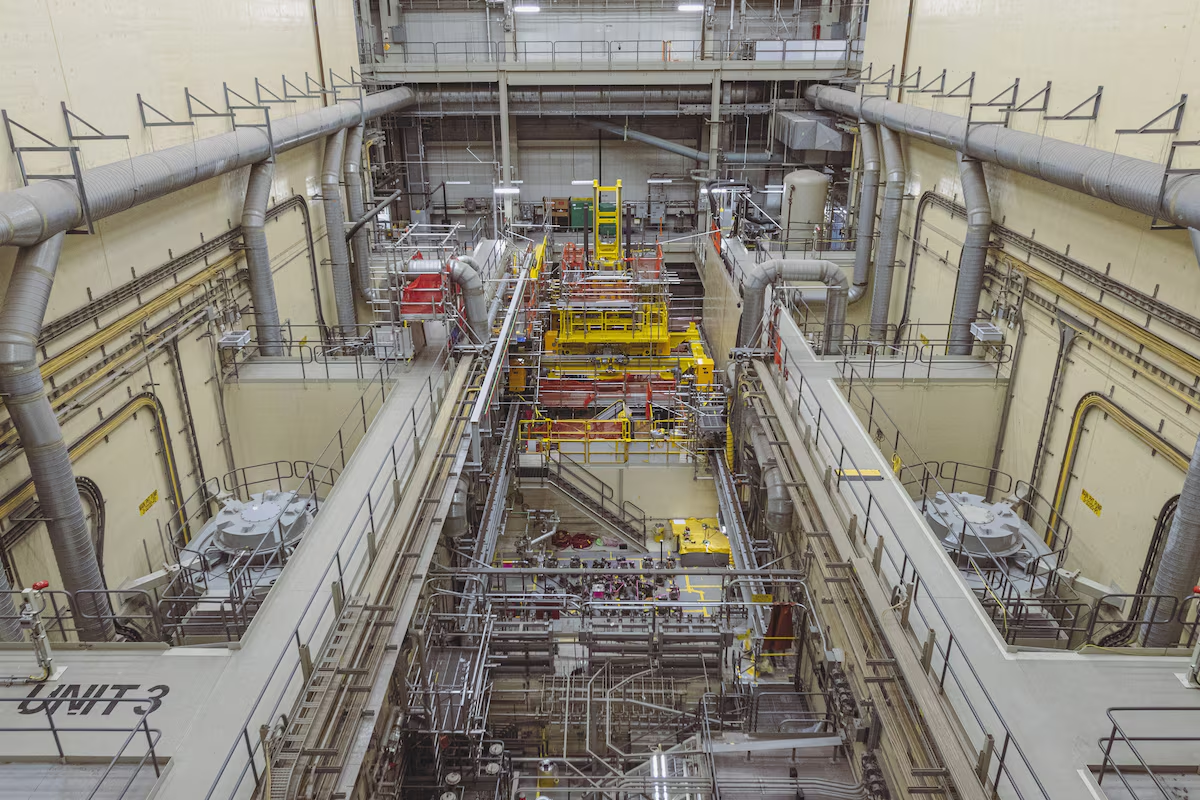
Open this photo in gallery:
A view of Darlington Nuclear Generating Station in Courtice, Ont., in May, 2023.Carlos Osorio/The Globe and Mail
Two of four reactors at Ontario’s Darlington Nuclear Generating Station have been out of service for prolonged outages, after the completion of a 10-year refurbishment that provincial officials have repeatedly characterized as an unqualified success.
The station’s reactors were refurbished between October, 2016, and early March, when the final unit returned to service. Ever since, station owner Ontario Power Generation and the provincial government have told the public that the project was completed four months ahead of schedule, and $150-million under its $12.8-billion budget.
Refurbishments of nuclear power stations are complex undertakings, requiring utilities to make crucial judgments about which components can remain fit for continued service for decades to come, and which ones must be replaced. The resulting outages and maintenance costs could significantly increase charges on Ontarians’ power bills.
According to data from the Independent Electricity System Operator, Darlington Unit 4 stopped producing electricity on April 11, roughly a month after it returned to service. A report from the Canadian Nuclear Safety Commission, the federal regulator, attributed the shutdown to “indications of a hydrogen leak in the generator stator cooling water (SCW) system on the secondary, non-nuclear side of the station.”
Ontario’s proposed nuclear plants could cost nearly $300-billion, study finds
Last month, OPG told The Globe and Mail in a statement that repairs on Unit 4 had been completed, and that it was scheduled to return to service by early June. IESO data show that the unit returned to service on May 26, and operated near full capacity for more than two weeks. However, it went offline again on June 10, and has generated no power since.
Last month, in a filing to the federal nuclear regulator, OPG reported that the four Darlington units “are all operating at full capacity following their successful refurbishment.” Earlier this month, OPG asserted in a final report on the Darlington refurbishment that, as of March 31, there had been “no loss of generation or impact to the schedule due to quality-related issues.”
The IESO had previously expected the unit to resume generating power in June. It declined to answer questions from The Globe for this story, contending OPG was “better suited” to respond.
OPG declined an interview request for this story. “Unit 4 was taken offline for electrical work that was unrelated to its recent refurbishment, and is expected to return to service in the next few days,” spokesperson Neal Kelly wrote in a statement.
Ottawa, Ontario to announce joint Indigenous loan guarantee for new Darlington nuclear reactors
In a statement for the federal regulator, spokesperson Braeson Holland said the commission was notified on June 10 of the outage, which was to repair electrical equipment. The repairs are complete, he added, and the unit is being returned to service.
Unit 3, which returned to service in July, 2023, after its own refurbishment, went offline on March 30 for a planned outage scheduled to last 230 days, to repair its steam generators.

When refurbishing a nuclear power plant, utilities must decide which components to repair or replace, and which ones remain fit for service. Misjudgments can lead to future outages and significant additional costs. OPG’s recently refurbished Darlington station requires additional major work, including on steam generators and turbines.
matthew mcclearn and john sopinski/the globe and mail,
Source: Canadian Nuclear Association; OPG

When refurbishing a nuclear power plant, utilities must decide which components to repair or replace, and which ones remain fit for service. Misjudgments can lead to future outages and significant additional costs. OPG’s recently refurbished Darlington station requires additional major work, including on steam generators and turbines.
matthew mcclearn and john sopinski/the globe and mail,
Source: Canadian Nuclear Association; OPG

When refurbishing a nuclear power plant, utilities must decide which components to repair or replace, and which ones remain fit for service. Misjudgments can lead to future outages and significant additional costs. OPG’s recently refurbished Darlington station requires additional major work, including on steam generators and turbines.
matthew mcclearn and john sopinski/the globe and mail,
Source: Canadian Nuclear Association; OPG
Each reactor at Darlington has four steam generators, for a total of 16. In the refurbishment’s early years, senior OPG officials deemed them to be in “excellent condition” after inspections, fit for 30 more years of additional service. But OPG later discovered that components inside the steam generators known as primary moisture separators, which provide dry steam to the station’s turbines, had deteriorated and needed replacement.
According to OPG reports, all moisture separators in Units 1 and 4 were replaced during the refurbishment. Additionally, they were replaced in two of Unit 3’s steam generators in 2023. Last year, OPG’s board of directors approved the replacement of the remaining moisture separators for Units 1 and 3, with a budget of more than $250-million.
More costly work lies ahead at Darlington. According to filings, OPG is planning major outages beginning in 2029 to replace turbine rotors, expected to cost $2-billion for the first three units. (Rotors on the fourth must also be replaced.) OPG said that work is required to “prevent the risk of failure over the remaining station life.”
Further work includes replacing components at Darlington’s Tritium Removal Facility ($253-million), upgrades to Unit 2’s turbine control and auxiliary system ($115-million) and rewinding the generator stator on Units 1 and 2 ($300-million).
“Per standard operating procedure, OPG regularly takes outages to perform maintenance activities of its nuclear fleet to meet regulatory commitments,” Noah Mawji, a spokesperson for Ontario Energy Minister Stephen Lecce, wrote in a statement.
“As electricity demand continues to surge, our government is ensuring Ontario has the power to attract investment, build more homes, create better jobs, and keep our economy growing.”
In a recent rate filing, OPG sought substantial increases to payments it receives for the power its two nuclear stations generate. If approved by the Ontario Energy Board, this could contribute to higher power bills for Ontarians.
Darlington’s units generally performed well after refurbishment, according to a Globe analysis of data from the International Atomic Energy Agency. Unit 2, the first at the station to be refurbished, had a capacity factor of 85.3 per cent between returning to service in June, 2020, through the end of 2025. Capacity factor, an important metric for reactor performance, expresses how much electricity is generated in a given period relative to its theoretical maximum, had it operated at full power without interruption.
New Brunswick Power’s Point Lepreau station, the first Candu station to be refurbished, has performed far worse than its peers since returning to service in 2012. NB Power has admitted that one reason is that it didn’t do enough work on the station’s non-nuclear side.
Ontario’s electricity demand typically peaks on the hottest days of the year, as residents rely on their air conditioners. Even so, Darlington’s outages are not expected to lead to shortfalls. In a seasonal update published June 18, the IESO said the province has an adequate supply of electricity to meet anticipated demand this summer, even under extreme conditions.
Four units at Ontario’s Pickering Nuclear Generating Station are scheduled to go offline in September. Mr. Lecce ordered the refurbishment of those units, collectively known as Pickering B, last November, with a budget of $26.8-billion.