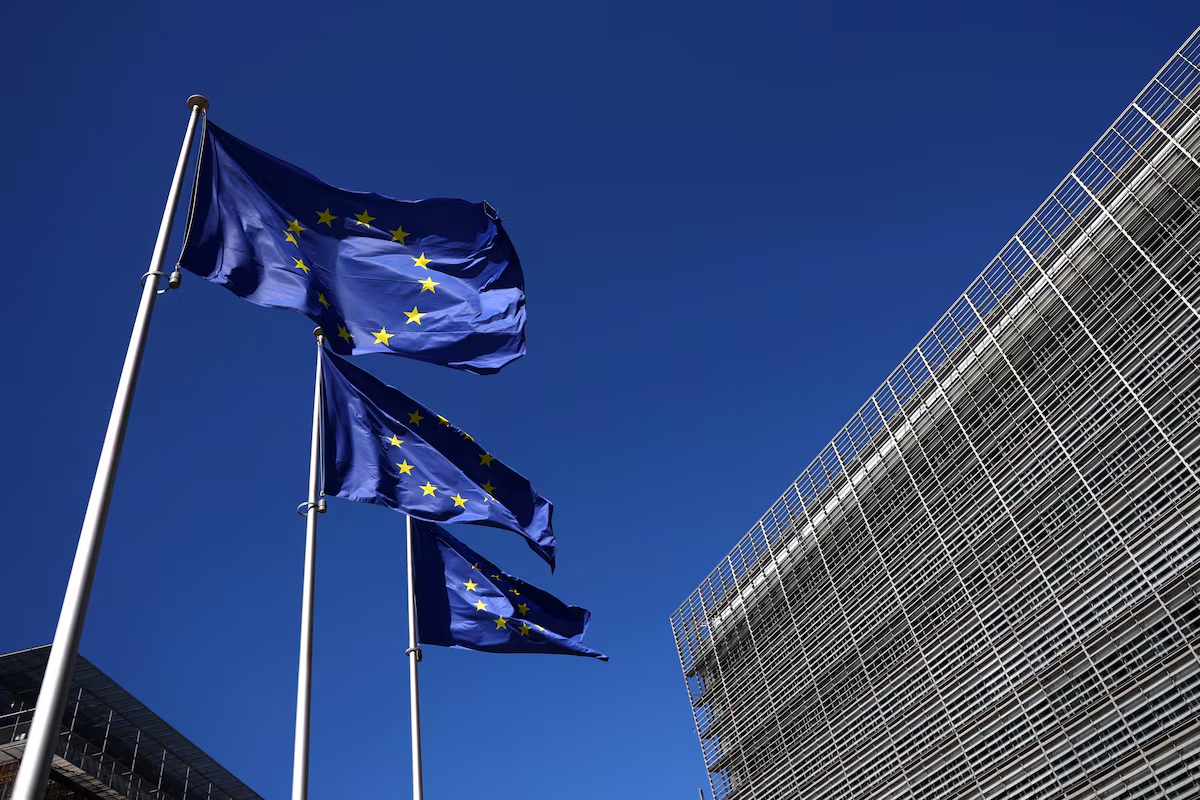

Open this photo in gallery:
European Union flags flutter outside the European Commission headquarters in Brussels on April 29.Yves Herman/Reuters
As Europeans swelter in the ferocious heat, they can take some comfort in knowing that the fitful re-opening of the Strait of Hormuz is freeing up vast quantities of oil and natural gas supplies. Prices for both are falling fast. The cost of electricity required to work air conditioners flat out should soon decline.
The Hormuz energy crisis seems to be ending. But the European Union and its biggest economies are adept at creating new crises to replace old ones. Sure enough, another is forming. The EU’s new Methane Regulation is kicking in and U.S. suppliers of liquefied natural gas (LNG), which have taken over the EU market, are whining loudly that they can’t meet the new rules anytime soon. They are threatening to send their LNG elsewhere.
If past experience on the energy is anything to go by, the EU will botch the methane file to guarantee that household and industrial energy prices remain among the world’s highest. EU and national energy policies have had a long, sorry history of working against the common good.
Let’s start with Germany, the industrial powerhouse that is losing its competitive edge because of high energy prices. Its first mistake came about 25 years ago, when then-Chancellor Gerhard Schroeder, a fan of Russian President Vladimir Putin, launched a campaign to make Germany wholly dependent on cheap Russian gas. His successor, Angela Merkel, doubled down on this strategy.
2023: The energy crisis that wasn’t: How Europe escaped the worst of Russia’s natural gas war
With their endorsement, two pipelines – Nord Stream 1 and Nord Stream 2 – were built across the Baltic Sea to take gas from Russia to Germany and beyond. German factories loved the Kremlin’s bounty. What could go wrong? The Russian invasion of Ukraine is what went wrong. Mr. Putin stopped sending gas through Nord Stream 1 and Germany blocked the commissioning of Nord Stream 2. German gas prices rose 1,000 per cent at one point. The lights went out in some energy intensive businesses.
Germany made a bad situation worse by not reversing Ms. Merkel’s decision, made in 2011, to shut down the fleet of nuclear power stations, which had been operating safely for decades and had generated almost a third of the country’s electricity without spewing out greenhouse gases. The last three plants closed in 2023 even as German industry was getting crippled by atrocious energy prices. Their closure ranks as one of Europe’s greatest acts of self-inflicted industrial sabotage.
The EU’s effective fracking ban added to the trading bloc’s woes. The EU does not specifically ban fracking – injecting high-pressure fluids to crack shale rock to allow the release of trapped oil and gas. But heavy regulations discourage it and some countries outright prohibit it. The drilling technique that turned the U.S. into an energy superpower and exporter does not exist in the EU, making it ever more dependent on foreign supplies.
Which brings us to U.S.
The Nord Stream pipelines were blown up in September, 2022 – culprits unknown – and probably will never reopen, thrilling U.S. LNG producers. They quickly filled the demand gap and, according to Bloomberg, now account for 59 per cent of the EU’s LNG market. Over-reliance on one supplier is always risky, especially under President Donald Trump, who seems to relish outraging his allies.
That’s one problem. The other is the EU’s new methane rules.
Methane is a highly potent greenhouse gas that makes up the vast majority of LNG. The production of oil and gas releases huge amounts of methane, mostly on purpose. Unwanted amounts are “flared,” meaning the methane is burnt as it is emerges from the ground, creating carbon dioxide; other amounts are simply “vented,” meaning the methane is spewed in raw form into the atmosphere.
A new World Bank report says that the amount of gas flared alone is on the rise and, in 2025, was equivalent to Africa’s entire gas consumption. That’s a lot of money – and heat – flung into the air. No surprise that Brussels wants to bring down the methane footprint of LNG imports, all the more so since Europe is warming at twice the global average rate.
The regulations do not specifically place a methane cap on imports. They outline a series of ever-tighter regulations that require gas (and oil) importers to report methane emissions from production and disclose methane intensity based on a methodology that has yet to be published. By 2030, imports must ensure methane emissions meet a threshold set by Brussels or face severe fines.
The Natural Gas Supply Association and the Center for LNG, two U.S. gas industry trade and lobby groups, say they cannot possibly meet the regulations and that exporters may send their gas elsewhere unless Brussels backs down. The gas producers may not be bluffing – the appetite for LNG in China, India and elsewhere is voracious.
Canada sees opportunity to further grow LNG and food exports to Asia
Knowing that it has little negotiating leverage, since the EU can’t live without American gas, Brussels recently backed down a bit by promising not to enforce the methane penalties for another three years. But the delay doesn’t kill off the problem. The EU is overly reliant on U.S. gas and U.S. producers can sell anywhere. This scenario will end in tears at some point.