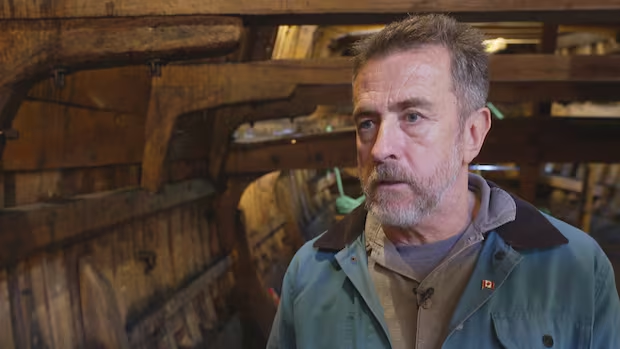
Xabier Agote has to push past people lined up to get on board the San Juan, tied up next to the dock in Pasaia, in Spain’s Basque country.
This is the first time the replica of a 16th century Spanish galleon is open for tours and it’s a popular attraction. Tickets sold out within hours.
“It’s fantastic,” he says as he walks over the metal gangplank and steps on board. “The more people [that] come, the happier I am.”
WATCH | The rebuilding of the San Juan:
Canada’s connection to a replica 16th-century Spanish ship
The San Juan is an exact replica of a Basque ship that sank hunting whales off the coast of Labrador in the 1500s. For The National, CBC’s Peter Cowan went to Spain to explore the rebuilding of the ship and how its reestablishing a connection with Canada.
Building this ship has been Agote’s life’s work.
“Since I was a child I was obsessed with the sea. I loved wooden boats,” he said. “I decided to learn boat building to be the one that would rebuild the heritage boats of the Basque culture.”
The original San Juan was built in the same harbour, 500 years ago.
It travelled to Canada with a crew of 60 to hunt whales off the coast of what is now Labrador.
It was North America’s first oil boom — the whale oil lit the lamps of Europe.
“It didn’t smell bad or didn’t stain the walls,” said Agote. “The Basques were the only ones providing this oil. So they made lots of money, assuming huge risk.”
 The San Juan opened to the public for the first time at the Pasaia maritime festival. Tickets sold out within hours. (Ousama Farag/CBC)
Part of history long forgotten
The history of the Basque presence in North America was forgotten for hundreds of years, and only came to light thanks to work by Canadians.
Selma Huxley Barkham was a British-Canadian amateur historian who changed that.
The history books only talked vaguely of Basque fishermen coming to North America but she knew there had to be more.
She moved her family from North America to the Basque country and dug through old legal documents.
Her son Michael Barkham has continued his late mother’s research.
“We were really dragged along to these archives,” said Barkham.
One power of attorney from the 1560s mentioned the whaling ship the San Juan, which had gone down in a storm, in the port of Buttes, in Terra Nova, as the Basques called what is now Newfoundland and Labrador.
“It gave the name of a ship. And secondly, the key in terms of locating it, it gave a port in North America, he said.
“I mean, that’s quite amazing, a port in North America. But she had to figure out where it was.”
 Selma Huxley Barkham was a self-taught historian who used old insurance contracts and other legal documents to locate the wreck of the San Juan in southern Labrador. (Submitted)
Rediscovering the San Juan
When they arrived in Red Bay, Labrador, they knew they were in the right spot.
Red tiles lined the shoreline, remnants of the red Spanish roofing tiles the Basques brought with them as ballast in the ships.
“This was clear evidence,” said Barkham. “That was the big eureka moment, finding proof, archaeological proof, of the historical record.”
Growing up in Red Bay, Philip Bridle used to use the flat red tiles to skip across the water. People dug them up in the garden and threw them out.
“It was a nuisance,” said Bridle, who today works as an interpreter at the historical site in Red Bay. “Only years later we realized…those were pieces of history that they were throwing out.”
But the real treasure was still to be discovered underneath the icy waters of the Atlantic.
 Historian Michael Barkham (left) and Ramón Martín, who heads the provincial archives in Gipizkoa, review some of the old documents detailing Basque whaling activities in what is now Canada. (Peter Cowan/CBC)
Selma Barkham’s research led underwater archaeologist Robert Grenier and a team from Parks Canada to a spot in Red Bay.
“The San Juan was especially well preserved, you know, like no other 16th century ship ever found,” said Agote. “That was very important because the San Juan provided them with the opportunity to understand 16th century deep oceanic technology.”
Each of the 3,000 pieces of the ship were carefully documented, and with decades of further research, it came together.
Basque shipbuilders never wrote down the plans; they were passed down through generations.
But armed with this new blueprint, Agote began to rebuild the ship, and rediscover old techniques.
“Canada has given us the best gift we could ever get, which is the gift of oceanic technology knowledge, that we lost completely” he said.
 Xabier Agote first learned traditional boat building in the United States, but his dream was always to rebuild Basque wooden ships. (Submitted by Xabier Agote)
Rebuilding Basque-Canada relations
That’s why Canada was the guest of honour at Pasaia’s maritime festival.
Boatbuilders and Indigenous leaders came over to chart a new course for relationships that first started 500 years ago.
When the Basque whalers came to Labrador to hunt whales, they met Innu and Inuit.
What we know about that relationship comes from European diaries.
Michael Barkham says there were good relations with the Innu.
“The accounts say they come aboard our ship and we eat and drink and barter goods,” said Barkham.
But with Inuit there was often conflict.
“The records say that the relations with the Inuit were were hostile,” said Barkham, with Europeans talking of attacks with bows and arrows.
 Nunatsiavut president Johannes Lampe says an apology from the Basque Country or Spain for the negative effects of European contact would help with reconciliation and building a new relationship. (Ousama Farag/CBC)
As the president of Nunatsiavut, Johannes Lampe represents Inuit in Northern Labrador.
He came to Spain to meet Agote, see the ship and learn about this shared history.
He says colonization has been hard on Inuit. It introduced alcohol and diseases.
“I believe those things are evidence enough for Europeans and the Basque and the Spanish too, certainly through discussion, to come up with an apology to Indigenous groups in Canada and most certainly the Labrador Inuit.”
Along on this trip is also a traditional kayak builder and paddler.
Noah Nochasack has the frame of an Inuit kayak with him. He’s sharing his own knowledge.
Like Agote, building traditional boats is a way for him to stay connected with his past.
“I wanted to have more in common with the people like my ancestors who are building kayaks,” he said.
This trip is also a chance to learn from others who share the drive to keep maritime traditions alive in the present.
“The passion that the other boat builders have is, is quite amazing,” said Nochasack.
 Using the frame of a traditional kayak, Noah Nochasak teaches people at Pasaia’s maritime festival about Inuit boatbuilding. (Peter Cowan/CBC)
Returning to say thank you
For Agote, that’s a key part of the rebuilding journey.
“We also want to replicate or at least retrieve the human relationships that were established many centuries ago that, you know, were forgotten,” he said.
At the cultural factory along the edge of the harbour in Pasaia, crews still have a lot of work to do to finish the ship.
Blacksmiths are hammering out an anchor. Carpenters are turning large logs into yardarms to hold the sails. But the next part of the San Juan’s story may be the most challenging.
“I have imagine lots of time what it would be like going to Canada on this ship,” said Agote.
He’ll get to find out for himself very soon.
 At the Albaola cultural factory, boat builders use traditional techniques to build wooden boats. (Peter Cowan/CBC)
In 2028, he plans to make the voyage from Pasaia to Red Bay, just as the Basques did 500 years ago.
Almost everything will be authentic, the sails, the rope, even the clothes people will wear. There’s no engine. They’ll even navigate using traditional instruments, with a GPS as backup.
“I know that I’m going to become a 16th century man,” said Agote.
“Its very different to experience history, he said.
“I’m sure that many new things will come to my mind, things that the writers, that the historians, never thought about.”
Download our free CBC News app to sign up for push alerts for CBC Newfoundland and Labrador. Sign up for our daily headlines newsletter here. Click here to visit our landing page.