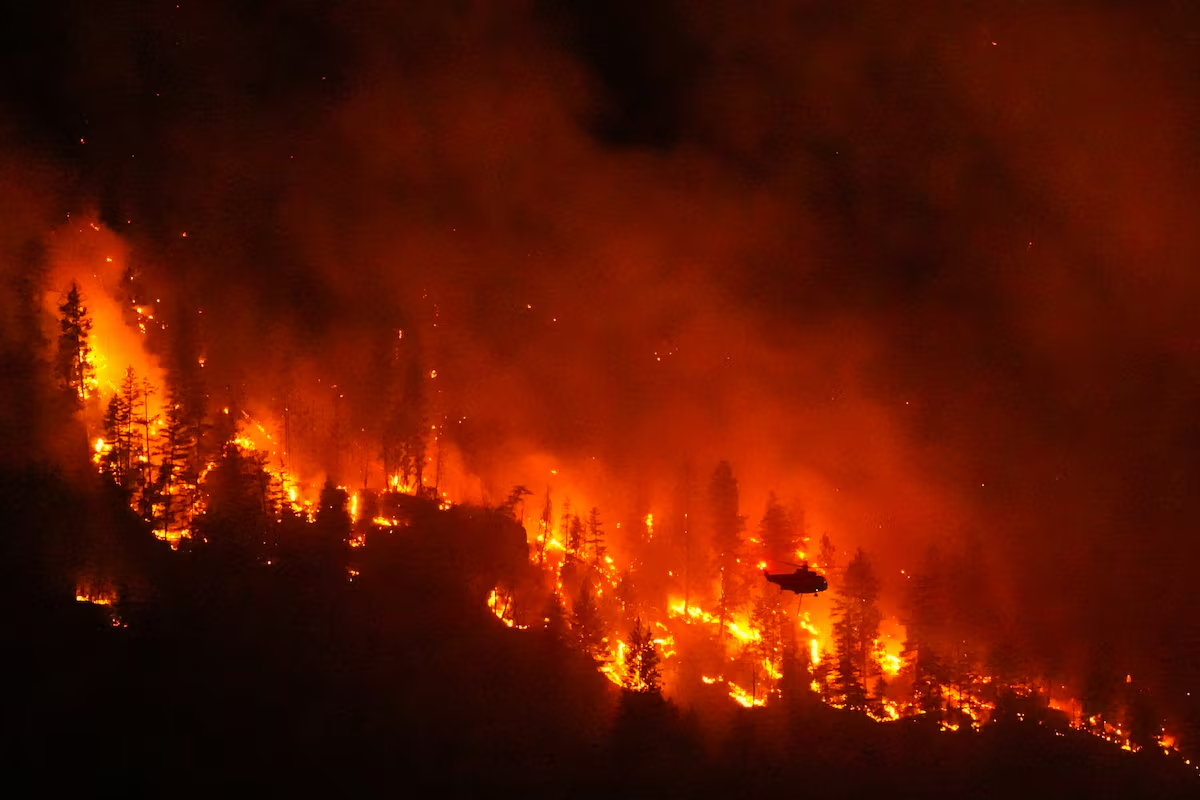

The scale of Canada’s wildfire seasons is told through a familiar accounting each summer: the total fire count, the control status of active blazes, the total area burned, the number of evacuation orders and the tally of structures lost.
The figures convey the immediate danger of encroaching blazes and the destruction they have wrought. Yet these figures, while important, fail to capture the human experience of a modern wildfire season, researchers say.
Even Canadians living far from the flames can spend weeks breathing in hazardous smoke, missing work, cancelling outdoor activities and experiencing stress and anxiety.
Climate change, driven largely by the burning of fossil fuels, is also transforming the frequency and intensity of wildfires – and with it, the way that Canadians experience them.
The Globe and Mail spoke with three researchers on the metrics they would like to see included when assessing the true toll of Canada’s wildfire seasons. They argued for a broader accounting that captures the health effects of wildfire smoke, the mental-health toll that can reach far beyond fire zones and the impact on First Nations communities.
Red, black and yellow skies have been an unsettling sight in the B.C. Interior in recent weeks, but many more parts of Canada have been hit by wildfire smoke over the summer.
Paige Taylor White/Reuters
Smoke exposure
In the summer of 2008, a lightning storm in Northern California triggered a series of wildfires that blanketed a large and populated region of the state in smoke for weeks. At a primate research centre on the University of California Davis campus, infant rhesus macaque monkeys housed in an outdoor enclosure were exposed to 10 days of wildfire smoke.
Researchers who tested the monkeys three years later found reduced lung size and immune dysregulation – particularly in the female monkeys – compared with a control group.
A separate study found that pregnant rhesus macaque monkeys that were exposed to wildfire smoke gave birth to infants with greater inflammation, a blunted cortisol response, more passive behaviour and increased memory impairment compared with animals conceived after the smoke had dissipated.
Sarah Henderson, scientific director of environmental health services at the BC Centre for Disease Control (BCCDC), cited the research in arguing that smoke exposure should play a larger role in how Canada measures the effects of a wildfire season.
“Obviously, monkeys aren’t humans, and we don’t keep our babies outdoors in cages,” she said in an interview. “But there are lessons to be learned here that these exposures – especially in early life – are not innocuous.”
Open this photo in gallery:
Exposure to wildfire smoke can cause headaches and shortness of breath. Fine-filter masks such as N95s can help against small particles of smoke, but not noxious gases.Darryl Dyck/The Canadian Press
Dr. Henderson, who has studied the effects of wildfire smoke for more than two decades, said key metrics when considering the widespread health effects and associated costs of wildfire disasters include the number of smoky days that people experience, the magnitude of that smoke and how those exposures compare with what people would have experienced in a summer without wildfires.
While research on the long-term effects of wildfire smoke on humans is limited, there is a growing body of evidence linking it to an increased risk of chronic conditions such as asthma and dementia, as well as adverse birth outcomes like low birth weight. Short-term effects include headaches and shortness of breath, as well as eye, nose, throat and sinus irritation.
A Canadian study published in July in the medical journal JAMA found that wildfire smoke was associated with a 6-per-cent increase in emergency department visits for migraines and other headache-related syndromes.
Dr. Henderson said publicly available data on wildfire smoke can better inform public health messaging. More detailed, real-time information on exposures – including those that may not be obvious – could inform advisories urging people not only to stay indoors and close their windows, but to run air cleaners to keep indoor spaces as smoke-free as possible, she said.
Her team at the BCCDC recently submitted a proposal to Environment and Climate Change Canada to develop a national dashboard that would allow people to see data on wildfire smoke in their area, and what to expect in the future.
“Wildfire smoke is seen as a nuisance compared with the direct threat of wildfire, and we have to move beyond that,” Dr. Henderson said. “It’s not just a nuisance; it’s another facet of the wildfire disaster.”
Health Canada collects some data to inform its wildfire-related messaging. The national Air Quality Health Index (AQHI), a program it jointly manages with Environment and Climate Change Canada, provides information on air quality, including when wildfire smoke is present, and issues protective advice.
The department commissions public surveys to measure and report on the percentage of people who receive the department’s health warnings related to the AQHI, and those who change their behaviour to avoid exposure to air pollution. It then uses this information to inform its public messaging and approach to advisories. The most recent results, published in 2021, found that 42 per cent of Canadians had taken action to reduce their exposure. Caregivers (52 per cent) and those with chronic respiratory conditions (50 per cent) were most likely to act, but seniors less so (44 per cent). An update is expected later this year.
“Health Canada continues to assess approaches to better measure the health impacts of wildfire smoke and to share this information publicly,” Health Canada spokesperson Mark Johnson said in an e-mail.
A new analysis by environmental economist Dave Sawyer estimates the annual cost of wildfire smoke in Canada to be $19-billion, with visible, acute costs such as emergency department visits and cancelled days of work representing less than 3 per cent of the total burden.
But for every dollar of visible acute smoke damage, another $43 is attributed to long-term health issues and premature death as a result of exposure to elevated wildfire smoke over time, Mr. Sawyer wrote for the Canadian Climate Institute.
A Health Canada study of wildfires from 2013 to 2018 estimated the annual cost of their smoke-related health effects to be between $5-billion to $21-billion, with fire severity and proximity to high-population areas driving the wide range.
Open this photo in gallery:
The wildfires have been especially stressful for people uprooted from their homes, like these evacuees in Vernon, B.C.Darryl Dyck/The Canadian Press
Mental-health effects
One of the least visible consequences of wildfires may be their effect on mental health. Soodeh Saberian, Canada Research Chair in Economics of Climate Change, Disasters and Inequality at Thompson Rivers University, investigated the topic with Janet Currie, a professor of economics at Yale University. They found that even people hundreds of kilometres away from smoke or flames have experienced increased mental-health hospitalizations, particularly for anxiety and substance-related disorders.
In a working paper published in June, 2025, the researchers said while most studies on the mental-health effects of wildfires focus on exposure to smoke, they found additional measurable effects related to evacuation orders, costs and distress about climate change.
These factors can worsen the mental health of susceptible people who live far from a fire, the research found. People with pre-existing health conditions that make them vulnerable are especially affected, as are the elderly.
“It’s not just about smoke exposure or evacuation risk,” Dr. Saberian said in an e-mail to The Globe. “There seems to be a real psychological toll just from reading about it; a kind of climate anxiety that’s distinct from physical exposure.”
The working paper said wildfire-related mental-health hospitalizations cost about $39.4-million annually in the 119 census divisions the researchers examined, accounting for 70.8 per cent of the Canadian population. The true burden of wildfire on mental health is likely much higher, it said.
“The common thread is that our existing metrics were built for property and logistics, not for population health and economic well-being, Dr. Saberian said. “So a season can look moderate by area burned and still be severe on this second dimension.”
Disruptions to First Nations
Tara McGee, a professor in the department of earth and atmospheric sciences at the University of Alberta, highlighted the significant social and cultural disruptions that wildfires can cause.
Her research has explored the disproportionate impact of wildfires on First Nations, of which 60 per cent are located along the wildland-urban interface. During evacuations, family members in remote northern or fly-in communities can sometimes be sent to different host cities, with the separation severing social support networks, Dr. McGee found. The disruption of traditional land-based activities also exacerbated the distress of displacement.
As well, few First Nations have up-to-date emergency plans tailored to their communities, which has led to logistical chaos and delayed responses during evacuations.
Open this photo in gallery:
‘My members barely escaped with the clothes on their backs. My community was left to evacuate without notice and support,’ Chief Helen Paavola said of the fire at Collins First Nation, accusing federal and provincial monitors of failing to warn them.Chris Young/The Canadian Press
Better tracking of the duration of evacuations and displacements, the distance that evacuees must travel and the number of evacuees who are not able to return home after evacuation orders have lifted would help to illustrate the enduring effects of a wildfire, she said.
More media coverage of a community’s recovery in the years after a wildfire would also help inform the public of its progress, Dr. McGee said.
“There’s sort of a myth that when communities go back, everything’s finished, whereas certainly the social and economic impact of evacuations on communities can extend for quite a long time,” she said.
Natural Resources Canada maintains a database on the number of evacuations and evacuees, evacuation duration and impact on Indigenous communities each year. However, data on the current fire season are used for internal reporting and emergency operations, and are not made publicly available. And figures are approximate, as the database relies largely on agency-reported evacuation data.
Indigenous Services Canada collects First Nations wildland fire and flood evacuation statistics, including long-term evacuations, defined as lasting for more than 60 days. Preliminary figures for April 1, 2025, to March 31, 2026, the most recent data that are available, show that there were 52 short-term and 21 long-term First Nations evacuations across Canada because of wildfires.
Where there’s smoke: More from The Globe and Mail
The Decibel podcast
First Nations spent centuries managing forests with fire, though their practices were suppressed in much of Canada. Is it time to rethink that? Anishinaabe scholar Riley Yesno spoke with The Decibel about the history and politics of shaping the landscape. Subscribe for more episodes.
The bigger picture
Inside the early battle against the Bald Range wildfire
Okanagan fires offer a glimpse of a worsening wildfire crisis
When wildfires struck, B.C. ranchers called the cowboy cavalry