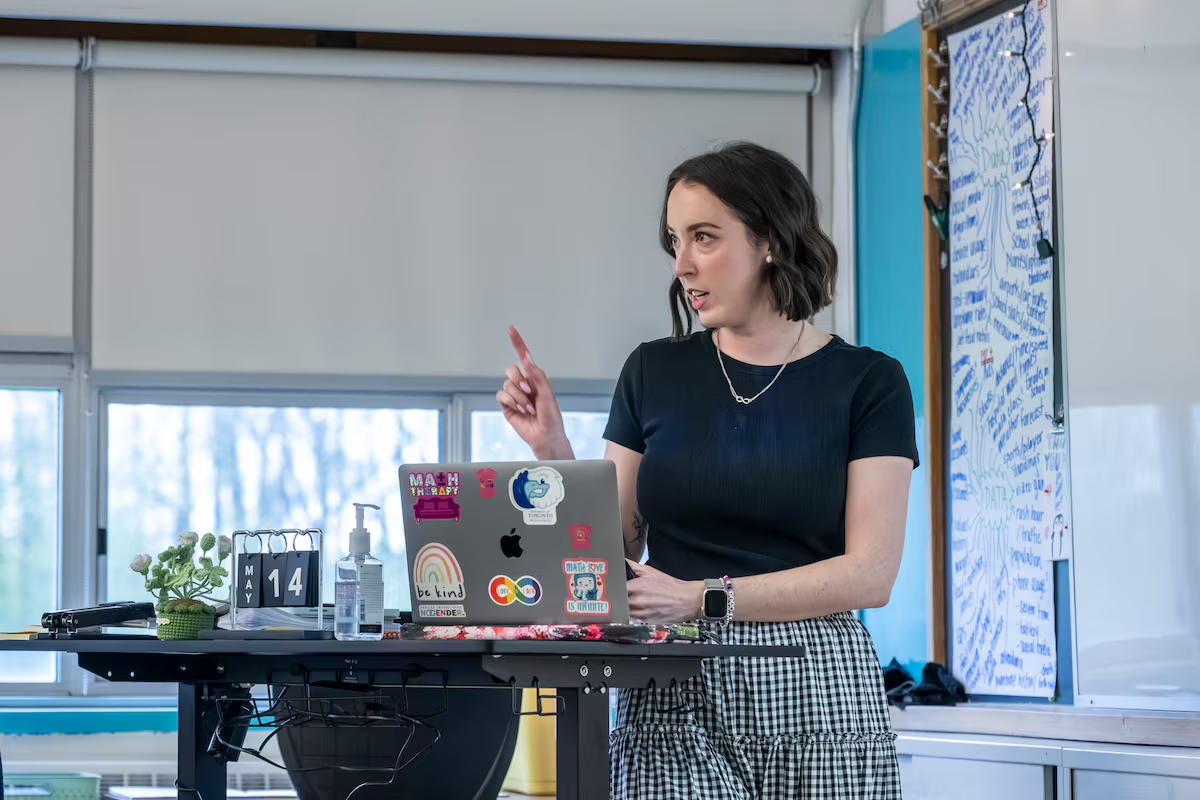

Open this photo in gallery:
Jacqueline Boutilier teaches a Grade 9 math class at Milton District High School, on May 14.EDUARDO LIMA/The Globe and Mail
It’s a sunny spring morning and the Grade 9 math students at Milton District High School, in the Halton District School Board, just west of Toronto, are seated in straight rows facing the blackboard.
Math teacher Jacqueline Boutilier hands out the results of the latest assignment, puts the students into groups of twos and threes, and sends them to whiteboards along the sides of the classroom.
The groups talk through how to create graphs of their rankings of 12 movie genres, from most favourite to least, to see how they compare.
There are no glazed eyes staring out the window. No one is idly doodling in their notebook as the teacher drones on.
Instead, there is engaged conversation throughout the room as concepts such as outliers, extrapolation, correlation and pattern recognition begin to sink in.
As opposed to the rote learning model that has long defined math class, this new approach has students talking through problems together in small groups while a teacher offers guidance.
Open this photo in gallery:
Students work on math at Milton District High School during class with Ms. Boutilier (not pictured). At the Halton District School Board, 74 per cent of Grade 9 students met the provincial math standard, putting it among the highest-achieving boards in Ontario.EDUARDO LIMA/The Globe and Mail
It has helped the Halton school board achieve some of the highest standardized test scores in Ontario. Its success may very well be a model for the advisers appointed by the Ontario Ministry of Education in December to review the province’s approach to standardized testing.
“These are just highly engaging pieces for kids who aren’t going to be receptive to the way you and I learned, which would have been in a desk in a row and very rote,” said Nick Frankovich, the Halton school board’s superintendent of education who oversees K-12 math.
The Education Quality and Accountability Office, an arm’s length agency of the provincial government, tests students in Grades 3 and 6 every year in reading, writing and math. In high school, Grade 9 students are tested in math and Grade 10 students take a literacy test.
The latest results, released last December, found half of Grade 6 students and 42 per cent of Grade 9 students in English-language schools did not meet the provincial standard for math in the 2024-2025 school year.
However, at the Halton District School Board, 74 per cent of Grade 9 students met the provincial standard, putting it among the highest-achieving boards in Ontario. For Grade 6, 62 per cent met the standard.
Opinion Newsletter
Keep your opinions sharp and informed with a helpful summary of The Globe’s most provocative columns, covering politics, world affairs, business, arts, health and the way we live
Unsubscribe any time. By signing up, you will be subject to our Terms and Conditions. See our Privacy Policy. Learn more
Already have account? Log In
Those results are the product of work to create a culture of math proficiency that goes back at least 10 years, Mr. Frankovich said.
Building that culture has included understanding teachers’ needs, investing in targeted professional development and designing classrooms to promote engaged, active learning.
The board regularly surveys teachers to determine what professional development they may need, and then invests in whatever instruction is required, Mr. Frankovich said.
“We’re not just picking PD that we think is important, we’re picking the PD that teachers see as their next step in their professional learning. That piece has been huge,” he said.
The board has also created professional development sessions for teaching math to students with individual education plans, who often have learning challenges and tend to do worse on standardized math tests than their peers.
The commitment to frequent and targeted professional development likely explains much of the board’s success, said Daniel Ansari, a professor at the University of Western Ontario’s Faculty of Education, who studies how children acquire math skills.
“We know that from international comparison studies that teacher confidence in teaching math is so important,” he said.
Open this photo in gallery:
Halton District School Board’s success may very well be a model for the advisers appointed by the Ontario Ministry of Education in December to review the province’s approach to standardized testing.EDUARDO LIMA/The Globe and Mail
The Halton board’s focus on math goes all the way down to the physical layout of classrooms, and a teaching philosophy that gets students thinking on their feet. As the students at Milton District High School work on their graphs, Ms. Boutilier moves about the room, asking as many questions as she answers.
“It builds a community,” she said after the class. “With math, I’ve always thought it’s not just what you think, you learn from hearing how other people are approaching it, because math isn’t just ‘You have to do it this way!’ ”
In education terms, this is a model of teaching known as “the guide on the side,” in which the teacher acts more as a facilitator among actively participating students, instead of the model many of us grew up with, in which students sit passively taking notes while a teacher lectures from the front of the room – the “sage on the stage” model.
“It makes it a lot more engaging, and it also makes it a lot more fun,” said Marko Aksentic, one of the students plotting graphs on a whiteboard. “Otherwise, you’d just be sitting watching a lesson for God knows how long, just writing down all your notes. But like this, you’re actually interacting. You’re having fun, you’re talking, you’re problem solving, you’re doing all these things to make more enjoyable.”
It is also a teaching method that encourages students to think creatively.
Researchers urge early screening for math struggles in Ontario
Emily Van der Valk, another student, came up with a graph of her own making when she realized it would better represent the data at hand.
While other pairs created graphs with one axis representing the ranking of one student’s favourite movie genres, and the other axis representing the second student’s, Emily’s graph had rankings up one axis, movie genres along the horizontal, and coloured dots plotted to show where she and her partner’s favourites met.
“She wanted us to compare the two different answers, so the two different perspectives, and I didn’t see the relationship in a normal scatter graph,” she said. “I though, okay, what’s the easiest way to compare these two things?”
The Grade 9 student has always enjoyed math, but it has become “more engaging and more interesting” doing it this way, she said.
This method of learning, with students working together to come up with solutions guided by their teacher, helps to promote positive peer interaction skills and classroom cohesion, which is bound to produce better understanding of the subject, Prof. Ansari said.
“If you’ve got good classroom climate, if you’ve got good communication skills, you’re going to learn more,” he said.