
Good morning. Police have arrested a man alleged to have made a bomb threat against the U.S. consulate in Halifax, the third recent incident targeting a U.S. consulate building in Canada. More on that below, along with an update on B.C. wildfires and a ghost resort on Prince Edward Island.
Open this photo in gallery:
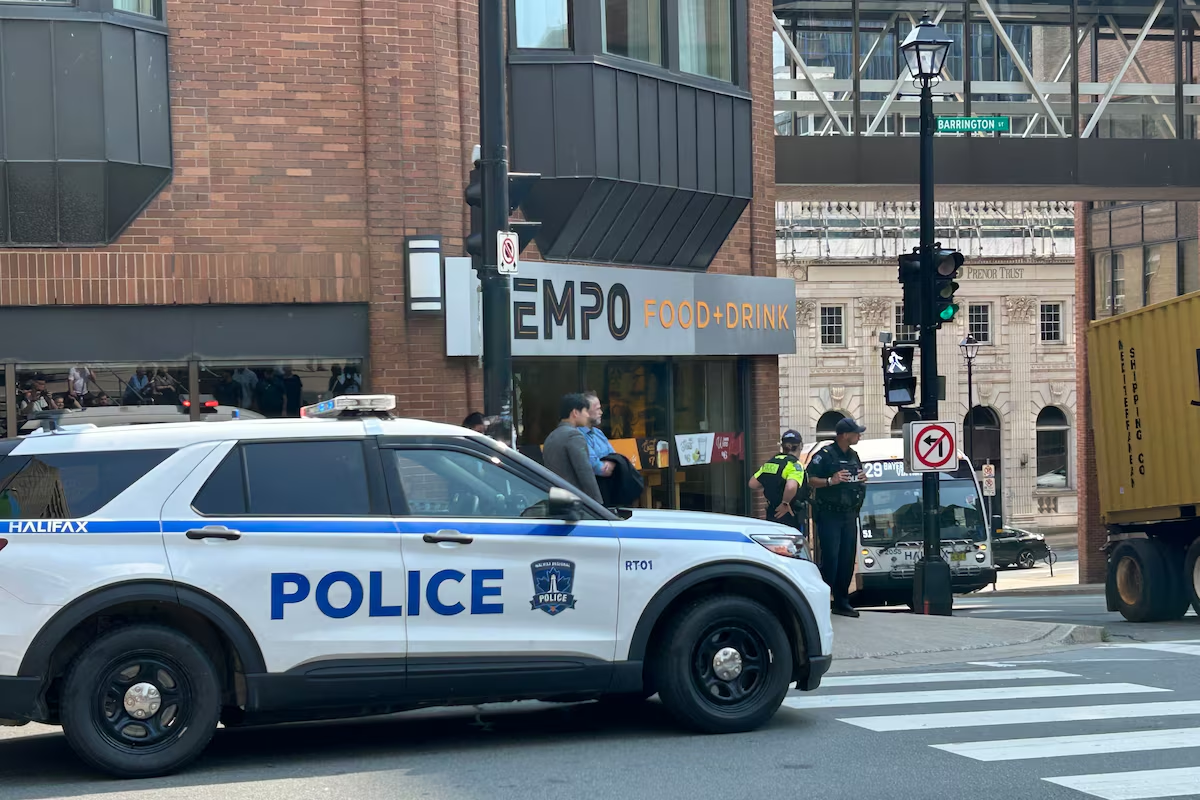
Police direct people to evacuate in downtown Halifax after a bomb threat against the U.S. consulate. A 54-year-old man has been arrested.Devin Stevens/The Canadian Press
TOP STORIES
Man arrested after U.S. consulate threat
Police have arrested a man after he allegedly made a bomb threat directed at the U.S. consulate in downtown Halifax that forced the evacuation of high-rise office towers and nearby waterfront streets for several hours on Monday.
It’s the third incident involving a U.S. consulate in Canada recently after shots were fired at the Toronto building in March and then again in July. No one was injured in any of the consulate incidents.
The U.S. Consulate General in Halifax informed police Sunday evening around 6:15 p.m. that they had received a bomb threat.
Halifax Regional Police spokesperson Sergeant Michelle Dooks said they quickly identified the 54-year-old suspect and began looking for him. But it wasn’t until Monday around 8:30 a.m. that he was arrested. They haven’t released the man’s name or a potential motive.
Here’s the latest on the bomb threat against the U.S. consulate.
Open this photo in gallery:
The Bald Range wildfire rages near Summerland, B.C., on Sunday.DARREN HULL/AFP/Getty Images
Military on standby for B.C. wildfires
Defence Minister David McGuinty says the Canadian Armed Forces are prepared to help British Columbia deal with its wildfire crisis if asked. A wildfire in B.C.’s Interior grew dramatically over the weekend; it has killed one person and displaced more than 20,000.
The fire: The Bald Range wildfire was discovered Friday on the west side of Okanagan Lake. It tore through 50 square kilometres in its first three hours and doubled in size by Saturday, when B.C. declared a provincewide state of emergency. By Sunday, it grew to 136 square kilometres.
The evacuations: Evacuation orders cover the entire district of Summerland, a community that is home to about 12,000 people and known for its orchards, vineyards and wineries, while 8,000 others were forced from their homes in nearby communities. The federal government earlier said it was auditing spaces that could serve as shelters for evacuees.
Open this photo in gallery:
Residents dig through debris after an earthquake in Cali, Colombia.Juan Pablo Arbelaez/Reuters
Powerful earthquake hits Colombia
Rescue efforts across western Colombia carried into a second day after a 7.4-magnitude earthquake tore through Colombia’s coffee-growing heartland, killing at least 164 people. The government response presents the first major challenge for President Abelardo de la Espriella, a Trump ally who was sworn in over the weekend.
The details: The country’s Pacific region lies along the “Ring of Fire,” a line of seismic faults where most of the world’s earthquakes occur. Small quakes are common in central and western Colombia, but those above 6.0 magnitude are rare. In late June, neighbouring Venezuela was devastated by two back-to-back quakes that destroyed hundreds of buildings and killed more than 6,300 people.
Sanctions to be imposed on Canadian-owned armoured-vehicle maker
Ottawa has announced sanctions on Streit Group, a major Canadian-owned manufacturer whose armoured vehicles have been deployed by the Russian army and a Sudanese paramilitary militia.
The company: Streit Group, now based in the United Arab Emirates, was founded in Ontario in 1992 by Guerman Goutorov, a Canadian businessman who reportedly also holds Russian citizenship. The EU announced sanctions against Streit last October, and Ukrainian-Canadian leaders have previously complained that Ottawa was not fully enforcing regulations that prohibit Canadians from selling weapons to Moscow.
Open this photo in gallery:
AbCellera cell culture scientists perform bioreactor sampling in Vancouver. The company previously discovered an antibody treatment for people hospitalized with the COVID-19 virus.Jimmy Jeong/The Globe and Mail
Treatment for hot flashes performs well in clinical trial
Shares of Vancouver’s AbCellera Biologics soared after the antibody developer published positive results from a clinical trial assessing the efficacy of its treatment for women experiencing moderate or severe hot flashes during menopause.
The treatment: The results could position the drug, called ABCL635, to be a best-in-class nonhormonal therapy with fewer health risks than competing treatments, and represent a milestone for the company, whose goal is to build Canada’s first homegrown pharma giant. The drug still needs to succeed in an expanded trial before receiving regulatory approval – but if it prevails, it could be a significant new treatment option for menopausal women.
The Take
In Canada, as in most of the world, it’s dangerous to not know how to swim.
Embedding swimming instruction into Canada’s education system, as some countries do, could help save lives, André Picard writes.
The Shot
Open this photo in gallery:
A behind-the-scenes tour of the long-delayed Ocean View Resort and Golf in Summerside.Vanessa Tignanelli/The Globe and Mail
From anywhere along the waterfront in Prince Edward Island’s picturesque Summerside, you can see a notorious ghost resort looming over the red shoreline. Residents have long sought answers about why the massive development has never had a single guest.
The Wrap
What else we’re following
At home: A majority of Canadians oppose government support for AI data centres, a new poll shows.
Abroad: Britain and France are bracing for yet another heat wave as temperatures soar across Europe.
In court: The Tupac Shakur murder trial is set to begin 30 years after the rapper’s shooting.
On camera: Canadian director Matt Johnson spoke to The Globe about his Anthony Bourdain biopic, Tony.
Look up: Two major celestial events – the annual Perseid meteor shower and a solar eclipse – will make this a great week for astronomy lovers.
Look out: A reader is seeing e-scooters everywhere – but where are they actually allowed?
Editor’s note: Yesterday’s edition included a photo caption that misidentified the field where Amin Babaeighazvini, chief science officer at CellCore Technologies, was standing. It was a canola field, not a flax field.