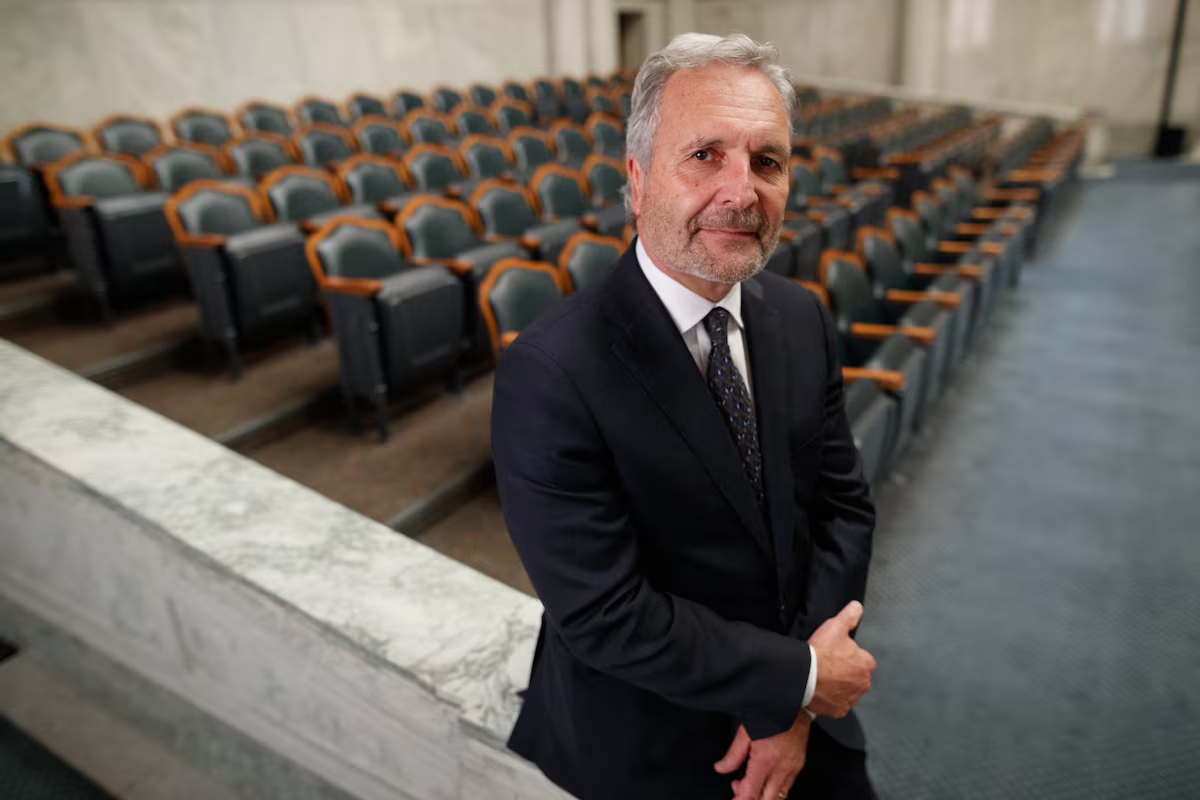

Open this photo in gallery:
Glenn Joyal, chief justice of King’s Court of Manitoba, at the Manitoba Law Courts in October, 2024. The judge has been nominated by Prime Minister Carney for the Supreme Court.Daniel Crump/The Globe and Mail
Prime Minister Mark Carney on Monday nominated Glenn Joyal, the long-time Chief Justice of the Court of King’s Bench of Manitoba, to the Supreme Court of Canada.
The legal community had widely expected Chief Justice Joyal to be named to the top court after Supreme Court Justice Sheilah Martin announced her retirement in January.
Chief Justice Joyal, in his mid-60s, had previously applied for a seat on the Supreme Court’s bench. This time, experts picked him as the obvious front-runner should he choose to apply again.
“Throughout his career, Chief Justice Joyal has demonstrated the integrity, experience, and sound judgment that service on our highest court demands,” Mr. Carney said in a statement.
From the archives: Indigenous traditions in trials can restore trust in justice system, Manitoba judge says
While Ottawa described Chief Justice Joyal as “the nominee” to the Supreme Court, Canada’s appointment system is not like that in the United States, where the Senate can reject a top court candidate. Mr. Carney has sole discretion on the choice.
MPs and senators will have a question-and-answer session with Chief Justice Joyal, though under the federal protocol, they are only allowed to ask benign questions and a moderator will steer them away from any probing queries. A date for the session was not announced.
Through Chief Justice Joyal’s long judicial career, he’s established himself as an expert in criminal and constitutional law. He has also overseen major Indigenous cases and worked to consider ways in which Indigenous legal traditions could be integrated into how courts operate, an effort to push forward on reconciliation.
The federal government’s news release did not indicate when Chief Justice Joyal would join the Supreme Court. Sheilah Martin retired May 30. Hearings at the court resume this fall, likely in October.
Earlier this year, Gerard Kennedy, associate law dean at the University of Alberta, told The Globe and Mail that Chief Justice Joyal is a type of top-level veteran judge Mr. Carney would likely look upon favourably.
“Carney really values intellectual chops and experience,” Prof. Kennedy said. “Clearly, Glenn Joyal has that.”
One unusual aspect of Chief Justice Joyal’s appointment is that he jumps to the Supreme Court from the superior court level. Most, though not all, Supreme Court judges rise to the apex courtroom in Ottawa from the appellate courts, the top court in each province.
In a February speech at the University of Ottawa’s law school, Chief Justice Joyal spoke about how leading judges in Canada need to balance traditional reserve with carefully chosen public statements. Supreme Court Chief Justice Richard Wagner has likewise pursued this path in his eight-plus years leading the top court.
Chief Justice Joyal noted the “the well-understood requirement for judicial reserve,” but insisted that being overly reserved was a mistake.
“There is now a need for the sometimes bold, albeit thoughtful, action of judges to say and to do things that might, at first blush, seem at odds or inconsistent with that traditional restraining reflex,” Chief Justice Joyal said in his February speech.
In the speech he pointed to a recent episode in Alberta, as well as a similar episode in Ontario last year.
In January, Alberta Premier Danielle Smith spoke out about wanting to “direct” judges. Several days later, top judges there, led by the province’s acting Chief Justice Dawn Pentelechuk, issued a rare statement that underlined the importance of independent courts in a healthy democracy.
Last year, Ontario Premier Doug Ford called judicial independence “a joke.” Top judges in the province, including Chief Justice Michael Tulloch, issued a statement that called judicial independence a cornerstone of Canada’s constitutional democracy.
In Chief Justice Joyal’s speech, he said: “I can assure you, all of you, that chief justices across the country on a daily basis are grappling with how and when to speak out.”