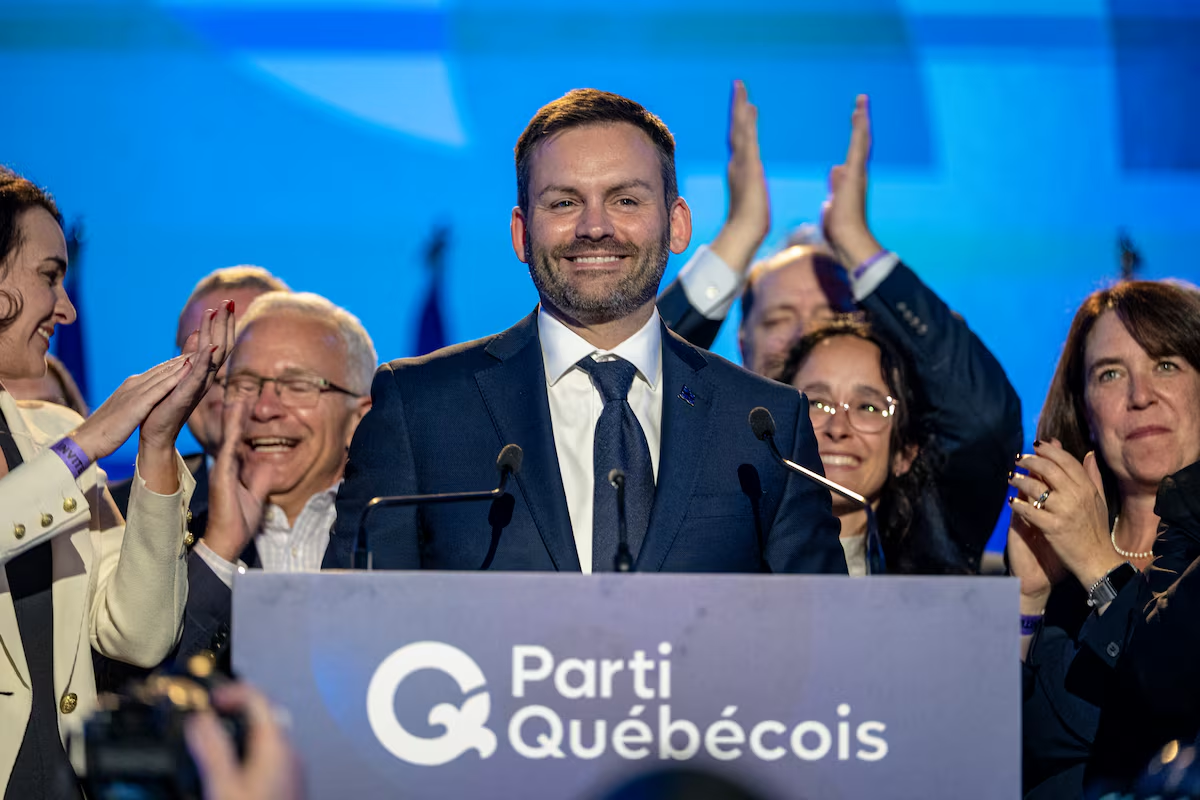

Open this photo in gallery:
Leader of the Parti Québécois Paul St-Pierre Plamondon makes a speech in Montreal after winning his election to become the next premier of Quebec on Monday.ANDREJ IVANOV/AFP/Getty Images
Quebec has voted in a separatist Parti Québécois government for the first time in more than a decade, after an election campaign marked by a desire for change and pronounced regional divisions.
The results of Monday’s election will shake up Quebec’s political landscape, with the PQ returning to power after being nearly wiped out four years ago, while the Coalition Avenir Québec is facing extinction after eight years in government.
The PQ has won a minority mandate with just 28 per cent of the vote, the lowest vote share for any government in Quebec’s history. Leader Paul St-Pierre Plamondon has promised his government will hold a referendum on independence within a first mandate, though not before U.S. President Donald Trump leaves the White House in 2029.
Here are five things to know about the Quebec election and the next chapter in the province’s political history.
Open this photo in gallery:
Supporters of Parti Québécois cheer as members of the party are elected in Montreal.ANDREJ IVANOV/AFP/Getty Images
Referendum takes centre stage
The PQ victory has brought Quebec closer to a sovereignty referendum than it has been in decades, but a minority mandate will make it difficult for Mr. St-Pierre Plamondon to follow through on his pledge, even if his government outlasts Mr. Trump’s time in office.
The PQ Leader reaffirmed his commitment to independence during his victory speech Monday night, calling it a “question of survival.” But the party would require support from the opposition to adopt a referendum question in the National Assembly, and the Liberals and Conservatives have both made it clear they will not play ball.
The left-leaning Québec Solidaire, which also supports sovereignty, has not said clearly whether it would support a PQ bid to hold a referendum. Co-spokesperson Ruba Ghazal has called for an extensive public consultation before holding a vote on independence, and on Monday said she wants to build a country that “leaves no one behind.”
André Lamoureux, a political scientist at Université du Québec à Montréal, said a referendum will be a “dead end” for a PQ minority. “There are too many obstacles,” he added.
Open this photo in gallery:
A minority mandate will make it difficult for Mr. St-Pierre Plamondon to follow through on his pledge to hold a sovereignty referendum.ANDREJ IVANOV/AFP/Getty Images
A new relationship with Ottawa
The arrival of a PQ government could herald a thornier relationship between Quebec City and Ottawa, as Mr. St-Pierre Plamondon looks to bolster support for independence. At a time when threats to Canada’s sovereignty are coming from both inside and outside the country, the PQ leader’s agenda could be an irritant for Prime Minister Mark Carney.
Outgoing Premier Christine Fréchette sought to build ties with the federal government, and appeared alongside Mr. Carney at several announcements in recent months. Mr. St-Pierre Plamondon pointed to those announcements as evidence of federal interference in the Quebec election intended to benefit the CAQ.
Late in the campaign, the PQ Leader vowed to break with the monarchy in Quebec if he became premier, promising to pass a law to abolish the office of lieutenant-governor. Critics say such a move would likely be subject to a constitutional challenge.
On Monday, Mr. St-Pierre Plamondon said he is willing to collaborate with Mr. Carney. “He will find in me someone who is direct, frank, and transparent – but above all, someone who will defend, first and foremost and at all times, the interests of the people of Quebec.”
Open this photo in gallery:
Quebec Premier Christine Frechette speaks at the Coalition Avenir Quebec party’s election night headquarters in Trois-Rivieres, Que.Mathieu Belanger/Reuters
The CAQ collapses
After winning two majority mandates in 2018 and 2022, the Coalition Avenir Québec was wiped off the map on Monday, losing every one of its 79 seats. It was a dramatic fall from grace, prompting speculation that the party may disappear altogether.
The CAQ rose to power eight years ago as an alternative to the federalist Liberals and the separatist PQ, promising a nationalist government that would not hold a referendum on independence. After the party’s first victory, it seemed the decades-old debate over sovereignty might have been permanently shelved.
Now, however, it seems the CAQ may have been “just a parenthesis in our political history,” said political analyst Raphaël Melançon. “It seems like we’re going back to these old battles.”
Open this photo in gallery:
Quebec Solidaire co-spokesperson Ruba Ghazal speaks to supporters on Monday night.Peter McCabe/The Canadian Press
A divided landscape
The Quebec electorate expressed a clear desire for change on Monday, with more than 90 of the province’s 127 seats switching hands. But voters remained divided throughout the six-week campaign about the kind of change they wanted to see. The PQ’s victory and the CAQ’s collapse in the final seat count mask the fact that all five main parties won between 13 per cent and 28 per cent of the vote.
Though a PQ government was declared shortly after polls closed Monday evening, tight races played out in ridings across the province. Early Tuesday morning, candidates were leading or elected by fewer than 1,000 votes in 15 seats.
The final map shows important regional divisions. The Liberals have retained their traditional stronghold in ridings in and around Montreal, while the left-leaning Québec Solidaire held onto a handful of urban seats in Montreal and Quebec City.
The Conservatives, meanwhile, claimed seats in Quebec City and surrounding regions.
Open this photo in gallery:
Quebec Conservative Party Leader Éric Duhaime speaks to his supporters on election night in Levis, Que.Karoline Boucher/The Canadian Press
The new kids on the block
The real winner Monday night was arguably Conservative Leader Éric Duhaime, who led his party to claim seats in the National Assembly for the first time. With 19 seats, the Conservatives will obtain official party status in the Quebec legislature and could hold the balance of power.
A Conservative party had not won seats in Quebec since 1935, after which the original party was dissolved to form the right-leaning Union Nationale, which would govern the province for the following two decades under the leadership of Maurice Duplessis.
The modern iteration of the party was founded in 2009 and has been led by Mr. Duhaime since 2021. He campaigned on major cuts to taxes, public sector jobs and government spending, and has promised to act as a watchdog to guard against government waste.
On Monday, Mr. Duhaime said the Conservatives will embody Quebeckers’ desire for change. “Finally, hope will be present within the walls of the National Assembly.”