
Open this photo in gallery:
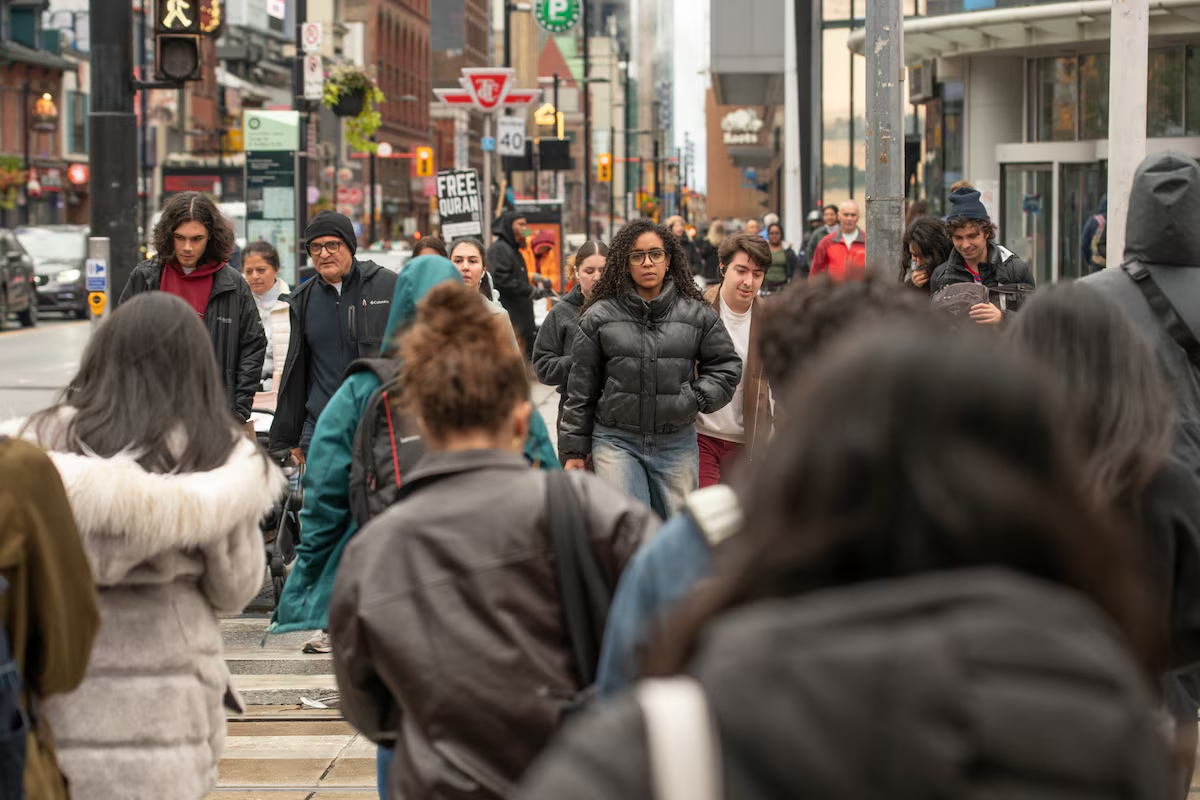
Pedestrians walk in downtown Toronto in October, 2025. Statistics Canada released new figures showing that the national population is estimated to have increased by nearly 300,000 last year.Fred Lum/The Globe and Mail
Remember those headlines about how, for the first time in Canadian history, our population shrank in 2025? It turns out that never happened.
Two weeks ago, Statistics Canada released new demographic estimates. A national population that it previously believed had fallen by more than 100,000 people in 2025 is now estimated to have increased by nearly 300,000.
This higher count is not the result of a new tally of births, deaths or immigrants arriving. It is almost entirely driven by what the statistical agency says is better information on temporary resident departures. Many of the visa students and visa workers the agency previously assumed had left Canada it now believes did not.
On the same day as Statscan dropped that news, Prime Minister Mark Carney was in New York, sitting for an interview with The New York Times. Among other things, he was asked about Canada’s “population decline,” and when he would begin “reversing” it through higher immigration.
The PM didn’t challenge the mistaken premise that Canada’s population is declining; he was presumably unaware of the new figures. But he gave a long and detailed answer about the immigration system’s recent history, which shows that he has a grasp on how things went off the rails under his predecessor.
Editorial: The population bust that wasn’t
I wrote a book last year on what Canada used to get right about immigration, and how after 2015 it got things so badly wrong. Most of what Mr. Carney had to say was on point.
He concluded with this: “Now the question starts to become: When do we resume some controlled increase in the population?”
The word “increase” set off alarm bells among Conservatives and some in the media, who took it as sign that Mr. Carney is done with pulling back, and is about to reprise the previous government’s immigration mistakes.
To refresh your memory, Canada dramatically lowered immigration standards under prime minister Justin Trudeau; offered an unlimited numbers of visas to poorly vetted students, many of whom were hoping to exchange puppy-mill tuition for citizenship; and pushed immigration to an annual average of one million permanent and net temporary arrivals between 2022 and 2024 – four times the level in the 1990s, 2000s and early 2010s.
There’s no doubt that the Carney government is being lobbied – by businesses seeking low-wage workers, by some provinces, by some in higher education and by progressive activists – to repeat aspects of that story. But how eager is the PM to listen?
Mr. Carney’s reply to his American interviewers’ immigration query ended with a question. It’s a reasonable question. His government’s answer – new immigration targets and details are expected in the coming weeks – must flow from the evidence.
The latest Statscan figures are a key part of that evidence.
The Carney government’s favourite word when talking about immigration is: “control.” What happened under the Trudeau government is described, correctly, as a loss of control; what Ottawa says it is aiming for is regaining control.
The government’s most important means of doing so is through scaling back temporary migration. Its self-declared metric of success is a significant reduction in the number of people in Canada on temporary visas.
“We’ve taken measures to get [the system] under control,” Mr. Carney told The New York Times, “and we have it under control.”
The first half of that is true. The second half, less so.
The latest Statscan demographic estimates show that what was thought to have been several quarters of sharp decline in the temporary resident population – adding up to net emigration and a drop in the national population – was nothing of the sort.
The story has been revised in light of better data. Even with initiatives to raise the number of temporary residents receiving permanent residency, the temporary population is dropping far more slowly than expected.
The Carney government wants to get the temporary resident share of the population down to 5 per cent by next year, but that goal – which would still leave temporary numbers far above where they were at any time prior to the early 2020s – looks far out of reach.
Statistics Canada’s latest says that the temporary population peaked at 7.2 per cent in 2024. It previously estimated that the figure had hit 7.6 per cent, and then dropped over the next year and a half to 6.1 per cent. With better data, the agency now says that the temporary population is 6.7 per cent of the national population. It has barely budged in nearly two years.
Statistics Canada now knows that, though many of the visa holders it had previously assumed left on the expiration of their visas in fact did so, hundreds of thousands of others did not.
The Trudeau government discovered that letting an ever-growing number of people into the country on temporary visas was easy, because the number of people eager to come to Canada is effectively unlimited. The Carney government is discovering that getting people to leave, if they are not chosen for permanent residency, is considerably more difficult.
In light of this evidence, along with Canada’s economic goals and what we know about what immigration can and cannot do to further those goals, what should the Carney government’s immigration policy and targets be?
More on that, later this week.