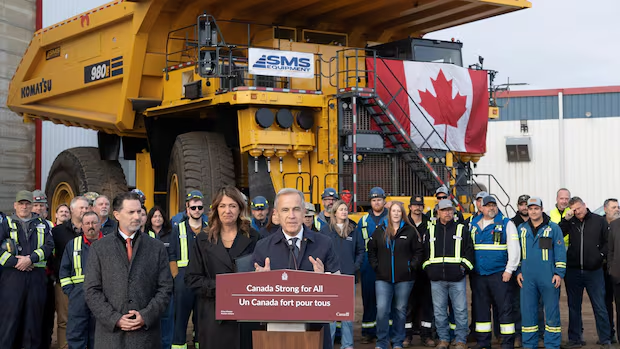
A proposed pipeline carrying one million barrels of oil a day from Alberta to the B.C. coast has become the first project designated in the national interest, the federal and Alberta governments have announced.
Listing the West Coast pipeline — which will now officially be named the Pacific Link pipeline — on Schedule 1 of the Building Canada Act means the federal government has moved from considering whether it should be built to how it will be built by fast-tracking and consolidating the approval process, including environmental assessments.
“Before the Building Canada Act, proponents would have to spend years and potentially billions of dollars doing this work before even knowing where the federal government stood on the project,” Carney said in Fort McMurray, Alta., on Thursday.
“For many builders, the risk was not worth it. So, Canada stopped building. Now, the federal government is making its position clear at the beginning of the process, rather than at the end.”
WATCH | Carney designates new pipeline project of national interest:
Carney designates West Coast pipeline a project of national interest
Prime Minister Mark Carney announced that the West Coast Pipeline, known as Pacific Link, will be listed as a project of national interest under the Building Canada Act, allowing the government to fast-track the approval process.
A senior government official told reporters in advance of the announcement that the pipeline is expected to boost Canada’s GDP by up to $30 billion annually — $20 billion of that coming from the pipeline itself.
By diversifying Canada’s exports away from the U.S., officials said Canada will be able to charge a higher price for the oil it currently ships south of the border, providing what could be an additional $10 billion a year in revenues.
The federal government also said that once approved, the project will create up to 140,000 jobs.
Dominic LeBlanc, the minister of one Canadian economy, has been tasked with completing the conditions document setting out the requirements for the project by Sept. 1, 2027, allowing construction to begin, with a view to having the pipeline up and running by 2032-33.
Carney said the work of crafting those conditions will be supported by the Major Projects Office and the Canada Energy Regulator who will hold consultations with stakeholders to determine environmental protections, oversight, Indigenous ownership and local hiring.
The estimated cost of the project is between $35.2 billion and $43.7 billion, which includes a contingency.
The Alberta government and the federally owned Trans Mountain Corporation would each own 45 per cent of the pipeline, with the Calgary-based Pembina Pipeline Corporation owning a 10 per cent stake through the construction phase.
Once the pipeline is up and running, the Pembina Pipeline Corporation will have the opportunity to purchase an additional 10 per cent stake.
Carney said that Indigenous communities will be offered a minimum 10 per cent ownership stake in the project.
Increasing private sector ownership
While the pipeline is 90 per cent owned by the federal and Alberta governments, a senior official speaking on background explained that there are investors poised to take part.
The official said that those investors are currently watching to see if Canada is capable of fast-tracking the approval and construction of the Pacific Link by 2032-33.
 Workers lay pipe during construction of the Trans Mountain pipeline expansion on farmland, in Abbotsford, B.C., in 2023. A new West Coast pipeline will ship one million barrels of oil a day from Alberta to the B.C. coast once it opens in 2032-33. (Darryl Dyck/The Canadian Press)
Those investors are cautious, the official explained, because of how fraught the approval process was for the Trans Mountain Pipeline and how long it took to build.
Alberta Premier Danielle Smith told CBC’s Power & Politics that she views government involvement in this pipeline as a way to encourage private investors to take the lead on future projects.
“I think in order to give the industry confidence that we can get these kinds of major projects built, we have to walk every step of the way with them until it’s completed,” she told host David Cochrane.
WATCH | Pipeline’s public-private ownership gives industry confidence: Alberta premier:
Pipeline’s public-private ownership gives industry confidence: Alberta premier
As Alberta’s proposed pipeline to the West Coast becomes the first project to be designated in the national interest by the federal government, it still lacks a private proponent. With 90 per cent set to be publicly owned — with more potential private investment to come — Alberta Premier Danielle Smith says the public-private partnership to build the pipeline will grow industry confidence.
Carney said Thursday’s announcement — where Alberta, B.C. and Indigenous communities are all involved in the project — and that Canada’s effective tax rate for investments has been cut to less than a third of the G7 average are reasons private investors will be attracted to the project.
“This is the best country in the world, major economy in the world, to invest. And I’m sure those companies and companies across the country will take that into account,” he said.
Higher emissions, lower intensity
Thursday’s announcement was welcomed by business groups such as the Canadian Chamber of Commerce which commended the Liberal government for providing up-front regulatory backing for the project.
“Getting our resources to Asia-Pacific markets is a path to more production, prosperity and a brighter future for workers, their families and communities,” said the chamber’s Bryan Detchou in a statement.
Environmental organizations like Greenpeace and the Pembina Institute, however, said Canada shouldn’t be pulling more oil out of the ground.
“New oilsands and pipeline projects will drive emissions even higher,” the Pembina Institute, which is not affiliated with the pipeline corporation, said in a post on X.
“Every fraction of a degree matters. Canada should be investing in cleaner, more resilient energy solutions.”
WATCH | Carney says Pacific Link pipeline demonstrates ‘power of Canada’:
Ahead of Alberta referendum, Pacific Link pipeline demonstrates ‘power of Canada’: Carney
Prime Minister Mark Carney said designating the Pacific Link pipeline in the national interest shows ‘Canada is working,’ when asked what message Albertans supporting a separation referendum should take from the announcement.
A government explanatory note says that while the pipeline “does not directly contribute to Canada’s greenhouse gas emission reduction targets,” it is a key part of plans to reduce emissions intensity, or emissions per barrel of oil produced.
That plan includes the Pathways Project, a carbon capture and storage initiative that Carney said will absorb as much as 16 million tonnes of carbon emissions annually and store them underground.
Rick Smith, president of the Canadian Climate Institute, told Power & Politics that Canada is nowhere near on track to meeting its emission reduction targets. He said the government will need to follow up with further climate policies in light of this new project.
“You’re only going to reduce pollution from this increased oil production if you actually fix some of Canada’s broken climate change policies,” he told Cochrane. “But it’s a work in progress.”
Carney said that the Pathways Project is only part of his government’s environmental mitigation plans which also include $1.2 billion in federal funding for ocean protections announced on Tuesday.
Carney said choosing a southern route, instead of a route through northern British Columbia, will ensure the project does not cross “highly sensitive ecosystems, including the Great Bear Sea.”
The 1,200-kilometre pipeline will carry bitumen through Alberta from Bruderheim to a deepwater port near Delta, B.C, where infrastructure at the Roberts Bank terminal will be expanded.
Carney said his government’s new oceans funding will include “a series of measures to protect the habitats of killer whales” during the expansion of Roberts Bank.
The federal government’s explanatory note says an agreement in principle with Alberta to reduce methane emissions by 75 per below 2014 levels by 2035 is a key component of “Canada’s plan to strengthen its position in global energy markets, as customers across the world prioritize low-carbon oil and gas.”
NDP and Conservatives weigh in
NDP Leader Avi Lewis accused the Liberal government of rushing the project through the approvals process “while sweeping aside environmental protections.”
“It is an offence to Canadian science, public health, collective safety and common sense. And it is a gift to an oil industry already on track to make $100 billion in wartime profits this year alone,” he said.
“This project leaves Canadians bearing all the risks of a bad investment without any of the rewards.”
- Just Asking wants to know: What questions do you have about Prime Minister Mark Carney’s plan to fast-track major projects and how that plan would affect environmental protection? Send us your questions before our Oct. 3 show.
Conservative Leader Pierre Poilievre said his party strongly supports a pipeline and congratulated Premier Smith for championing the project.
“It has taken Mark Carney almost a year and a half to put one proposal on a national interest list. We need a pipeline in the ground, not just on a list,” he said.
“The federal government needs to get out of the way and let builders build, investors invest and workers work.”