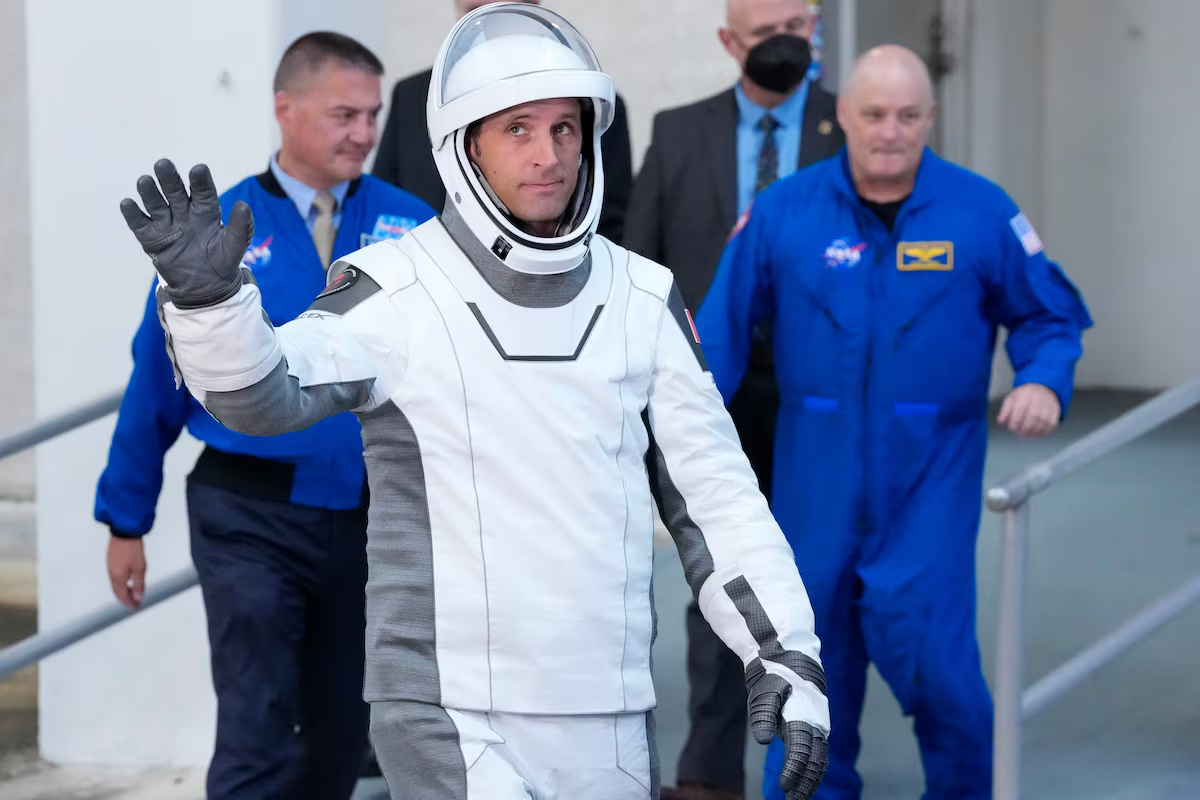

Open this photo in gallery:
Canadian Astronaut Joshua Kutryk waves as he leaves the Operations and Checkout Building at the Kennedy Space Center in Cape Canaveral, Fla., on Thursday.John Raoux/The Associated Press
Those who followed the news of Joshua Kutryk’s successful flight to the International Space Station this week can be forgiven for wondering if the Canadian astronaut stepped into a time machine rather than a space capsule.
Col. Kutryk, who hails from Fort Saskatchewan, Alta., was one of four astronauts who lifted off on Thursday morning from the Kennedy Space Center in Florida and docked with the station later that night.
Their arrival marks the start of a busy handoff period during which the population of the station will temporarily be at 11 – four of which will depart some time next week.
With astronauts from the United States, Russia, France and Canada currently on board, the image of comity and diversity on the station is certainly what proponents had in mind when construction of the orbiting laboratory began in 1998.
Today it remains a vision of a more congenial time – challenged to varying degrees by Russia’s invasion of Ukraine, the growing rift between Canada and the U.S., and even Alberta’s coming decision about whether it wants to remain a province.
With Canadians quietly lending a hand, a U.S. spy satellite-turned-telescope takes flight
All of these developments highlight the fact that as the station sails the airless expanse overhead, the world down below is changing fast.
It has been a big year for Canada in space, with Col. Kutryk’s mission following on the heels of Jeremy Hansen’s voyage around the moon in Artemis II last April. What is less clear is whether Canada’s next chapter in space can be as high profile and productive.
Most ISS partners, including the U.S., Canada, Japan and European countries, have committed to supporting the station until the end of 2030. Russia’s current commitment extends only through 2028. Once the station is decommissioned, it will likely be deorbited into the Pacific Ocean.
With the station’s end approaching, it remains an open question whether any Canadians will go there after Col. Kutryk’s mission is completed.
“At this point we’re working with NASA and the other international partners to see what we can do to fly astronauts,” said Matthieu Caron, director of astronauts, life sciences and space medicine at the Canadian Space Agency.
A SpaceX rocket safely lifted off from Florida on Thursday, launching a crew of two U.S. astronauts, a Canadian astronaut and a Russian cosmonaut toward the International Space Station for a science mission devoted to human health and performance in orbit.
Reuters
He noted that Canada earns credits for continued investments in the station – credits that can be put toward a future Canadian flight. But it’s not yet clear if there will be enough such credits for another Canadian to fly by the time the station reaches the end of its lifespan.
With Col. Hansen’s retirement from the agency earlier this year, there are currently only three active astronauts in the Canadian program. Of those, only Jenni Gibbons, who served as Col. Hansen’s backup on Artemis II, has not yet logged any time in space.
Mr. Caron said that for now there are no plans to expand Canada’s contingent of astronauts while the focus remains on getting at least one more mission. It’s been more than nine years since Dr. Gibbons and Col. Kutryk were selected to be astronauts. The gap since then indicates the uncertainty in what opportunities there will be for Canadians to fly once the station is retired.
The Artemis II mission was a glorious distraction from more serious problems in space
It’s long been clear that the U.S. has redirected its human space program toward the moon. In 2018, Canada agreed to partner in this effort.
Canada’s main contribution was to be an updated version of the space station’s robotic arm made for Gateway, a future station to be placed in orbit around the moon. But earlier this year, NASA sidelined Gateway to prioritize the construction of a moon base on the lunar surface. Canada is still working out how it will accommodate the pivot and provide hardware that is relevant to the revised scenario.
This contribution will help determine when a Canadian could next be heading to the moon. But much depends on whether NASA can sustain its moon program at the accelerated pace outlined this year by administrator Jared Isaacman. That plan would see U.S. astronauts returning to the moon’s surface in 2028.
Hammering out Canada’s role on the moon is likely to be a high priority for the next president of the Canadian Space Agency, a key position that has been vacant since July.
Meanwhile, the federal government has determined that it needs to do more at home to build a viable space sector that is not overly dependent on the U.S. or other countries for access to orbit.
Ottawa has already said it wants to build a domestic launch capability in Canada as a matter of sovereignty.
Jeremy Hansen returns home with the Artemis II crew to talk not about science or space, but humanity
Federal Industry Minister Mélanie Joly said this priority won’t fade any time soon “because I think that geopolitics won’t calm down.”
To that end, she said she is working toward a new space strategy for Canada and hopes to enlist Col. Hansen, among others, to participate in its development. The strategy would cover three domains of the Canadian sector, including science, defence and commercialization.
Brian Gallant, chief executive of Space Canada, an industry association, said he welcomes the effort as long as it can be accomplished swiftly to match the sector’s need for momentum.
“Space over the last few decades has changed,” Mr. Gallant said. “The role of industry has completely changed. So we need to keep pace with other governments that are rolling out programs and investments to help build the space industrial base of their respective countries.”
If taken at face value, the statements suggest that Canadian policy makers need to be as busy as Col. Kutryk will be on the space station in the coming months. By the time he returns to Earth early next year, Canada’s future in space will need a clear direction or risk becoming trapped in time.