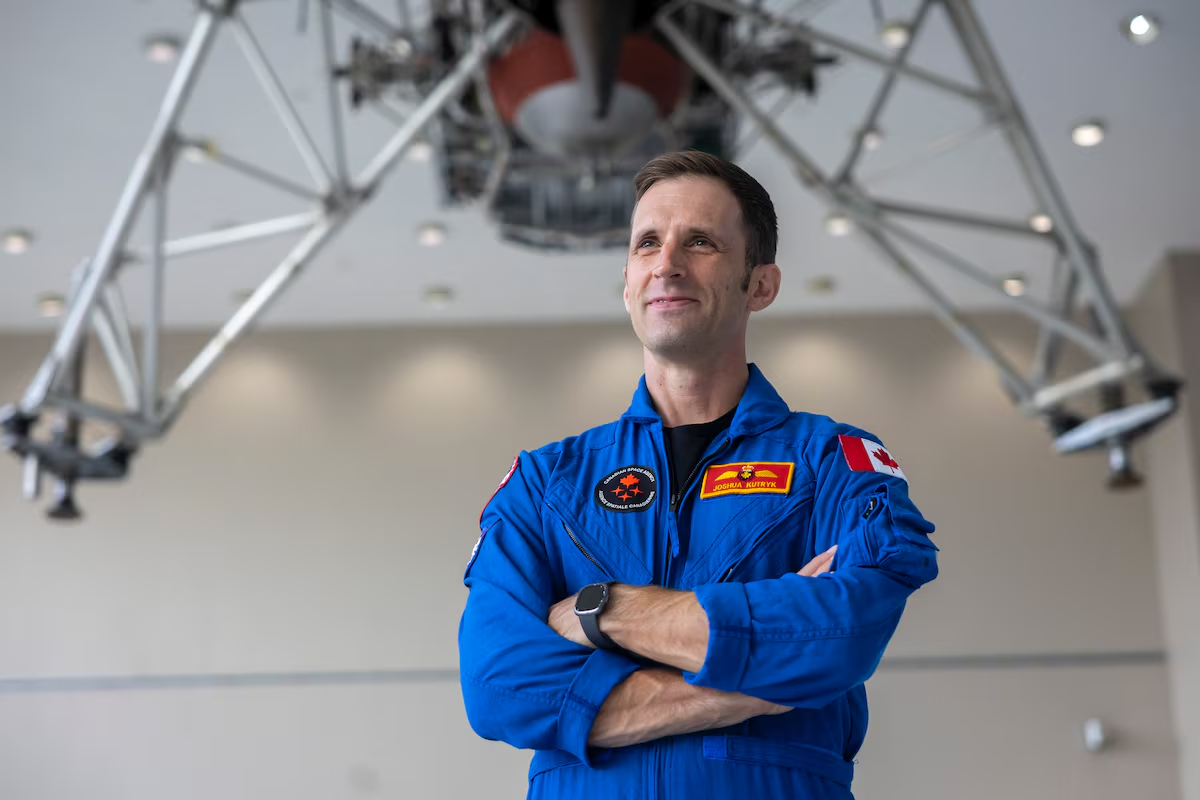

Open this photo in gallery:
Col. Kutryk is set to become the fourth Canadian to undertake a long duration mission in space.Annie Mulligan/The Globe and Mail
Canada’s next space traveller is fast approaching his scheduled departure – but the weather may have other ideas.
On Wednesday afternoon, officials at NASA’s Kennedy Space Center in Florida said there was a 55 per cent chance of favourable conditions for the launch of a four-person crew heading to the International Space Station for half a year.
The group includes Joshua Kutryk, a native of Fort Saskatchewan, Alta., and an air force pilot who was selected to be an astronaut by the Canadian Space Agency in 2017.
Colonel Kutyrk is scheduled to fly with Jessica Watkins, crew commander, and Luke Delaney both of the United States, as well as Sergey Teteryatnikov of Russia. The team is set to lift off aboard a SpaceX Falcon 9 rocket Thursday at 11:10 a.m. ET and dock with the space station about eight hours later.
“I’m excited to do the science, I’m excited to look at the Earth, but I’m also excited to do it as a Canadian,” Col. Kutryk said during a press conference after he and his crewmates arrived on Sunday in advance of their launch.
He also stressed the value of the partnership that has enabled Canadians to work together with NASA colleagues.
Col. Kutryk’s planned six-month stint on the ISS is another example of how active that partnership has been this year.
In April, Canadian astronaut Jeremy Hansen and his U.S. crewmates captured the world’s attention with Artemis II, the first mission to take humans around the moon and back in more than half a century.
Now, it’s Col. Kutryk’s turn to begin his nearer but far longer residency in Earth’s orbit.
During that time he will conduct a wide range of science experiments and help keep the station running in whatever way is needed.
And while it’s tempting to call the mission a marathon – especially when compared with Col. Hansen’s 9½ day lunar sprint – there is a more apt comparison.
Open this photo in gallery:
Jessica Watkins, Luke Delaney, Joshua Kutryk and Sergey Teteryatnikov speak upon arriving to prepare for the Crew-13 launch to the International Space Station in Cape Canaveral, Florida, U.S., Sept. 26.Joe Skipper/Reuters
“It’s a Tour de France,” said Robert Thirsk, a retired astronaut and physician who became the first Canadian to spend multiple months in space in 2009. “You get up and you go hard every day.”
Dr. Thirsk said he picked up the metaphor from Gennady Padalka, a seasoned Russian cosmonaut who was the station’s commander when he first arrived there for a 188-day stay.
“Gennady was a master at what I had to learn,” Dr. Thirsk said. “Every mission is going to have contingencies and inevitable malfunctions. So you need to have the physiological, but also the psychological reserves to deal with that.”
He said that while astronauts on short duration missions tend to train for specific tasks they need to complete on a tight timeline, those who expect to spend many months in orbit instead focus on skills that may be required to deal with the unexpected and maintain their physical and mental capacity over the long haul.
Dr. Thirsk said that Col. Kutryk was well suited for the challenge.
“During the fifth month of his expedition, he is going to need as much energy and enthusiasm to perform his tasks and his experiments as he will during this first week,” Dr. Thirsk said.
Col. Kutryk is set to become the fourth Canadian to undertake a long duration mission in space. Besides Dr. Thirsk, only Chris Hadfield and David Saint-Jacques have had comparably long flights aboard the ISS.
Jeremy Hansen and fellow Artemis II crew receive Congressional Space Medal of Honor
One way that Col. Kutryk’s mission differs is in how he will reach the station. Unlike his predecessors who were all launched from Kazakhstan in Soyuz spacecraft, Col. Kutryk will be transported in a SpaceX Dragon capsule as part of NASA’s commercial crew program.
Because it is the 13th regular flight under the program that relies on industrial partners to take astronauts to and from the station, the mission is referred to as Crew-13.
The flight was originally scheduled for mid-September, but was held up when engineers detected an oxidizer leak and decided to investigate. This led to the replacement of a valve – a delicate operation while the rocket was in its vertically stacked configuration.
During a call with reporters last week, Col. Kutryk said the problem was a minor one, but the decision to delay “makes us all feel that much more confident” in the safety of the vehicle.
Another way that Col. Kutryk’s trip is likely to be unique among Canadian astronauts is the fact that he and his wife Heather are expecting their third child to be born later this year while he is still in space.
Mathieu Caron, director of astronauts, life sciences and space medicine with the Canadian Space Agency said that Col. Kutryk would have access to enhanced communications with his family during his time on orbit.
“We have a team that’s dedicated to making sure that we support Josh and that the Kutryk family will receive whatever support is needed during the mission,” he said.