
Open this photo in gallery:
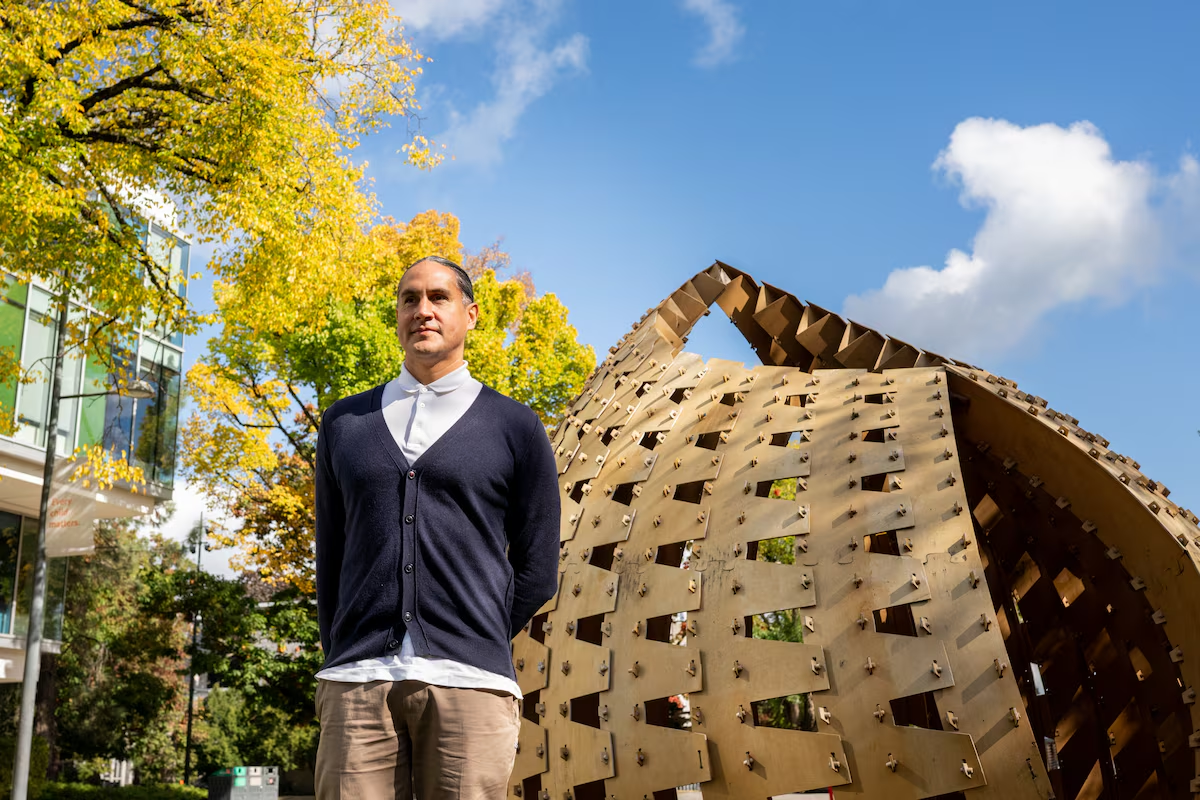
Dustin Louie, director of the Indigenous Teacher Education Program at the University of British Columbia. Not having Indigenous teachers can discourage youth from pursuing education as a career, perpetuating gaps in the system, he said.Felicia Chang/The Globe and Mail
Growing up in Burns Lake, a small community in B.C., Dustin Louie never had an Indigenous teacher.
This experience is familiar to many Indigenous youth, and it has detrimental effects, he said.
Indigenous students are more likely to do better at school when they have Indigenous teachers, and not having those teachers influences students’ ideas about the careers they might pursue, said Prof. Louie, now 45 and director of the Indigenous Teacher Education Program at the University of British Columbia.
“That sets the expectation for those students about what’s possible for them,” he said. Not having Indigenous teachers could discourage them from pursuing education as a career themselves, perpetuating the pattern.
Last September, the UBC program launched a field centre in Prince Rupert to deliver the university’s full bachelor of education program to more than 40 Indigenous students from the area, funded by a grant of nearly $1-million from the Rideau Hall Foundation.
“Within four years of getting those funds, there are going to be at least 25 new teachers in this school district that is 63 per cent Indigenous,” he said. “You cannot overemphasize the implications of this region having 25 new Indigenous teachers.”
When the Truth and Reconciliation Commission of Canada issued its 94 calls to action in 2015, among them was a directive to the federal government to work with Indigenous groups to “develop a joint strategy to eliminate educational and employment gaps between Aboriginal and non-Aboriginal Canadians.”
One program that takes aim at both gaps is the Indigenous Teacher Education Initiative, launched by the Rideau Hall Foundation, a non-partisan national charitable organization, in 2022.
The initiative has two overarching goals, said Annette Trimbee, co-chair of the foundation’s national advisory committee on Indigenous teacher education.
The first is to understand how teachers move through the educational system, what inspires them to become teachers and what barriers they face.
“We’re trying to understand all the things that might be behind the underrepresentation of Indigenous teachers,” she said.
The second goal is to support the recruitment and retention of 10,000 First Nations, Inuit and Métis teachers across Canada.
The initiative has supported 22 projects to date, including several research projects, Dr. Trimbee said.
“I really see it as a bit of a catalyst and accelerator because there are phenomenal things happening all across the country,” she said.
“Education opens doors, and Indigenous students do better when they have the opportunity to learn from Indigenous teachers who they can share culture, history, language with. It creates a sense of pride.”
The foundation has estimated there are 6,000 to 8,000 Indigenous teachers in Canada, added Dr. Trimbee, who is also president of MacEwan University in Edmonton.
Increasing the number of Indigenous teachers is key to improving high-school graduation rates for Indigenous students, said Evelyn Steinhauer, associate dean of Indigenous teacher education at the University of Alberta and a member of the Rideau Hall Foundation’s advisory committee.
“Graduation rates don’t really go up when you keep sending our children to schools where people don’t understand us,” she said.
The high-school graduation rate for First Nations youth is 63 per cent, compared with 91 per cent of the non-Indigenous population, according to the 2016 census, the most recent data available.
For those living off reserve, the graduation rate is 73 per cent, while for those living on reserve it is just 46 per cent.
Last year, the teacher education program that Prof. Steinhauer helps oversee received a nearly $1-million grant from the Rideau Hall Foundation. She said it has been pivotal in helping build relationships with Indigenous communities.
The grant will support up to 90 students annually between 2025 and 2029 to bring traditional practices and perspectives to field experiences, while also connecting them with mentor teachers, among other things.
Training Indigenous teachers who will then take up positions in their communities is vital to the success of students who live there, Prof. Steinhauer said.
“We have to have somebody who’s from the community that understands,” she said. “If you don’t have the lived experience, how can you really relate to what the children are saying?”
Often, teachers working in remote Indigenous communities come from other parts of Canada, and frequently stay only for a couple of years, Prof. Louie said.
That can have a very negative affect on students in those communities, he said.
“Students kind of see the teacher as being transient, and there’s only so much that you open up, create trust, want to connect with somebody if the expectation is they’re just going to leave,” he said.
Prof. Louie said this shows the value of the field centre model: “We want to educate people from those communities because we know they’ll stay there.”
Having more Indigenous teachers across the country is good for all students, not just Indigenous ones, especially considering how much Indigenous material is included in curriculums, said Nicole Bell, an associate professor of education at Trent University whose research focuses on Indigenous culture-based education.
“The way we teach our Indigenous teachers how to teach in culturally appropriate ways is found to be extremely beneficial by all students,” she said. “It’s just good pedagogy for everyone.”
Indigenous teachers can help all students better understand themselves and the world, Prof. Louie said.
“We think of the massive benefit for the settler students – not just having enough certified teachers to be able to fill the schools, but the new types of learning that they’re going to be exposed to that’s going to fundamentally change their view of the world as well.”