
Open this photo in gallery:
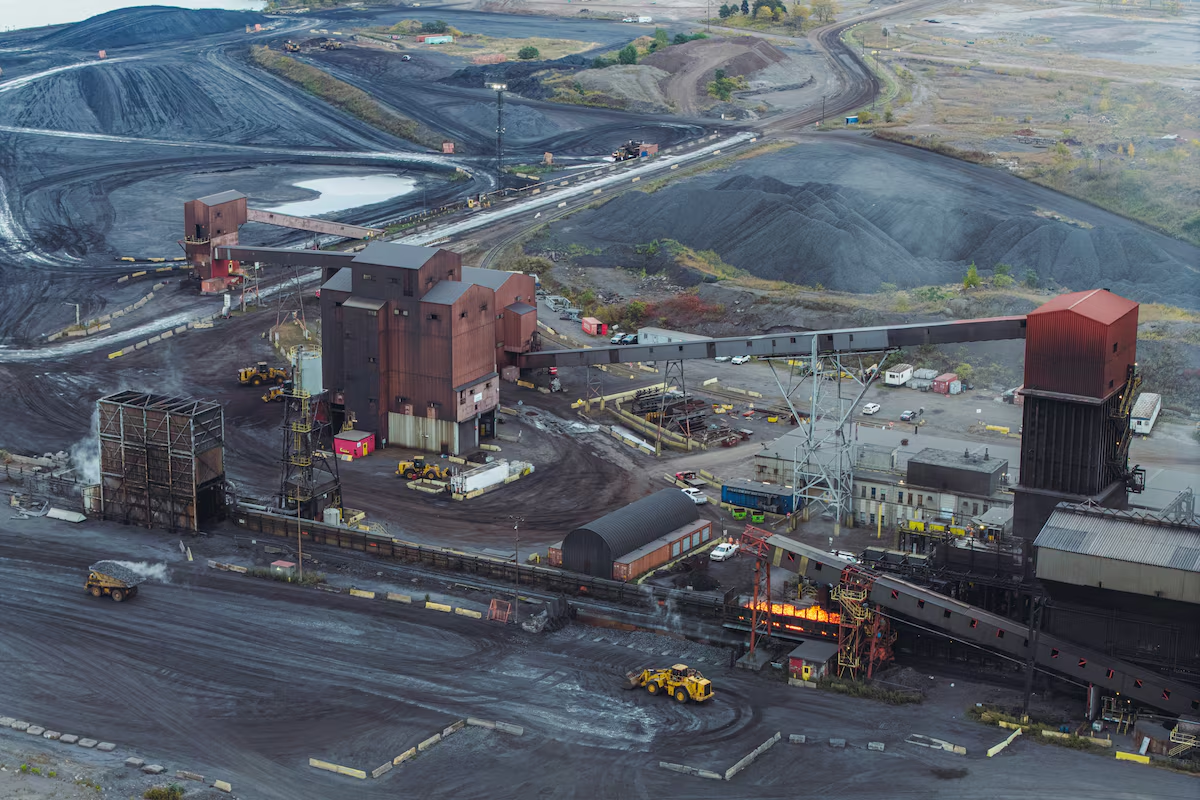
The Stelco Hamilton Works steel mill, owned by Cleveland-Cliffs, in Hamilton, Ont., on Tuesday.Carlos Osorio/Reuters
U.S. steel maker Cleveland-Cliffs Inc. CLF-N could face legal action from Ottawa for violating job commitments stemming from its 2024 acquisition of Stelco Holdings Inc. after announcing hundreds of layoffs in Canada on Monday, but the devil will be in the details, a legal expert told The Globe and Mail.
In 2024, the Cleveland-based company announced its intentions to buy Stelco for $3.4-billion. The federal government approved the transaction, but only after imposing a series of legally-binding conditions on Cliffs.
Those included Cliffs promising to maintain for five years at least the same number of unionized employees and the vast majority of non-unionized employees.
Cliffs on Monday said it was laying off a total of up to 500 workers at Stelco’s Hamilton plant and its Lake Erie Works operation in Nanticoke, Ont. The company said the layoffs were necessary to ensure the company’s survival during the trade war with the United States.
Some of the workers affected by the layoffs will be offered jobs at Lake Erie Works, but the number won’t be nearly enough to fill the void left by the cuts.
Trump expects Canada to cave in trade war as Stelco cites tariffs for layoffs
Ron Wells, president of United Steelworkers Local 1005, said that there are only 46 openings at Nanticoke and he is now pushing for Ottawa to hold Cliffs to its promise to maintain employment levels.
“We’re hopeful that the Canadian government enforces the Investment Canada Act,” he said. That act stipulates that major investments into Canada by foreign companies should benefit the domestic economy.
The Globe asked the office of Industry Minister Mélanie Joly whether the government considers Cliffs to be in violation of its commitments, and whether it is intending to sue the steel maker.
“Stelco and Cleveland-Cliffs have made significant commitments to Canadian steelworkers,” Gabrielle Landry, deputy director, media relations with the office of Ms. Joly wrote in an e-mail.
“We will use every lever possible to defend Canadian industry, protect jobs, and secure our supply chain.”
Cliffs did not respond to a request for comment.
Six charts that explain Canada’s countertariffs on U.S. goods
Subrata Bhattacharjee, national chair of the competition and foreign investment review group with Borden Ladner Gervais LLP, said that without knowing the details of the legal agreement between the company and Ottawa it is impossible to know with certainty whether Cliffs is offside.
“Until you actually see the agreement, you can’t really say for sure,” he said.
At the very least, however, he believes Ms. Joly will be having a conversation with the company around the promises it made in the agreement.
“Cleveland Cliffs will likely be trying to explain how the tariff situation is out of its control, and that it will need either some other deal, or have to be released from the undertaking, and then we’ll see what happens,” Mr. Bhattacharjee said.
“The process now includes the opportunity to renegotiate or mediate another solution, and I suspect that in the current environment, it’s quite likely the government may try to seek some other type of assurance.”
Trump’s attacks on Canada keep colliding with U.S. interests
There is precedent for the government to act and it revolves around the same Canadian steel maker. After U.S. Steel acquired Stelco in 2007, it made commitments under the Investment Canada Act around jobs and production levels. After the financial crisis hit in 2008, U.S. Steel laid off workers in Canada. The federal government later sued the company for allegedly reneging on its legally-binding commitments. A settlement was reached in 2011 with U.S. Steel agreeing to a new set of commitments, including around production levels and investment in Canada.
Canada’s steel sector has been throttled by 50-per-cent tariffs imposed by U.S. President Donald Trump last year. The federal and provincial governments have rolled out multiple initiatives to help the industry, including providing hundreds of millions of dollars in funding, cracking down on the dumping of foreign steel into Canada and mandating that publicly funded projects use Canadian steel wherever possible.
Ms. Landry said that financial aid has been offered by Ottawa to Stelco to keep its operations going during the trade war in order to maintain employment levels, but it was turned down.
“For some time, our government has made clear to the company that we are ready and willing to provide financial support to sustain operations and protect jobs,” she said.
“Its decision to reject these practical proposals and continue with layoffs is extremely disappointing.”