
Open this photo in gallery:
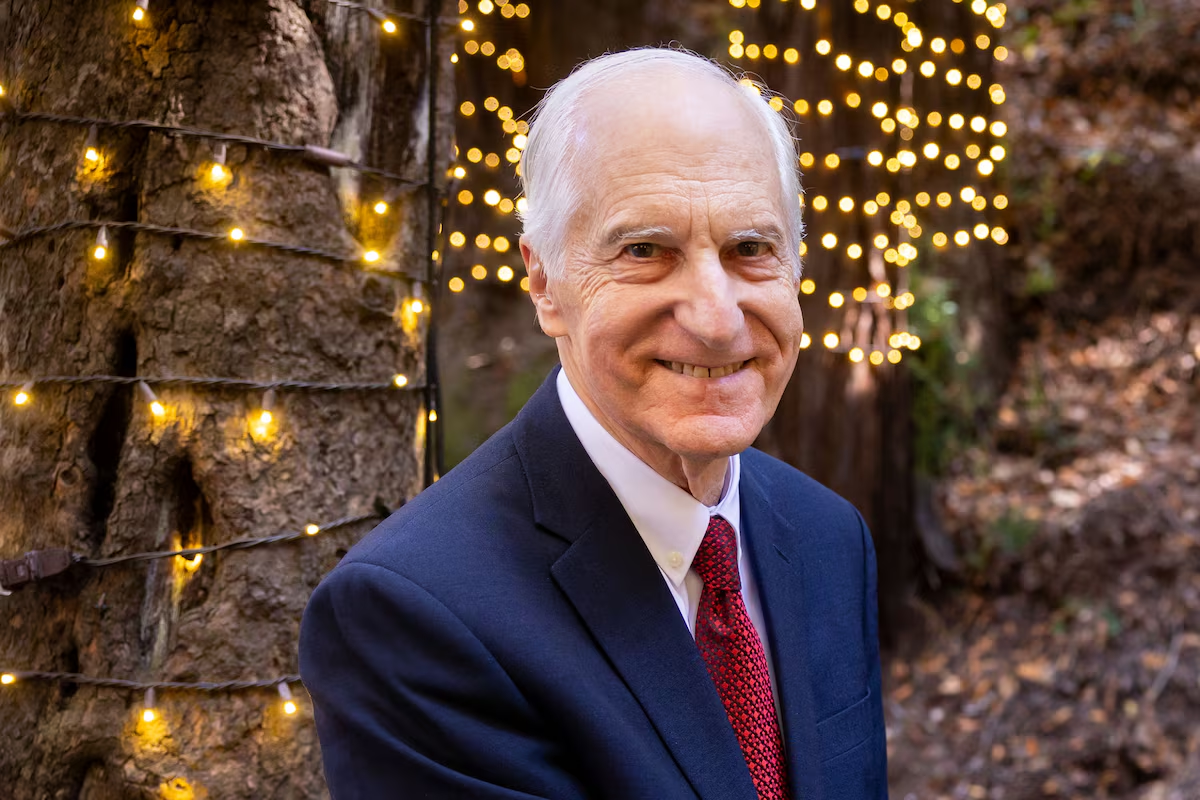
Rabbi Leigh Lerner was the long-time lead rabbi of the reform Temple Emanu-El-Beth-Sholom in Westmount, Que. until his retirement in 2012.Scott Lasky/Supplied
Rabbi Leigh Lerner’s catchphrase was “Go do it,” no matter if the goal was to start a food bank, combat human trafficking, fight for LGBTQ rights or overcome opposition to interfaith marriage. As a university student in the United States in the mid-1960s, he was steeped in the tradition of social justice advocacy, with a finely honed sense of right and wrong and the quiet determination to get things done, even if others disagreed with him.
As the long-time lead rabbi of the reform Temple Emanu-El-Beth-Sholom in Westmount, Que. (upon his retirement in 2012, he became the synagogue’s “Rabbi Emeritus”), he saw the job as something that was rooted in tradition but needed to change to respond to the times. Like the Talmudic scholars of yore, he believed that issues needed to be discussed openly, not only within the confines of the Jewish community, and that faith should encompass everyone who wanted to participate, even in the most peripheral of ways.
In 1977, when Mr. Lerner was the senior rabbi at the Mount Zion Temple in St. Paul, Minn., he officiated over what the state’s historical society calls the first interfaith wedding in any Minnesota house of worship. He continued that practice in Montreal, where he also regularly presided over same-sex civil unions and then same-sex marriages when they became legal.
“If you spend 23 years leading one congregation and over 50 years in the rabbinate, like Leigh did, you don’t do it well without perseverance and a commitment to who you are and what you do,” said Rabbi Lisa Grushcow, his successor at Temple Emanu-El-Beth-Sholom. “He left a strong and healthy community in a city where we are the only Reform congregation with all the unique pressures that entails. And he did it by bringing us to the table with a radical inclusivity.”
Mr. Lerner died in Las Vegas on Sept. 5 from complications due to a stroke. He was 81 years old, a tall, lean, polyvalent man who learned French when he moved to Montreal in 1989 in order to better understand the city at large, and who was given to striding the streets in a deerstalker hat, his hands folded behind his back.
His friend, Rabbi Bob Alper, with whom he studied at Hebrew Union College in Cincinnati, said their relationship really began a few years after they had both graduated. That was when Mr. Lerner returned class notes he had borrowed from Mr. Alper in their final year.
“I had asked for the notes to be returned but Leigh insisted he had no idea what I was talking about,” Mr. Alper recalled. “Then, as he was going through old boxes in St. Paul, he found them, sent them to me with an apologetic note.
“That was a spark for me. He was a man of quality and modesty, with great strength of character.”
It demonstrated what his friend was so good at, Mr. Alper continued: creating sparks of kindness and understanding day by day, year by year, that represented the highest form of Judaism.
For 22 years, Mr. Lerner marched in Montreal pride parades, while he was a member of the advisory council of the now-defunct Across Boundaries Multifaith Institute in Montreal, a past president of the Montreal Christian Jewish Dialogue and a supporter of the Montreal Muslim Jewish Dialogue. He was wont to say that it was through such dialogues that people learned of the diversity that thrives on the other side of the table.
“Is inter-religious dialogue realistic? Is it practical? Yes, and it is very necessary,” he once said during a panel discussion in November 2003. “It is remarkable for me to see how people who have been in dialogue for some time are discovering that others are coming to them and saying, ‘Can we get in on it?’
“They realize that there is a gap, there is something missing in the quality of our understanding of one another, and that only dialogue is a viable and safe way for people of different faiths to understand each other.”
At a time when anti-Semitism is on the rise, including a firebombing of the Temple Emanu-El-Beth Sholom earlier this year, Mr. Alper said that his friend’s message is more important than ever.
“As grief-stricken we all are, as upset, angry at what the world has come to, Leigh would have been consoling and strengthening people where he could, encouraging people to be strong,” he noted.
Leigh Lerner was born in a military hospital in Fort Snelling, Minn., on March 3, 1945, the first of David and Edith Lerner’s two children. At the time, his father was overseas with the army in the final months of the Second World War; when he came back, he worked as a car salesman. The family lived in St. Louis Park, a suburban community just west of Minneapolis before moving to Atlanta for about a decade, then to Chicago. Perhaps because of the moves, Leigh and his little sister, Trudie, were close; when they fought, as siblings will do, it was always the brother who would approach his sister later, hand outstretched and asking for them to be friends again.
Neither parent wanted their son to enter the rabbinate. Indeed, his mom pushed for him to become a doctor. Wanting to please her, he took premed classes at Duke University in Durham, N.C., but was drawn more to English and writing, eventually getting his undergraduate degree in English literature.
While he was at Duke, his mother became gravely ill. As she lay dying, she gave her son her blessing to become a rabbi. In 1972, he was ordained by the Hebrew Union College-Jewish Institute of Religion in Cincinnati and embarked on a career that would take him from St. Paul to Montreal and, upon his official retirement, to minister to congregations during stints in Italy, for which he learned Italian. As much as he loved Montreal, he was happy to leave snow and ice storms behind, so he established a new home in Las Vegas.
Among the highlights was a trip he took with Mr. Alper in 1983 to Moscow and Leningrad (now Saint Petersburg) to meet with Soviet refuseniks, the term for Jewish citizens who were denied visas to emigrate.
“It was one week of an amazing, dangerous, scary, spiritually uplifting experience, the most important week of my life as a Jew,” said Mr. Alper. “We met in the Frankfurt Airport, where we walked around and around, coding our notes, memorizing them, then throwing them out because we knew the last thing the KGB wanted was for nosy American rabbis encouraging dissidents.
“I have this memory of Leigh standing tall and straight in Moscow next to a woman we’d hired as our tour guide for a day, laughing delightedly when I told them to smile and say ‘visa’,” he continued. “His smile was just one of the innumerable sparks he lit that will continue to light our way into the future.”
Mr. Lerner was awarded the Queen Elizabeth II Diamond Jubilee Medal in 2012 for his contributions to the community and to Canada. He leaves his wife, Loren Lerner; his sister, Trudie Lerner; a half-brother, Terry Brashem; his daughters, Meredith Bloom and Sasha Lerner; his stepsons, Sam and Daniel Singer; and four grandchildren.
You can find more obituaries from The Globe and Mail here.
To submit a memory about someone we have recently profiled on the Obituaries page, e-mail us at obit@globeandmail.com.