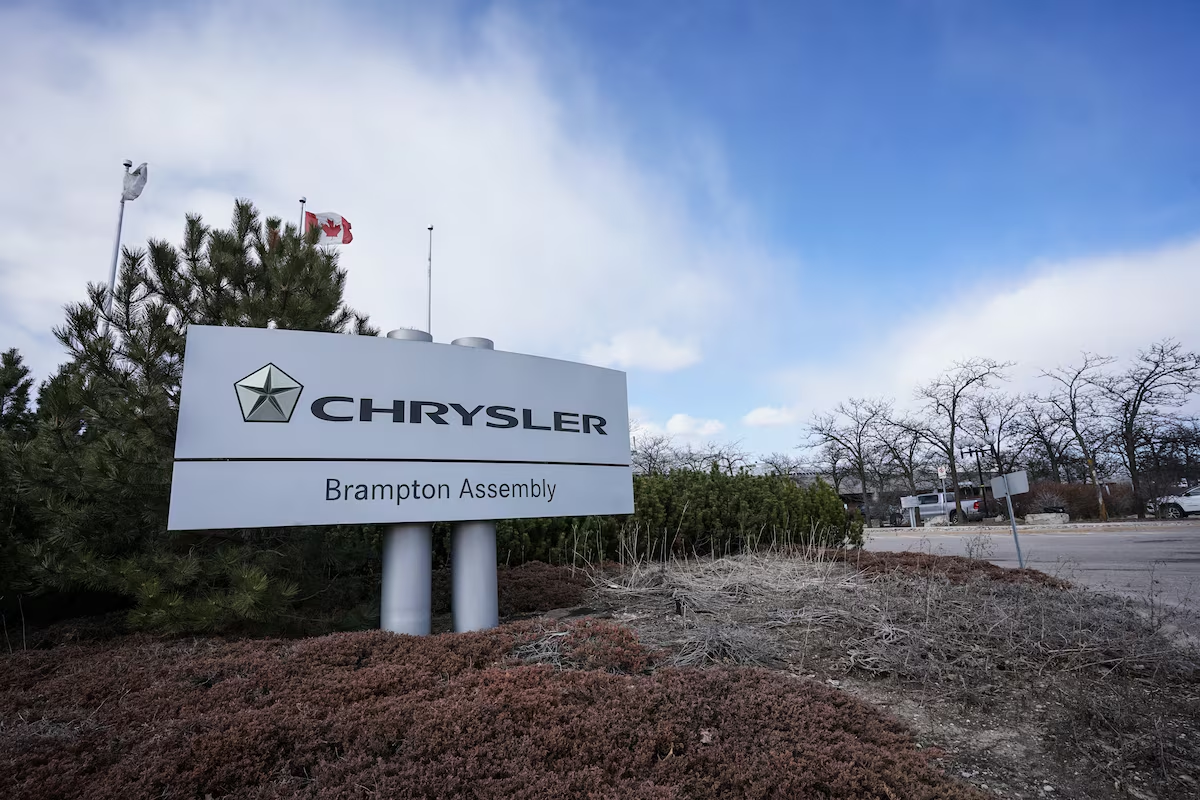

Open this photo in gallery:
The Stellantis plant in Brampton has been idled for a year and a half and its 3,000 workers without jobs after planned production of the Jeep Compass was moved to Illinois.Andres Valenzuela /The Globe and Mail
The General Motors plant sits silently at the edge of Highway 401 in Ingersoll, Ont., the parking lot mostly empty and the assembly line still. The two-million-square-foot factory, which made the BrightDrop electric delivery van, closed in October and its 1,150 workers were laid off.
About 90 minutes away, in Brampton, a Stellantis car plant has been idled for a year and a half and its 3,000 workers without jobs after planned production of the Jeep Compass was moved to Illinois.
The Detroit-based carmakers have not declared the plants surplus, and are not ruling out the chances they will make vehicles again.
But industry experts and labour officials say the factories’ fates depend on trade talks with the United States that bring relief from U.S. President Donald Trump’s Section 232 tariffs and the renewal of the free-trade deal.
Mr. Trump has said the U.S. doesn’t need Canada’s cars. This is despite the countries’ interwoven supply chains that have fostered efficiency and tariff-free trade for decades.
Unifor sets July 10 deadline for tentative agreement with Ford as auto talks kick off
July 1 is the date by which the countries in the U.S.-Mexico-Canada Agreement must declare if they want the free-trade deal to continue, expire, or be reviewed annually. Mr. Trump has also applied 25-per-cent tariffs on the non-U.S. content of vehicles made in Canada, forcing manufacturers here to halt investments and rethink supply chains as they pay billions in U.S. duties.
Lana Payne, head of the union that represents Canadian auto workers, says finding new vehicles for Ingersoll and Brampton will be among the demands Unifor negotiators will make when contract talks begin with the two automakers in the next several weeks.
“There’s a lot of our members that are struggling right now,” says Steven Pye, president of the union local that represents the Ingersoll workers.
Still, industry experts say reopening plants – and maintaining existing ones – depends on dropping the tariffs and renewing free trade, not labour agreements.
“We need to renew USMCA because it sets the framework and the rules for the automotive industry that’s totally integrated across North America, but you cannot renew the agreement without certainty from the Americans that the Section 232 tariffs will go away,” says Brian Kingston, head of the Canadian Vehicle Manufacturers’ Association, which represents GM, Stellantis and Ford Motor Co.
Auto production at Ontario plants in 2025 was 1.2 million vehicles, down by about 2 per cent from 2024, but a steep drop from a decade ago, when it was 2.3 million. Without affordable access to other markets, about 90 per cent of Canadian production is shipped to the U.S. and subject to tariffs.
Canada has applied countertariffs on cars imported from the U.S., with breaks for companies that maintain a footprint here.
In bilateral talks with Mexico, the U.S. has signalled it is looking at increasing U.S. content in cars, but has yet to commence discussions with Canada.
Meanwhile, tariffs on cars made in Canada or Mexico exceed US$1,600 per vehicle, according to Anderson Economic Group, a Michigan-based consultancy. That doesn’t include duties on the steel and aluminum used to make the components.
“Building vehicles in Canada is costing manufacturers billions of dollars in tariff costs,” Mr. Kingston said. “It’s not sustainable. We have to deal with this first, and then we can start to have more substantive discussions around ways to perhaps change, improve, modernize elements of” USMCA.
The Ingersoll plant, known as CAMI Assembly, opened in 1989 as a partnership with Suzuki Motor Corp. The plant made the Suzuki Sidekick, GEO Metro and Suzuki Swift before the Japanese company sold its half to GM a decade later. GM would go on to make the popular Chevrolet Equinox in Ingersoll, turning out 300,000 a year and employing 3,000, but shifted production to Mexico in 2022. That’s when the plant was retooled with taxpayer money to become Canada’s first large-scale electric vehicle plant.
Open this photo in gallery:
The GM-CAMI assembly plant in Ingersoll, Ont., October, 2025.Mark Spowart/The Canadian Press
But the BrightDrop sold poorly, and faced tariffs crossing the border. GM discontinued the model and closed the plant last fall.
“CAMI Assembly continues to be assessed for future opportunities, and GM is investing the time necessary for discussions that will deliver better outcomes for our people, our communities, and our customers,” GM spokeswoman Jennifer Wright said.
There have been rumours and reports about the plant’s future that include a sale to a European company, a partnership with a Japanese or South Korean carmaker, and the plant’s retooling to make GM military vehicles.
None has panned out yet.
For Brampton, the federal government rejected the idea of a Stellantis-Leapmotor partnership that would build electric cars from kits shipped from China.
Opinion: If Canada Auto can’t survive, let it fade away. Courting China is not the solution
“We continue to explore options that support a sustainable future for the Brampton assembly plant,” said LouAnn Gosselin, a Stellantis spokeswoman.
Trade tensions aside, Sam Fiorani, an analyst with Pennsylvania’s AutoForecast Solutions, points to a couple other reasons the plant will remain empty, including pressure from Mr. Trump himself. “GM doesn’t have a lot of excess product right now to put into that plant, and it would be very difficult for them to announce anything until USMCA negotiations are finished,” Mr. Fiorani said.
“It’s also the position of the U.S. where if any investment goes to Canada, the belief is it should have gone to the U.S.,” Mr. Fiorani said. “That’s from the White House.”
Peter Frise, a professor at the University of Windsor, is blunt when asked what it will take to reopen the plants: “Better sales.”
The Brampton plant’s retooling was halted early in Mr. Trump’s trade war on Canada, but the part of the Ingersoll factory that made the BrightDrop is modern and in good shape. “I think it could be resurrected, but that would be predicated on General Motors selling a lot of cars and needing the capacity,” Prof. Frise said.
Strong sales of the highly profitable F-series pickup trucks drove Ford to retool its Oakville assembly plant – closed since 2024 – and reopen it this spring. Ford reversed an earlier plan to make EVs at the factory west of Toronto amid U.S. policy shifts that slowed growth of emissions-free vehicles.
Mr. Pye, the union leader, says that if Ford can restart a factory that will employ 1,800 making trucks destined for the U.S., then so can GM and Stellantis.
“If Ford can do it, we’re not really taking GM and Stellantis at face value that they can’t do something in these facilities,” he says, pointing to commitments Stellantis made to Brampton before shifting plans to a factory in the U.S.
“The Big Three are gonna do what they’re gonna do, and all we can really do is try and fight for product and get our members back to work.”