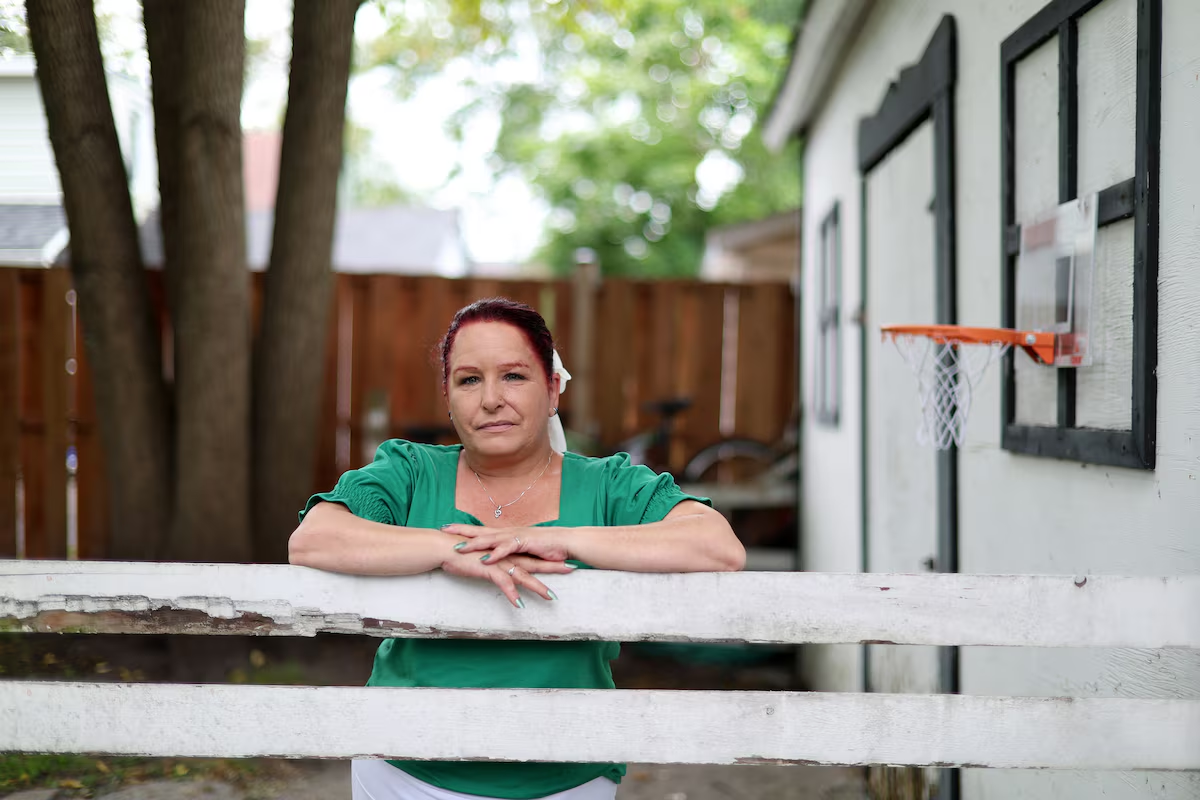

Open this photo in gallery:
Jennifer Gaskin at her Ontario home on Sept. 17. Ms. Gaskin is appealing her 2002 manslaughter conviction; specialists testified during her trial that her newborn’s fatal injuries were caused by the now widely contested ‘shaken baby syndrome.’Dave Chan/The Globe and Mail
More than 20 years after she was convicted in the death of her baby boy, and more than a decade after the science of “shaken baby syndrome” was called into question, Jennifer Gaskin is hoping to finally clear her name.
The 51-year-old, convicted of manslaughter in 2002, is preparing to appear before the Ontario Court of Appeal. In advance of the Sept. 29 hearing, Ms. Gaskin’s lawyers and the Crown have come together, jointly submitting to the court that her conviction be quashed.
“In light of the overwhelming weight of the current expert opinion, the appellant’s conviction cannot and should not stand,” Crown lawyer Elise Nakelsky said in written arguments, filed in court. “This Court ought to set aside her conviction for manslaughter and enter an acquittal.”
For Ms. Gaskin, who spent 18 months in prison, it is a chance to lift the stigma she has long carried and an opportunity to prove to her surviving children, who were taken from her after Joeseph’s death, that she is innocent.
“For 27 years, my other two children have thought I killed their brother Joeseph,” she said in a statement to The Globe and Mail. “If my appeal goes well, I pray they will realize I did not kill their brother, and accept me as their loving mother.”
The appeal is the latest in a decades-long effort to undo the damage caused by the now widely contested forensic theory of shaken baby syndrome (SBS).
The term was first coined in the early 1970s and became a go-to diagnosis for pathologists probing baby deaths in cases where infants had a combination of brain swelling, retinal bleeding and tissue damage to the brain lining.
But it came under scrutiny in the early 2000s, when some experts began to dispute the validity of the diagnosis and raise concerns that it had led to wrongful convictions.
From the archives: Experts divided over shaken baby syndrome
In Ontario, an inquiry into errors by Charles Smith, a former forensic pathologist at Toronto’s Hospital for Sick Children, uncovered more than a dozen child-death cases that were tainted by flawed analyses, often involving marginalized families, including those involved with child welfare agencies.
A committee was established in 2008 to specifically probe so-called shaken-baby deaths in the province dating back to the 1980s. It reviewed 129 cases, ultimately narrowing in on 13 cases in which people were convicted.
Ms. Gaskin’s case was one of them.
The fresh evidence submitted by Ms. Gaskin’s legal team in her appeal includes the findings of that committee, along with new reports by a forensic neuropathologist, a biomechanical engineer and a forensic pathologist, who concluded that while it would be difficult to rule out an inflicted injury, natural causes could also have been to blame.
They pointed out that much more substantial testing and analysis would be done after a death like this today than was done (or even possible) at the time.
“As of today, the original expert evidence supporting the conviction of the appellant at trial has been wholly undermined and placed in grave doubt,” Ms. Nakelsky summarized in the Crown’s written arguments.
Baby Joeseph Gaskin was nine-and-a-half weeks premature when he was born via cesarean section on April 13, 1999.
He was intubated and ventilated for two days, according to the documents filed by Ms. Gaskin’s counsel, veteran wrongful convictions lawyer James Lockyer. He was kept on oxygen for five days, and was treated for moderate respiratory distress syndrome, hypoglycemia and an elevated white blood cell count usually associated with infection. He was given a 10-day drug regimen to fight bacterial infections.
As he gained weight, the monitoring was scaled back, and he was finally able to go home on June 11.
On June 30, Ms. Gaskin – who was 23 and also had a 13-month-old baby at the time – took Joeseph to the clinic, concerned that he’d been throwing up his formula feedings. According to the defence’s court filings, a nurse looked Joeseph over and said he was “fine as long as he kept peeing and pooping, and his skin didn’t get dried up.”
He’d gained half a pound from five days earlier. He was smiling and appeared healthy and hydrated. She took a swab of his right eye, which was crusty, but otherwise instructed not to overfeed him and to return if the vomiting continued.
The next day was Canada Day, so the clinic was closed. Ms. Gaskin remained concerned about Joeseph, who was still spitting up on and off, according to the defence’s court filings, but took solace in the nurse’s reassurances from the day before.
When a friend visited that evening, Ms. Gaskin told her she was having trouble coping, according to the defence’s court filings. She did not have a large support system in Ignace, Ont., where she was living with her boyfriend, Dale Jones, raising two kids under the age of 2.
After being diagnosed with severe pre-eclampsia during her pregnancy with Joeseph, she had asked the Children’s Aid Society to take care of her older baby on a temporary care arrangement.
A worker with CAS – who assisted the family after both babies came home – also visited on July 1. She said the baby seemed fine, according to the defence’s court filings, but noticed his eyes “had a type of glaze or a haze that wasn’t normal looking.”
Throughout the night and into the next morning, Joeseph continued to spit up, on and off.
On the morning of July 2, Ms. Gaskin and Mr. Jones took the children to the health unit for their weekly weigh-in. A clerk recalled that the toddler seemed normal, but Joeseph was “cranky” and “pale looking,” according to her court filings.
Afterward, the couple ran into a friend and headed to a local restaurant for lunch.
Mr. Jones took the babies home around 11:30 a.m., after Joeseph started to whine for a bottle, and Ms. Gaskin stayed with her friend.
When he got home and changed Joeseph’s diaper, Mr. Jones noticed the baby turning bright red, according to the defence’s court filings. He tried CPR and then sought help from neighbours before an ambulance was called. By then the baby was grayish-blue, unresponsive and not breathing.
Mr. Jones called her at the restaurant.
“I hung up, ran and grabbed my things and ran to the clinic,” Ms. Gaskin later told police. “I got there before the ambulance.”
Joeseph was intubated and given oxygen, epinephrine and atropine. He was pronounced dead early that afternoon.
An autopsy was conducted by David Welbourne, a surgical pathologist at Thunder Bay Hospital. He described Joeseph as a normal-looking premature baby with no external injury or bruising and no fractures to his limbs or scalp.
But he identified bleeding and bruising on the baby’s brain, as well as epidural bleeding throughout Joeseph’s spinal column, retinal bleeding and bleeding in the optic nerve sheaths.
Dr. Welbourne concluded Joeseph had incurred multiple injuries at different times from shaking and that “head injury” was his cause of death.
William Halliday, a neuropathologist at the Hospital for Sick Children, who, according to Ms. Gaskin’s court filings, was qualified by the court as a “shaken baby syndrome” expert, provided a second opinion.
Dr. Halliday, too, concluded that the injuries were caused by shaking, and that the baby had been in a traumatic environment for about two weeks.
(A spokesperson for the Thunder Bay Hospital, where Dr. Welbourne works, directed The Globe to the provincial coroner’s office, where a spokesperson declined to comment. SickKids and Dr. Halliday did not respond to e-mails from The Globe.)
In interviews with police, Ms. Gaskin “vehemently and consistently” denied that she or her boyfriend had ever hit or shaken either of the children.
She told the officer that if she ever felt herself getting stressed out or overwhelmed, she would simply put the baby down and go for a cigarette.
“I’ve never shaken that baby,” she said, according to the court filings. “I could kill myself before I do anything to hurt my kids.”
Eight months after Joeseph died, Ms. Gaskin was arrested and charged with second-degree murder.
At trial, the Crown’s position was that the baby died from injuries inflicted by at least three incidents of shaking, and that as the primary caregiver, Ms. Gaskin was the only one who could have shaken him three times.
Her defence lawyer at the time argued that the Crown had not proven that Ms. Gaskin had injured the baby, either intentionally or unintentionally – and that many questions about his injuries remained unanswered by the evidence at trial. But the jury found her guilty of manslaughter. She was sentenced to two years less a day in prison.
In 2010 – as part of the Shaken Baby Death Review Committee’s process – Ms. Gaskin consented to having her case reviewed by an International Medical Panel (IMP).
The panel, according to the court filings, was unable to determine Joeseph’s cause of death, and “could not say whether death occurred ‘with’ or ‘of’ a head injury.”
In the Shaken Baby Death Review Committee’s report on Ms. Gaskin’s case, excerpted in both the Crown and defence’s court filings, they wrote that “the fact that the IMP could not determine the cause of death, or whether the baby died of a head injury at all, raises concerns about the evidence relied on to support Ms. Gaskin’s conviction.”
In addition to Ms. Gaskin’s case, the committee flagged concerns with three other cases involving convictions based on now discredited shaken-baby syndrome testimony.
One of them was that of Bernard Doyle, who was acquitted in 2023 of manslaughter charges in the 1996 death of his partner’s 17-month-old son. Mr. Doyle – who was convicted in 1997 and, like Ms. Gaskin, was represented on appeal by Mr. Lockyer – had maintained that he was dancing with the boy when he accidentally tripped and fell.
In the United States, too, the justice system continues to reckon with the fallout of the shaken-baby debate.
Robert Roberson, a death row inmate in Texas, narrowly escaped execution for the third time last fall, days before he was slated to become the first person in the U.S. to be put to death for a shaken-baby-syndrome murder conviction. Mr. Roberson and his lawyers assert that his 13-month-old daughter Nikki died not of abuse, but of complications from pneumonia.
The day after Joeseph’s funeral, in July, 1999, Ms. Gaskin’s 14-month-old daughter was apprehended by Children’s Aid and then adopted by a family in Dryden. While on bail awaiting her trial, Ms. Gaskin gave birth to a third child, a son. He too was apprehended.
Ms. Gaskin – who lives in Eastern Ontario today, where she works as a restaurant hostess – has not seen her surviving children since then, she wrote in an affidavit earlier this year, and has never been able to grieve Joeseph properly.
“I have never felt able to breathe freely because I feel everyone sees me to be a monster,” she wrote.