
Open this photo in gallery:
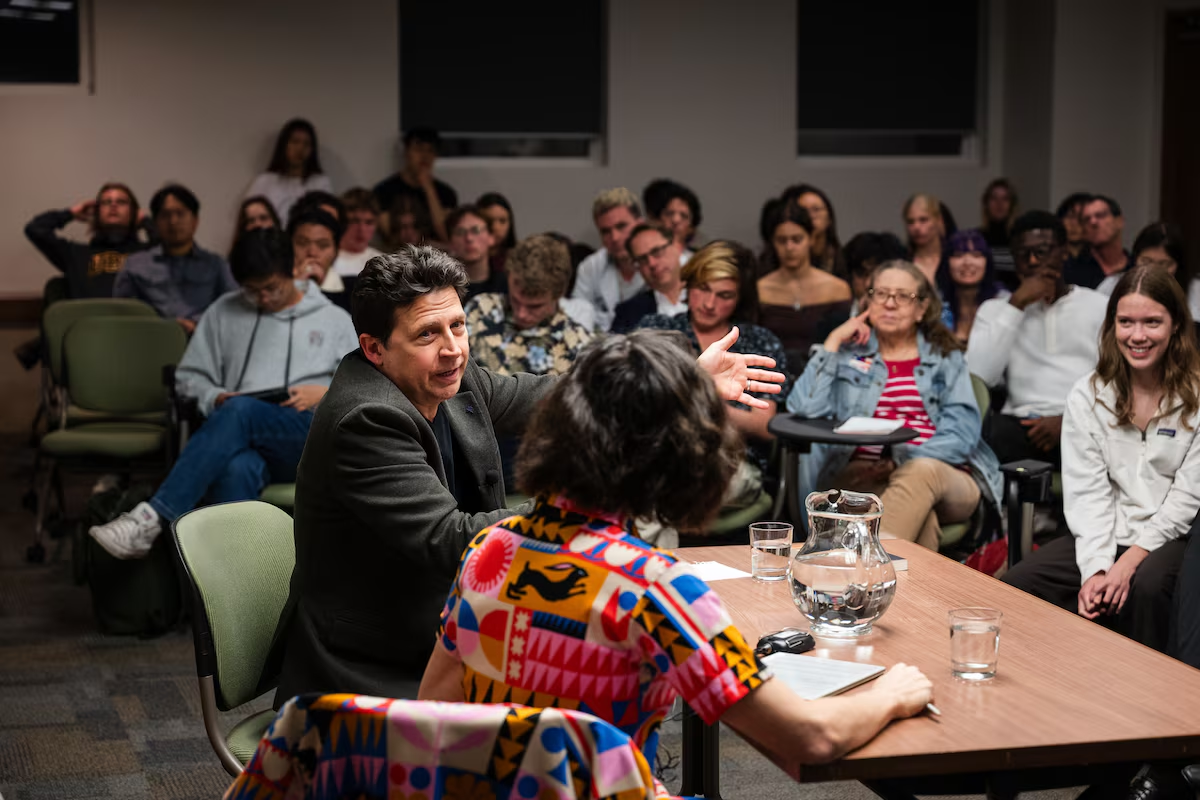
Agnes Callard, professor of philosophy at University of Chicago, speaks with Joe Heath, a political and economic philosopher at the University of Toronto, during U of T’s inaugural Night Owls, a late-night conversation about philosophy, in Toronto on Thursday.Photography by Laura Proctor/The Globe and Mail
In his brief remarks welcoming University of Toronto students to the first Canadian instalment of the after-dark philosophy series “Night Owls,” Randy Boyagoda commended the audience for coming to an event that wouldn’t juice their résumés or help them score a job.
“This is not going to get you into law school,” Prof. Boyagoda, the new director of U of T’s Jackman Humanities Institute, said with a wink. “No one’s going to write you a rec. letter for being here. I will sign no co-curricular transcripts because you are here.
“Why are you here? You are here because you have made the decision to live as if ideas matter.”
For the nearly three hours that followed last Thursday night, about 100 rapt students sat – or stood if they had trickled in late to the packed, fluorescent-lit lecture room – as celebrity philosopher Agnes Callard of the University of Chicago and Joe Heath, a political and economic philosopher at U of T, debated the ethics of capitalism.
The Night Owls event gave students a chance to hear ideas bandied about for their own sake, something that isn’t exactly in vogue in Canada’s job-obsessed postsecondary education sector, where funding is increasingly directed to STEM, trades and professional fields.
Open this photo in gallery:
About 100 students attended the nearly three-hour event.
The freewheeling discussion roamed from a comparison of co-operative and competitive capitalism, to talk of whether modern dentistry could be seen as a triumph of pricing and markets, to the differences between true socialism and what Vermont Senator Bernie Sanders advocates for. (“That’s just Canada,” Prof. Heath said to laughs.)
“I thought it was great,” Tiara Maleki Yazdi, a first-year student who plans to major in philosophy and English, said over pizza and cans of Bubly sparkling water at the break.
She and her friends still weren’t sure how some of the philosophical concepts Prof. Callard and Prof. Heath tossed around would apply in real life, but said “it was a real privilege to listen to it and get exposed to a new perspective.”
Opinion: Capitalism has always been deeply political
The Ontario government is spending $1.7-billion over four years to fund 70,000 new seats at colleges and universities for programs in STEM, health care, teaching and skilled trades. Forty-thousand of those spaces were allocated only after schools consulted local businesses to make certain their program expansions met labour-market demands, the provincial government announced Sept. 10.
The following day, Alberta unveiled the next phase of its expanded enrolment plan, adding 8,000 seats at colleges and universities by 2028-29 in nursing, teaching, paramedicine, engineering, technology and trades.
The humanities haven’t benefited from the same government largesse or student demand.
Liberal arts programs are mostly contracting, although the specifics differ by school and discipline. About 70,000 fewer students were enrolled in humanities programs at universities and colleges across Canada in 2023-24 compared with a decade earlier, according to the most recent data from Statistics Canada.
And that was before Ottawa’s curbing of international student visas, which deprived postsecondary institutions of a major funding source. The policy change led some schools to cut or freeze their offerings, notably in the humanities.
Open this photo in gallery:
The discussion ranged from what true socialism is to a comparison of co-operative and competitive capitalism.
Prof. Boyagoda is a novelist, critic and longtime English professor, who in July became director of the Jackman Humanities Institute, which hosted the Night Owls event. He said he is sympathetic to students who want to major in the STEM or professional fields that seem likeliest to land them a job.
“I acknowledge fully the importance of providing students with the practical skills needed to succeed in the professions,” he said. “But at the same time, we shouldn’t mistake universities for technical institutes − for trade schools with better architecture.”
Many undergraduate students pursuing professional degrees are eager to study subjects such as history, art, literature, and – especially – philosophy as second majors, minors or electives at a time when artificial intelligence makes the human mind feel more valuable, he added.
Opinion: What’s university even for? Schools are broke, and degrees are worth less and less
The number of registrations in undergraduate philosophy courses has held steady or ticked up slightly since 2018-19 at U of T’s three campuses, the school’s data show.
“Philosophy is teaching you how to actually think,” said Julia Nefsky, chair of the philosophy department at U of T Scarborough. “So it’s like a power combo with a technical field.”
Prof. Nefsky and her colleagues Daniel Silver, a professor of sociology at U of T Scarborough, and Gurpreet Rattan, chair of philosophy at U of T Mississauga, proposed the Night Owls event to Prof. Boyagoda.
They were inspired by the late-night philosophy rap sessions of the same name that Prof. Callard has emceed at the University of Chicago for nearly a decade.
Open this photo in gallery:
The number of registrations in undergraduate philosophy courses has held steady or gone up slightly since 2018-19 at U of T’s campuses, the school’s data show.
Topics have ranged from “How do we judge the dead?” and “The ethics of artificial intelligence,” to “Is love worth the pain?” and the “Philosophy of divorce.”
Prof. Callard hosted the latter event with her ex-husband, fellow University of Chicago philosopher Ben Callard. The former couple later philosophized to The New Yorker about living together with Agnes’s new husband.
The University of Chicago, historically a giant of humanities education, stunned postsecondary observers when its Arts and Humanities Division decided to pause admissions to most PhD programs for the 2026-27 academic year to help the indebted school get back on its financial feet.
Opinion: We mustn’t lose sight of Canada’s education reputation on the world stage
Only the philosophy department and one program in music escaped the freeze.
After the Toronto Night Owls event wrapped up around 10:45 p.m., Prof. Callard said in an interview that enrolment in philosophy courses at the University of Chicago has bucked the downward trend of the humanities overall, just like at U of T.
Philosophy endures as a popular second choice for students majoring in hard-edged subjects such as economics, physics and math, she added.
“A lot of the humanities might seem kind of inaccessible or you’re not really sure what their concerns are,” she said. “I think philosophy wears its heart on its sleeve.”