
There’s a story Victor Montagliani likes to tell about being insulted in his first big moment as a global soccer executive.
This was in March, 2017, at the Zurich headquarters of FIFA, the global governing body of soccer. Two years earlier, the leadership of CONCACAF, the regional Confederation of North, Central America and Caribbean Association Football, had been implicated in a corruption scandal that was tearing its way through the sport. Hoping to turn the page, CONCACAF’s membership decided in 2016 to install a new president who seemed beyond reproach, which is to say a Canadian, which is to say Montagliani.
The job came with a vice-presidency of FIFA, suddenly vaulting Montagliani into one of the most powerful positions in global sport. On that March day, he found himself in the organization’s executive boardroom, a black, subterranean cavern notorious for its Dr. Strangelove aesthetic. He was chairing the inaugural meeting of the Football Stakeholders Committee, one of FIFA’s post-scandal initiatives. Representatives of some of the world’s richest clubs and leagues lined the rectangular table, along with FIFPRO, the worldwide players’ union.
Open this photo in gallery:
Mr. Montagliani speaks during the 76th FIFA Congress in his hometown of Vancouver in April, 2026.ETHAN CAIRNS/The Canadian Press
“It was all this global football, very European-based. And we’re talking about serious issues of football,” Montagliani recalled during a recent video interview from his home office in West Vancouver.
“I remember after the meeting, a couple of the guys who ran big leagues – we’re talking EPL, Bundesliga – came up to me, and one guy says: ‘Wow.’ I go: ‘What?’ He goes, ‘I never thought a Canadian had this kind of knowledge about football.’”
Montagliani paused, eyes growing wide at the affront. “And I went, ‘Wow.’” Another pause. “‘I guess it’s a compliment?’”
The executive began backpedalling, he said, clarifying that he didn’t mean any disrespect. Montagliani brushed it off. “I said, ‘You didn’t offend me. I totally get it. But you know, there’s more than one of us. There’s a lot of us. We just haven’t had the opportunity.’”
Montagliani has a lot of these stories: of being underestimated, snubbed, and of rising above the slight, of using the tales to inspire others to join him in battle against those who would count them out.
Open this photo in gallery:
From right, Mr. Montagliani, Diana Fox Carney, Prime Minister Mark Carney, and FIFA President Gianni Infantino watch the World CUp match between Canada and Qatar in Vancouver on June 18.ETHAN CAIRNS/The Canadian Press
As Canada hosts a World Cup for the first time, Montagliani has been on something of a victory tour, smiling for the press and hosting Prime Minister Mark Carney at a pair of games in Vancouver. Fifteen years ago, he and a couple of other dreamers began to sketch out an improbable plan to bring the tournament to these shores. Few took them seriously at the time, but in June, 2018, FIFA said yes to a bid that would put 13 matches in each of Canada and Mexico and 78 in the United States.
It was not a smooth road to kickoff. All international sporting competitions are fraught, but FIFA and the World Cup have carved out their own impressive brand of infamy. Spiralling costs and corruption around the 2014 edition in Brazil gave way to allegations of bid-rigging and widespread worker abuse for Russia 2018 and Qatar 2022. This year’s tournament has been beset by an array of problems, from exorbitant ticket prices to attacks by U.S. President Donald Trump’s administration on foreign fans and America’s co-hosts, undermining the spirit of an event that had been conceived as a celebration of continental unity.
Here at home, Montagliani’s World Cup dream carried a heavy cost, burdening Canada Soccer with a business deal that almost brought down the federation. That prompted nasty spats with its women’s and men’s senior teams; the toppling of its leadership; fears of bankruptcy; a $40-million lawsuit; and ugly parliamentary hearings in which MPs personally chastised him.
But Montagliani has been battling his whole life. He grew up in the rough-and-tumble 1970s in East Vancouver. “You need to stand on your own two feet and think on your own two feet pretty quickly,” he explained. He fell in with a crew of fellow Italian-Canadian kids obsessed with football – not the sport indigenous to North America but the one that, back then, was considered an immigrant’s game. Soccer might show up occasionally on TV, but it was largely ignored by the mainstream. In Canada, pro teams launched and folded regularly. Internationally, the Canadian men’s team didn’t even rate as an afterthought.
You could understand how all that might give Montagliani a chip on the shoulder, a simmering frustration that sometimes boils over into blunt language or action, as it did even on this video call. He is a man of big emotions: At Vancouver City Hall last fall, he choked up while giving an acceptance speech in front of family and friends after Mayor Ken Sim proclaimed Sept. 12, his 60th birthday, Victor Montagliani Day. He cries a lot – “my mom says sometimes too much,” he chuckled.
Sometimes that passion can rub people the wrong way. Carl Valentine, a longtime friend who played for the men’s national team in the 1986 World Cup, said Montagliani’s no-nonsense leadership style means “you’re either going to like him a lot or dislike him a lot, because what you see is what you get.”
Open this photo in gallery:
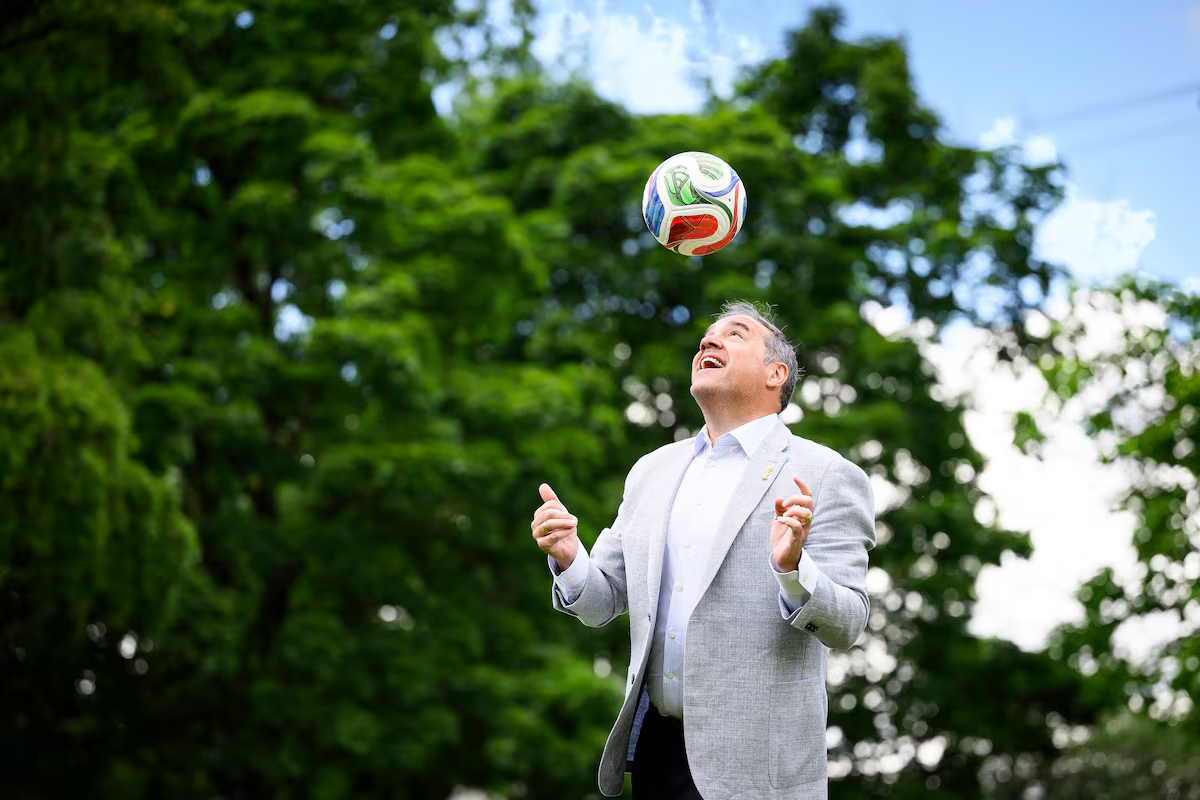
Mr. Montagliani juggles a ball at Garden Park, where he used to play pickup soccer as a kid growing up in East Vancouver.Jennifer Gauthier/The Globe and Mail
Earlier this month, Montagliani returned to where it all began for him, a one-square-block patch of grass in East Van called Garden Park. His mother still lives a couple of streets away in the house where he and his younger brother, Mario, grew up. (Their father passed away in 2024. He was such an ardent Inter Milan fan that he gave Mario the middle name Mazzola after one of the team’s legends, Sandro Mazzola.)
Back in the seventies, Montagliani recalled, the park had a big wooden fence, and “we’d just smash balls on it.” There were, he said, “a lot of pickup games on that pitch.”
A bunch of the neighbourhood boys went on to play or coach for the men’s national team. He namechecked Dale Mitchell, Bruce Miller, Dino and Carlo Alberti, Frank Ciaccia, Colin Miller. “It’s kind of a unique little spot.”
On this June day, Montagliani had brought along a Trionda, the red-blue-and-green Adidas ball designed for this year’s World Cup, to show off his skills for a Globe and Mail photographer. Though his stocky upper body may seem more fit for a rugby scrum, in his prime, Montagliani played a technical style that allowed him to assist many goals from centre midfield. He honed the fancy footwork by kicking a ball against his family’s garage wall “a thousand times” a day, said Mario, who added that his brother has always been known more for his offence than his defence.
“He couldn’t check his coat, but he can put the ball on your foot from 40 yards,” he joked in a recent interview.
Open this photo in gallery:
Mr. Montagliani balances a Trionda, the red-blue-and-green Adidas ball designed for this year’s World Cup.Jennifer Gauthier/The Globe and Mail
When he is back home for longer stretches of time, Victor still makes the occasional trek across Burrard Inlet from tony West Van to the weekly Friday morning futsal match his childhood friends still play at East Vancouver’s Italian Cultural Centre.
Montagliani played semi-pro soccer with Columbus FC and then futsal (indoor soccer on a hard court, played five-a-side) internationally until a brutal ankle injury at age 28 ended any hope of a career on the field. After getting a BA in political science with a minor in French at Simon Fraser University, he moved into the insurance business. Then a friend of his father’s said they needed someone like him to join the board of BC Soccer. He said he’d try it out for a year, loved it and soon became president, recalled Mario.
He joined the board of Canada Soccer in 2006, and in 2012, won the presidency on a platform of governance reform and the need to improve the level of on-field performance through what Montagliani called a “football first” approach. He had a reputation as “the soccer guy.”
Open this photo in gallery:
Former FIFA President Sepp Blatter, right, and then-CSA President Victor Montagliani attend the opening press conference for the FIFA Women’s Under 20 World Cup in August, 2014.The Canadian Press
Open this photo in gallery:
Former CSA president Mr. Montagliani, left, introduces then-new head coach of the Men’s National Team Octavio Zambrano in March, 2017.The Canadian Press
The game is threaded through his life. When he and his wife, Tanya, emerged from the church after their wedding 34 years ago, they did so to the strains of You’ll Never Walk Alone, Rodgers & Hammerstein’s weepie from the Broadway musical Carousel that has been adopted as a rousing anthem by fans of Liverpool FC, Borussia Dortmund, Celtic FC and other clubs.
When the FIFA scandal hit in May, 2015, and almost a dozen executives linked to CONCACAF were indicted by the U.S. Department of Justice for kickbacks and rigging World Cup bids, Montagliani was asked to be part of a seven-person caretaker committee to help right the organization.
For decades, the 41-nation governing body had been an unwieldy three-headed Hydra, with the 31-country Caribbean Football Union consistently outvoting the three North American and seven Central American associations. But with its reputation and finances in a shambles, the membership was ready for something radical.
In 2016, Montagliani ran for president on a platform of unifying the confederation under what he called “One CONCACAF.” Bobby Lenarduzzi, an East Vancouver soccer legend, recalls his friend making sure he directly lobbied every one of the 40 other soccer associations that had a vote for the presidency.
He defeated rival candidate Larry Mussenden, the head of the Bermuda Football Association, by a 25-16 margin.
Unlike Montagliani’s BC Soccer and Canada Soccer positions, the CONCACAF presidency is paid: IRS filings for the Miami-based non-profit show he received almost US$3-million in compensation in 2024.
Montagliani may seem an odd choice to lead a continental confederation. He is unpolished, inclined to blue language, physically imposing and given to awkward malapropisms. In part, that’s a function of the fact that his family spoke only Italian in the home: Family lore holds that Victor returned from his first day of kindergarten in tears because he hadn’t understood the English coming out of his teacher’s mouth, according to Mario.
Montagliani said his upbringing and decades of soccer – as well as his fluency in languages (he also speaks Spanish and French) – helped him navigate CONCACAF.
“The teammates I played with came from literally all six [FIFA continental] confederations,” he said. “I had players I played with or against that were from the Caribbean and Latin America and everywhere, and I think that really helped me be culturally sensitive and appreciative – and not judge other cultures. To listen more than you talk.”
Within a few years, he had revived CONCACAF’s reputation and fortunes, hiring new staff and introducing a raft of new and expanded competitions, hundreds of new matches each year, with robust programming on the women’s side. This brought in tens of millions of new dollars in media, sponsorship and ticketing revenue, making everyone happy. He would run for re-election twice, in 2019 and 2023, both times unopposed.
But back in Canada, the national federation he’d left behind a few years earlier began to tear itself apart in a crisis that could be traced straight to Montagliani’s time at the helm and his aspiration of landing a World Cup.
Open this photo in gallery:
From left, Sunil Gulati, former president of the U.S. Soccer Federation, Decio de Maria, former president of the Mexican Football Federation, and Mr. Montagliani, then president of the CSA, hold a news conference about the he CONCACAF bid for the 2026 World Cup, in April, 2017.The Associated Press
If Canada wanted to co-host in 2026, it needed to have a domestic professional men’s league. As Canada Soccer president, Montagliani had helped design an arrangement under which a new private company, Canadian Soccer Business, would pay the federation a flat annual fee of $3-million to $4-million for its sponsorship and broadcast rights (not including international tournaments such as the World Cup). The owners of CSB would launch a new league – the Canadian Premier League that hit the pitch in 2019 – and a streaming service, OneSoccer, which would carry the games of both the new league and Canada Soccer’s national teams.
But when money got tight for the program, critics began to blame the CSB deal, noting that profits were supporting the new league instead of the national teams.
Things got nasty. In the spring of 2022, the men boycotted a friendly match and released a public letter condemning the deal. The next winter, at a competition in the U.S., the women called for a strike until Canada Soccer forced them back to the pitch with the threat of a lawsuit.
The House of Commons standing committee on Canadian heritage convened hearings in March, 2023, in which MPs slammed Montagliani for advising Canada Soccer’s board of directors to “strip” the organization of its media and sponsorship assets and turn them over to the privately held CSB. (He left Canada Soccer in May, 2017, as the deal was being negotiated; it wasn’t signed until early 2019, by his successor, Steve Reed.)
As the controversy intensified, Nick Bontis, Canada Soccer’s president, resigned. (Days earlier, he had been elected as a paid vice-president of the CONCACAF Council, the confederation’s main decision-making body.) Chief executive Earl Cochrane quit a few months after that. In early 2024, the union representing players on the women’s team sued the Canada Soccer board members who had made the CSB deal, for $40-million. The suit is still before the courts.
Four months ago, with the World Cup and its spotlight looming, CSB – which had just rebranded as Canadian Soccer Media and Entertainment – and Canada Soccer finally announced they had struck a new deal that would give millions of dollars a year more to the federation.
“Now it’s one big happy family and I think it’s going really well,” Montagliani said. “Honestly, you need to go through these things sometimes, and I think the federation and the game is in a better shape because they went through it, quite frankly.”
Open this photo in gallery:
Mr. Montagliani, left, celebrates with delegates of Mexico and the United States, along with FIFA President Gianni Infantino, after winning a joint bid to host the 2026 World Cup, at the FIFA congress in Moscow, Russia, in June, 2018.Alexander Zemlianichenko/The Canadian Press
You’ll hear this a lot from Montagliani, this talk of family. It echoes through the way he speaks about CONCACAF. He is its proud and indulgent paternal figure.
But critics say that FIFA and its confederations have a conflict of interest at their core that can’t help but corrode the institutions.
They “not only regulate football, they regulate all markets related to football,” noted Miguel Maduro, a Portuguese governance expert, in a recent interview. “At the same time, they are also the main commercial actors in those markets.” That is, they are driven to maximize revenues, he said, “and that is not always in alignment with what ought to be the best regulation, in terms of the common good for the sport.”
Maduro was brought in by FIFA’s new president, Gianni Infantino, in 2016 to chair its governance and review committee as part of post-scandal clean-up efforts. But he left only eight months into the job after falling out of favour with Infantino, he said.
The system builds loyalty to those at the top, he added.
While FIFA’s official policy is to distribute equal funds to all of its 211 member associations (not counting the compensation for playing in tournaments such as the World Cup), it also sprinkles its largesse on associations it deems deserving through initiatives such as the FIFA Forward Development Programme. When FIFA gave US$5.4-million toward the first national soccer training centre in Indonesia in 2024, the president of the national football association thanked Infantino personally in a public letter.
“By getting more money, the president of FIFA, or the presidents of confederations, then reward or punish football associations and the people within the world of football that support them or oppose them,” Maduro said.
He noted one pernicious effect of the system is that, once presidents of confederations have solidified their power, they are rarely opposed in elections. Neither Infantino nor Montagliani has faced any challenger since they were first elected to office.
“The votes in the Congress of FIFA are ridiculous,” said Maduro. “They are unanimous. There’s no voice criticizing, and that’s all a consequence and a reflection of this power structure.”
Open this photo in gallery:
From left, Mr. Montagliani, CSA President Peter Augruso and FIFA President Gianni Infantino are presented with Canadian team jerseys during the 76th FIFA Congress in Vancouver, in April.DARRYL DYCK/The Canadian Press
For decades before Montagliani took the helm, CONCACAF’s presidents would consolidate power by rewarding loyalists. Asked whether the organization has changed much since those days, he struck a magnanimous tone.
“I always like to say that our members used to have a vote – although I don’t think they ever voted for anything – but now they have a voice. And that’s been the biggest change. We have presidents’ meetings, they’re not afraid to say their opinions because of some political stupidity or retribution. So, I think there’s a real sense of: ‘I matter and I count.’”
When he was president of Canada Soccer, not all board members felt they mattered and counted. Some told The Globe and Mail that Montagliani’s reign was known as the Victatorship.
More than a decade later, Montagliani bristled when he was reminded of this, the anger flaring through the video screen.
He brought it back to football and its team-above-all mindset. “I grew up in the game,” he said, his tone growing curt and his language turning blue.
Players, he said, might tear each other apart in training, “but when you walk out of the dressing room, you got one jersey. And that has always been my philosophy.
“So, if you’re a board member, you just want to go give interviews because you think your opinion matters more than the board that’s collectively made a decision?
“With all due respect, there’s a common denominator with a lot of people that say those things: They know nothing about the game, have never really been a part of the game. And a lot of them got involved with the game for the wrong reasons, right? Probably to build their résumé. But people that really know football understand this philosophy. You’re a team. And you disagree on the training pitch, you disagree in the locker room, but when you go out on the pitch, you’re one team.”
That team-first approach would seem to keep even Montagliani quiet. He has distanced himself from some of the more outrageous moves by Infantino, such as the creation and sycophantic awarding of the FIFA Peace Prize to Trump. But the criticism is muted. “There’s decisions that are made that I may disagree with, but in the end, the decision is made and you got to get on with it,” he said.
If the World Cup comes off without too many more bumps, it will boost Montagliani’s capital within FIFA, positioning him for a rumoured presidential run in 2031, when term limits will end both his and Infantino’s times in their respective offices.
Open this photo in gallery:
As FIFA vice-president, Mr. Montagliani holds one of the most powerful positions in global sport. He plans to hold on to the role, and says he’s focused on winning re-election next year.Jennifer Gauthier/The Globe and Mail
He did a double-take when told that former board members of Canada Soccer recall him musing, back when he led that organization, that perhaps FIFA should have a Canadian president. “I said that?” he exclaimed.
Would he want the job? “I think it’s an honour that the question is even asked, because you’re talking about a position that only nine people on the globe have had,” he said.
“My dad taught me: You never chase money, because you’ll never catch it. So, I feel the same way about all those kinds of positions. I never chased this position. It just happened.” For the time being, he said, he’s focused on winning re-election next year. “I’ll let the future take care of itself.”
As the call wound down, he admitted there was one job he craved. If he were still young and in shape, and he were tapped to play for Team Canada, “I would trade everything to put on the jersey and get on the field and play,” he said.
“Like – take whatever. Take my title, take whatever you want. If somehow God said, ‘You’re fit and you can play and you’re 25 years old?’ I’m in!”
With reports from Mike Hager