
Open this photo in gallery:
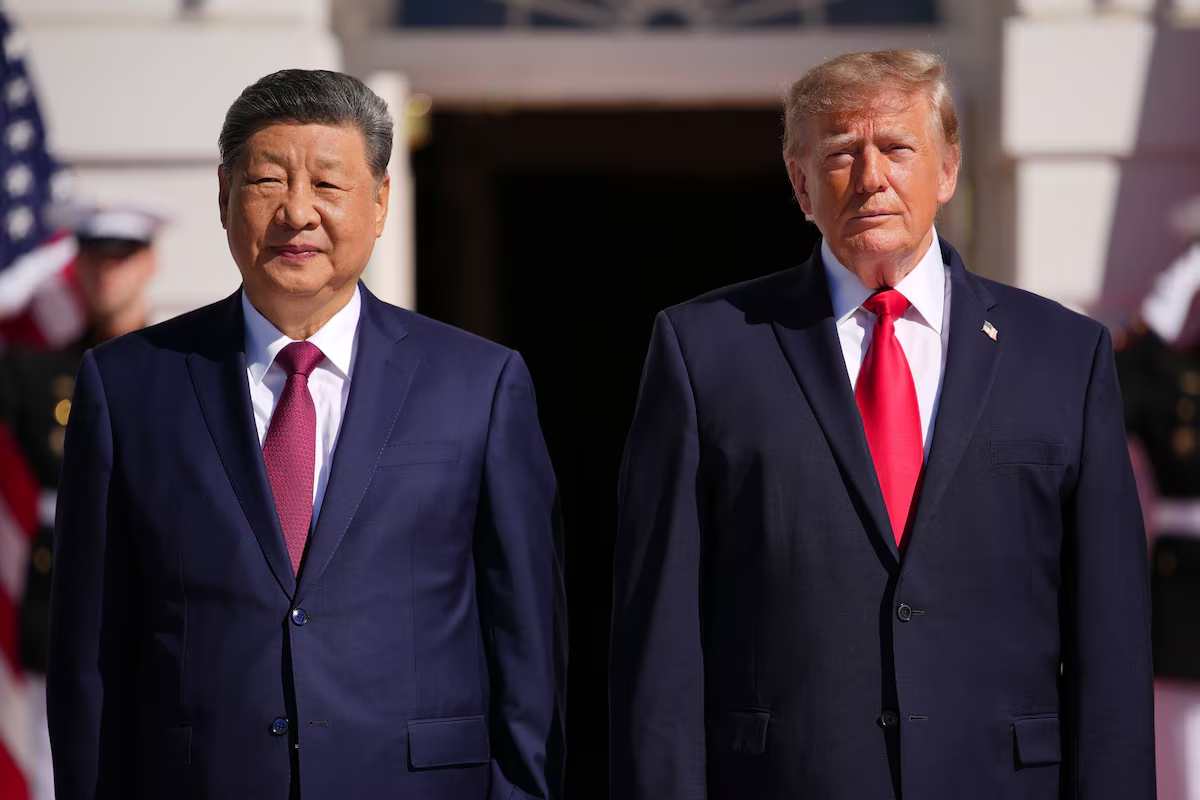
U.S. President Donald Trump greets President of China Xi Jinping as he arrives to the South Portico of the White House on Friday.Andrew Harnik/Getty Images
Over the past 18 months, the Trump administration has tried to remake the global trading system in an effort to isolate Beijing and force trade partners to trim ties with China.
But when U.S. President Donald Trump met with Chinese President Xi Jinping last week in Washington, it was not as the leader of a geopolitical bloc marching in lockstep to confront Chinese industrial might.
Washington’s heavy-handed approach to trade and economic security – using tariffs to browbeat other countries into mirroring its restrictions on China – has proved to be a mixed success.
Some countries, such as Mexico, have tacked closer to Washington. Others, like Canada, have moved closer to Beijing or begun pursuing “strategic autonomy” apart from both superpowers. A third group, which includes countries like Malaysia and Indonesia, is simply playing for time, having signed deals with Washington without implementing them completely.
Where this goes from here is uncertain. Many countries share Washington’s concerns about surging Chinese exports of automobiles and metals and China’s chokehold on supply chains for key industrial inputs like rare earths and magnets.
Trump rolls out the red carpet for China’s Xi as both sides seek stability
But Washington’s aggressive approach to economic security has stoked sovereignty concerns from Ottawa to Kuala Lumpur that make it tougher to address mutual challenges with Chinese industrial overcapacity.
“The situation [with China] is just getting more serious. It’s very hard to overstate the dominance that China has and the damage it’s doing in the steel industry … I think the same thing is true for critical minerals,” said Wolfgang Alschner, a trade law professor at the University of Ottawa.
“But of course, it’s very hard to work with this [U.S.] administration that’s sort of shooting you in the foot on one side and sort of reaching out to give you a handshake with the other.”
It’s made harder by Mr. Trump’s own flip-flops on China. Sometimes he’s feting Mr. Xi and offering concessions to Beijing, such as loosening semiconductor export controls. At other times he’s threatening to escalate the trade war.
Open this photo in gallery:
Mr. Trump and Mr. Xi, accompanied by first lady Melania Trump and China’s first lady Peng Liyuan, outside the National Archives Museum.Julia Demaree Nikhinson/The Associated Press
Washington’s concerns about China aren’t new. Economic competition with Beijing has been at the heart of U.S. trade policy since 2018, when Mr. Trump imposed sweeping tariffs on Chinese products – a policy that was largely maintained by his successor, Joe Biden.
What’s changed during the second Trump administration is that these efforts have become more global, with Washington co-opting other countries into its efforts to restrict Chinese goods and prevent them from being “transhipped” through third countries into the U.S. market.
Since Canada-U.S. trade talks broke down last month, a lot of attention has been paid to Prime Minister Mark Carney’s claim that Washington was looking to control aspects of Canadian trade policy and limit its ability to enter into trade agreements. What’s less commonly mentioned is that this is part of a global effort coming out of the Office of the United States Trade Representative.
The U.S. has signed around 20 deals with trade partners over the past year, either “framework agreements” or more formal “Agreements on Reciprocal Trade” (ARTs), all of which contain some language that implies alignment against China.
(China is never mentioned explicitly, but there’s little question among trade experts about the target).
The 10 ARTs, signed with countries such as Malaysia, Indonesia, Argentina and Guatemala, spell out specific things trade partners are meant to do in return for avoiding even higher tariffs.
With some variation, each ART commits the partner to taking “complementary actions” to reinforce U.S. trade policy. If the U.S. imposes a tariff, quota, or other restriction on a third country in the name of economic or national security, the partner will mirror these restrictions. Other commitments include aligning with U.S. export controls, investment screening mechanisms or rules-of-origin.
The Trump administration’s concerns about China and economic security are not substantively different from those of the Biden administration, said Emily Kilcrease, director of the energy, economics, and security program at the Center for a New American Security and a former U.S. trade official.
What’s different, she said, is that the Trump administration is embedding these directly into trade agreements, then using the threat of tariffs to coerce the behaviour it wants to see.
“It very much used to be that conversations around export controls and investment screening and all that were just held separately. They were not integrated into the trade agreements, and that was a very deliberate decision because those were seen as national security issues, and that’s not something for trade negotiators to haggle over,” she said.
Opinion: China and the U.S., the worst frenemies of the world economy
And now, instead of the carrot-and-stick approach taken by previous U.S. administrations, “it’s just a stick,” Ms. Kilcrease said. “That gets into these sovereignty issues because it’s very unusual to say, ‘we’ll implement any export control or investment screening mechanism that you tell us to without any sort of guardrails around that.’”
Perhaps unsurprisingly, there’s been pushback to the ARTs in some of countries that have signed them. In Malaysia, opposition politicians slammed the government for giving up sovereignty, and the country’s trade minister said earlier this year that the deal was “null and void” after the U.S. Supreme Court struck down the “Liberation Day” tariffs that had underpinned the deal.
Other Asian countries that have signed ARTs are not yet enforcing them, said Deborah Elms, head of trade policy at the Hinrich Foundation in Singapore.
“The governments have become reluctant to proceed when there still is lack of clarity about: ‘What exactly do you want me to do?’ You know, how much mirroring of national security do I have to do under what time frame to deliver what kind of outcome?”
It appears that Ottawa was heading toward something that resembled an ART in August, before Mr. Carney walked away from the negotiating table. But it remains unclear exactly what the U.S. was demanding from Canada in terms of trade alignment.
Opinion: The U.S.-Canada trade war is really about what alignment means – and about China, too
Mr. Carney has said that the U.S. trade team was proposing language that could have given Washington a say over Canada’s ability to sign trade deals with other countries. American officials have disputed this characterization, and pointed out that the United States-Mexico-Canada Agreement already contains a clause that restricts Canada’s ability to make trade deals with “non-market economies.”
Janice Charette, Canada’s chief negotiator, said in an interview with CBC last month that she never actually saw the text of a U.S. proposal on this specific issue.
“The details on future free-trade agreements came up quite late in the discussions, and because we never got to a full draft on it, it was never entirely clear whether the Americans wanted consultation on future agreements, or a sign-off before we could pursue them,” she said.
Details do matter. The ART signed with Jordan, for example, contains a crucial addition that the other ARTs lack. It says the country must mirror U.S. policy, but in a way that’s consistent with its “international rights and obligations.” In other words, it wouldn’t be required to break an existing treaty.
Ultimately, there were also questions of trust which made Ottawa think twice about agreeing to the deal last month, said Carlo Dade, director of the New North America Initiative at the University of Calgary.
“The Americans have a rap sheet of using reasonable-sounding security, economic security, concerns to create the hole that they drive a Mack truck through,” he said.
What’s striking is where this leaves Canada. For the past decade, Ottawa marched in lockstep with Washington when it came to China, placing tariffs on Chinese steel and aluminum, stopping Chinese takeovers of Canadian mines, introducing “forced labour” legislation aimed at Chinese companies and mirroring hefty U.S. tariffs on Chinese electric vehicles.
That alignment is now starting to crack. Earlier this year, Mr. Carney struck a “strategic partnership” with Mr. Xi, and agreed to lower tariffs on annual imports of 49,000 Chinese EVs.
This balancing act between the U.S. and China could become increasingly difficult for Canada, especially if Mexico and the U.S. agree to more tariff alignment and tighter rules-of-origin as part of bilateral USMCA renewal talks. That could put Canada in a difficult take-it-or-leave it position with regard to preferential access to the broader North American market.
But any path back to the table will likely require two things: Ottawa taking U.S. economic security concerns seriously and Washington taking Ottawa’s sovereignty concerns seriously.
“We’re concerned about excess capacity in non-market economies. We care deeply about forced labour, child labour …. We want to align our approaches,” Mr. Carney said last month, a day after walking away from trade talks with the U.S.
“But when it moves into restrictions and using Canada effectively as more leverage for America, I mean, clearly Canadians wouldn’t accept that. We’re a proud, independent country.”