
Open this photo in gallery:
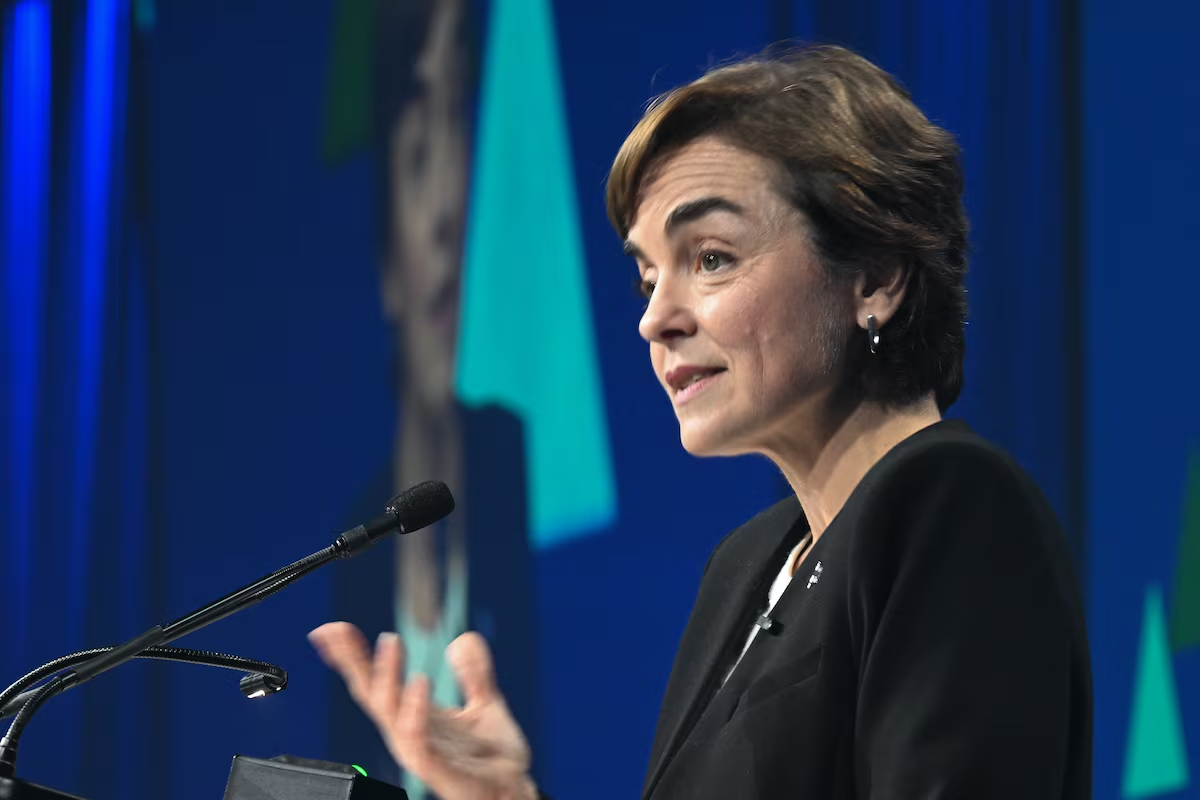
Coalition Avenir Québec leader Christine Fréchette speaks at the Federation quebecois des Municipalities in Quebec City on Friday.Jacques Boissinot/The Canadian Press
Quebec Premier Christine Fréchette is warning of U.S. attempts to sow division between the province and Canada less than two weeks from an election that could see the sovereigntist Parti Québécois come to power.
She was responding to media reports saying the federal government has warned Ms. Fréchette’s Coalition Avenir Québec government about possible U.S. interference in the Quebec election aiming to help elect sovereigntists.
The Premier also said on Friday that U.S. authorities sought a separate trade deal with Quebec around sensitive sectors such as aluminum earlier this year. Ms. Fréchette said she rejected the deal in order to maintain a common front with the rest of Canada amidst tense negotiations.
“There was an approach in the spring to attempt to have an agreement with us, Quebec,” Ms. Fréchette told reporters Friday. “When my team told me that, I closed the door right away. It’s not possible to think that Quebec would conclude an agreement with the U.S. on our own, and in any case it wouldn’t respond to the needs of Quebec. We need to have a comprehensive agreement. It’s important to keep a united front and to join our efforts.”
Quebec party leaders square off in final debate
In a separate statement also released Friday, Ms. Fréchette said there is no proof of interference in the province’s electoral process. She said her government became aware last Saturday of a U.S. think-tank document proposing to break up Canada by supporting Quebec independence, including by helping to elect the PQ and offering the province its own trade deal.
The relatively obscure think tank Defense Analyses and Research Corporation, or DARC, published the document in February.
She said her government met with the Canadian Security Intelligence Service about it on Wednesday, and that she was only addressing intelligence matters publicly because of the media reports.
CSIS did not respond to requests for comment Friday afternoon.
The Premier told reporters she is seeking a meeting with Prime Minister Mark Carney to shed light on the situation.
The Québécor media chain reported on Friday that the federal government informed the Quebec government about the think-tank publication earlier this month in a secret meeting.
In the document, a pseudonymous author suggests funding for the Parti Québécois, along with “behind-closed-doors trade negotiations with the PQ where the United States commits to offering lower tariffs on Quebec than on the rest of Canada.”
Crowded political landscape leaves Quebec voters lukewarm as election nears
On Friday, Parti Québécois Leader Paul St-Pierre Plamondon denied receiving any foreign assistance and questioned the timing of the media leaks, with his party leading in the polls shortly before election day on Oct. 5.
He told reporters he had “never heard of” DARC before Friday.
Canada’s Foreign Affairs Minister Anita Anand said at a news conference in Ottawa that the federal government is taking the issue very seriously.
“Protecting our democracy is of the utmost importance to our country,” she said.
She added that she will speak with her U.S. counterpart, Marco Rubio, after reviewing evidence of the allegations.
“Right now I have not seen the evidence,” Ms. Anand said.
Thomas Juneau, a professor at the University of Ottawa’s Graduate School of Public and International Affairs, said it’s possible there is more to the federal warnings about election interference in Quebec than is publicly known.
“Given the irrelevance of that group, and the amateurishness of some of the recommendations in that report, it makes me wonder if there are other aspects to what was detected,” he said.
It is too early to draw clear parallels with the pro-separatist disinformation campaigns directed at the continuing Alberta referendum campaign, some of it from U.S. sources, he added.
“The one coherent element here, the one parallel, is that our assumptions are shattered,” said Prof. Juneau. “Whatever exactly is going on, the simple fact that we’re thinking about this should tell us, if anyone still had any doubts, that relations with the United States are not what they were.”
With reports from The Canadian Press, Mercedes Stephenson and Maura Forrest