
Open this photo in gallery:
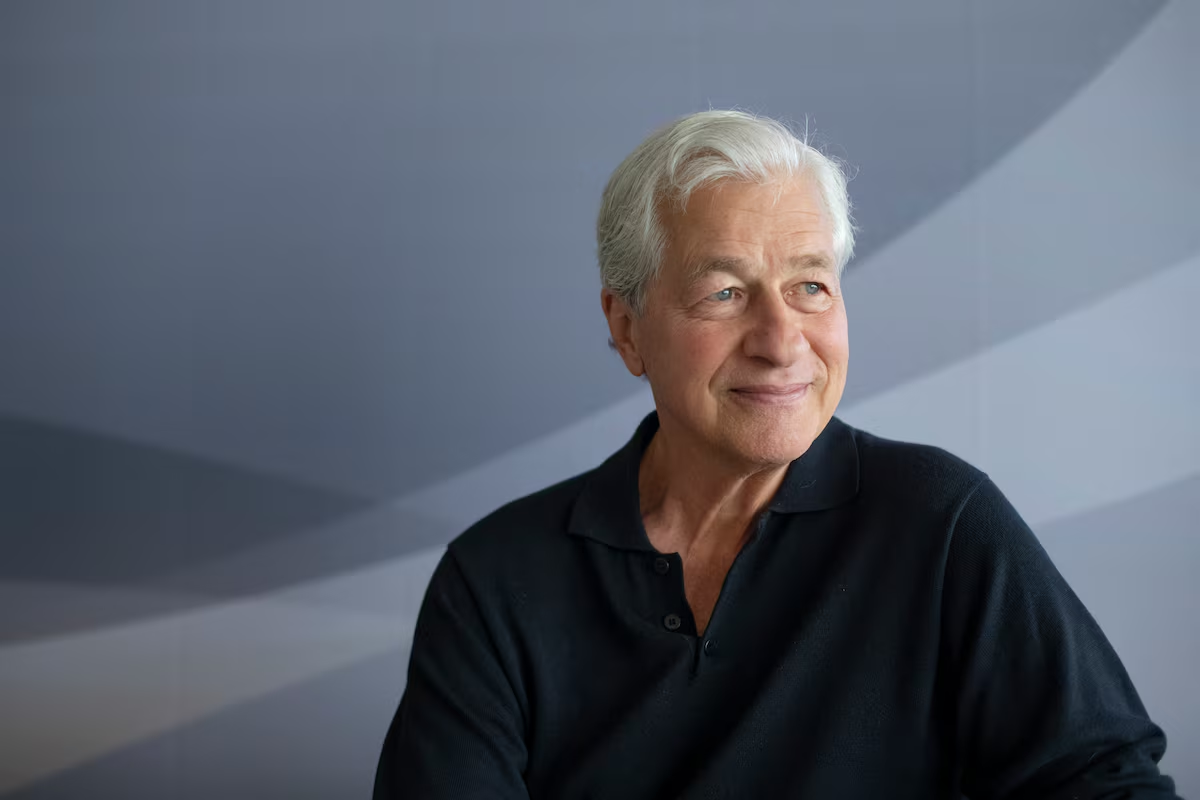
JPMorgan CEO Jamie Dimon, shown in Toronto on Thursday, oversees a burgeoning Canadian banking arm that serves an increasing number of clients doing cross-border business.Fred Lum/The Globe and Mail
Jamie Dimon never meant to give Donald Trump the idea that U.S. banks aren’t allowed to compete in Canada.
For two decades, JPMorgan Chase & Co.’s chairman and chief executive officer has overseen a burgeoning Canadian banking arm that serves an increasing number of commercial and corporate clients doing cross-border business from Canada.
Annual revenue from Canadian operations has nearly doubled over the past five years to more than US$3-billion, and the world’s largest bank is looking to do billions of dollars of new business in the country in the years to come. It’s a small but expanding slice of JPMorgan’s operations, which brought in US$185.6-billion of revenue and a US$57-billion profit last year.
So when the U.S. President grumbled on social media last year that “Canada doesn’t allow American Banks to do business” in the country, “but their banks flood the American Market,” it caught confused bankers and politicians off guard.
The complaint came at a combustible moment when tensions over tariffs were ratcheting higher.
“The President kind of got a little bit of that from me,” Mr. Dimon said Thursday in an interview with The Globe and Mail in Toronto. But he later corrected the record. “We’re here. We can compete with all your banks here in commercial banking, investment banking, market making, payments.”
What major lenders such as JPMorgan can’t do is buy a large Canadian bank, because legislation caps ownership stakes – foreign or domestic – at 10 per cent. It’s a rule at odds with Mr. Dimon’s free-market instincts. But it won’t stop JPMorgan from further developing its business in Canada, and neither will strained trade relations between the two countries, Mr. Dimon said.
“This trade tiff, to me, will be a bump in the road,” he said.
Canada must be ready to cut a USMCA deal if one arises, Carney says
JPMorgan built its Canadian operations by following Mr. Dimon’s playbook to win business outside the U.S., an approach that favours discipline rather than resorting to splashy deals: hire more bankers, take on more clients, bring JPMorgan’s vast global scale and expertise to the table and avoid retreating when conditions get tough.
At age 70, he has led JPMorgan as CEO for more than 20 years, an unusually long tenure at the pinnacle of global banking. Hours before he spoke to The Globe and Mail on Thursday, JPMorgan promoted Troy Rohrbaugh and Doug Petno to be co-presidents reporting to Mr. Dimon, setting one of them up as his likely successor. But Mr. Dimon is still widely expected to be the bank’s CEO for a few more years, then likely move to a role as executive chairman.
“The timetable is pretty much the same,” he said.
Mr. Dimon cemented his reputation by steering JPMorgan safely through the global financial crisis in 2008-09. He is one of corporate America’s most influential and outspoken CEOs on finance, economics and policy.
He also has uncommon access to world leaders who will shape the future of trade and commerce in North America.
In the past month, he hosted Prime Minister Mark Carney in New York at a gathering of the U.S.-based Business Roundtable, visited Mexico City to discuss trade with Mexican President Claudia Sheinbaum and was in Versailles with French President Emmanuel Macron and Mr. Trump a week later.
Carney pushes Canada-U.S. ‘new partnership’ ahead of upcoming trade talks
This week, he made a whistle-stop visit to Toronto to meet with dozens of CEOs and clients, such as Brookfield Asset Management Ltd.
At every stop in his tightly packed schedule, he talks energetically and candidly, then moves on as swiftly as he arrived. Not a minute is wasted and still, he seems at ease. He swept into JPMorgan’s Toronto office in jeans and a black, long-sleeve polo shirt on Thursday as a crush of local staff gathered to hear him lead a town hall meeting.
He came to Toronto with a soothing message for anyone, on either side of the border, who is anxiously following negotiations to renew or redraw the linchpin of North American free-trade, the United States-Mexico-Canada Agreement (USMCA).
“I tell people, you guys should all take a deep breath,” he said.
Yes, Canada’s economy is struggling with “a little lower growth than you want,” and some industries have been hit hard by sector-specific tariffs, he said. But trade and investment flows are largely carrying on and, in the long run, close ties binding the U.S. and Canada are “still a magnificent gift” for both countries.
“When I speak to the administration, they say they want to resolve it,” he said, adding: “There will not be a divorce.”
Open this photo in gallery:
Mr. Dimon is a board member of the Business Roundtable, an influential group stocked with top U.S. CEOs that advocated for the USMCA in previous negotiations.Eduardo Munoz/Reuters
Mr. Dimon used his annual letter to shareholders, published in April and widely read, to make the case that the U.S. should work to strengthen its own economy “and that of our critical allies,” and to “bind them closer to the U.S.”
He is also a board member and former chairman of the Business Roundtable, an influential group stocked with top U.S. CEOs that advocated for the USMCA in previous negotiations eight years ago, and favours reaching a deal now to preserve its core aspects.
U.S. Trade Representative Jamieson Greer is leading trade talks for the Americans, and Mr. Dimon expects Commerce Secretary Howard Lutnick and Treasury Secretary Scott Bessent could also play a role.
“If they were here today I’d be saying exactly the same things: Let’s get it done,” Mr. Dimon said.
Looking to Canada’s side of the negotiating table, he said he thinks Mr. Carney is very bright and “knows what to do.” The two first got to know each other in the financial crisis, when Mr. Carney was a central banker trying to calm markets.
When they met in New York in May, the two men exchanged ideas, Mr. Dimon said, but he declined to give details. Mr. Carney seemed confident, flexible in his thinking and attuned to America’s priorities, he said. “He listened.”
And though a trade deal may not be reached just yet, “I think he felt pretty good that we’re going to get there,” Mr. Dimon said.
On Thursday, Mr. Dimon also suggested Canada has ample ingredients to thrive economically. He cited manageable debt levels, strong universities, large and well-funded pension plans, global companies and strong rule of law. And he acknowledged Canada in his shareholder letter for pursuing policies to shorten permitting times to develop new projects.
He also said it makes sense for Canada to diversify its economic options by seeking new trade deals with countries such as India, and planning to build new pipelines to move oil and gas to more international markets.
“I would if I was the Prime Minister, because I wouldn’t want to be totally beholden to one country,” Mr. Dimon said.
Ottawa nearing major projects deal with B.C. as Alberta closes in on West Coast pipeline proposal
But at a recent Council on Foreign Relations event, he dismissed Mr. Carney’s call for middle powers to band together to increase their clout as “a fantasy,” saying, “they did that, it’s called Europe.”
There are, however, a range of policy changes that Canada could make to boost its economic growth, he added. That could include ironing out regulatory barriers to trade and investment, investing in skilled workers and lowering corporate tax rates.
Regardless, Mr. Dimon said JPMorgan will continue to expand its business in Canada.
Earlier this month, JPMorgan extended its US$1.5-trillion economic security and resilience initiative to Canada, aiming to extend billions of dollars of financing and support to key sectors such as energy, defence and critical minerals.
JPMorgan expands financing pledge to Canadian companies
The bank has also added staff to serve commercial clients as well as Canada’s innovation economy, especially emerging technology and biotech companies. And its global payments platform has become an important tool to manage clients’ cash transactions.
But JPMorgan won’t be making a push into consumer banking in Canada. The country’s Big Six banks still have a stranglehold on part of the market, thanks in part to the same restrictions on large domestic bank mergers that irked Mr. Dimon and Mr. Trump. And a rule change that would put major Canadian banks in play is considered extremely unlikely, given the potential political fallout.
“It is what it is. We’ll go and build, we’re very happy here,” Mr. Dimon said.
But if JPMorgan ever had a chance to acquire a major Canadian bank, would Mr. Dimon do it?
“Maybe, that’d be a possibility,” he said. But JPMorgan’s plan is to build out its existing business “100 per cent organically.”
If the U.S. and Canada can settle their differences on trade, and Mr. Carney’s government can meet its goals to ramp up defence spending, build infrastructure more quickly and invigorate the country’s energy sector, Mr. Dimon is hopeful that foreign direct investment will pick up.
That could give JPMorgan’s Canadian arm a new path to growth, as multinational companies and investors do more business in the country. The bank is positioning itself to help finance shifting supply chains for manufacturing, as well as an expanding defence sector.
The challenge for Canada – as for its allies – will be to follow through on those ambitions.
“You’re on the march, man,” Mr. Dimon said. “Just get the stuff done and get the politicians to approve good policies, and you will be going for decades.”