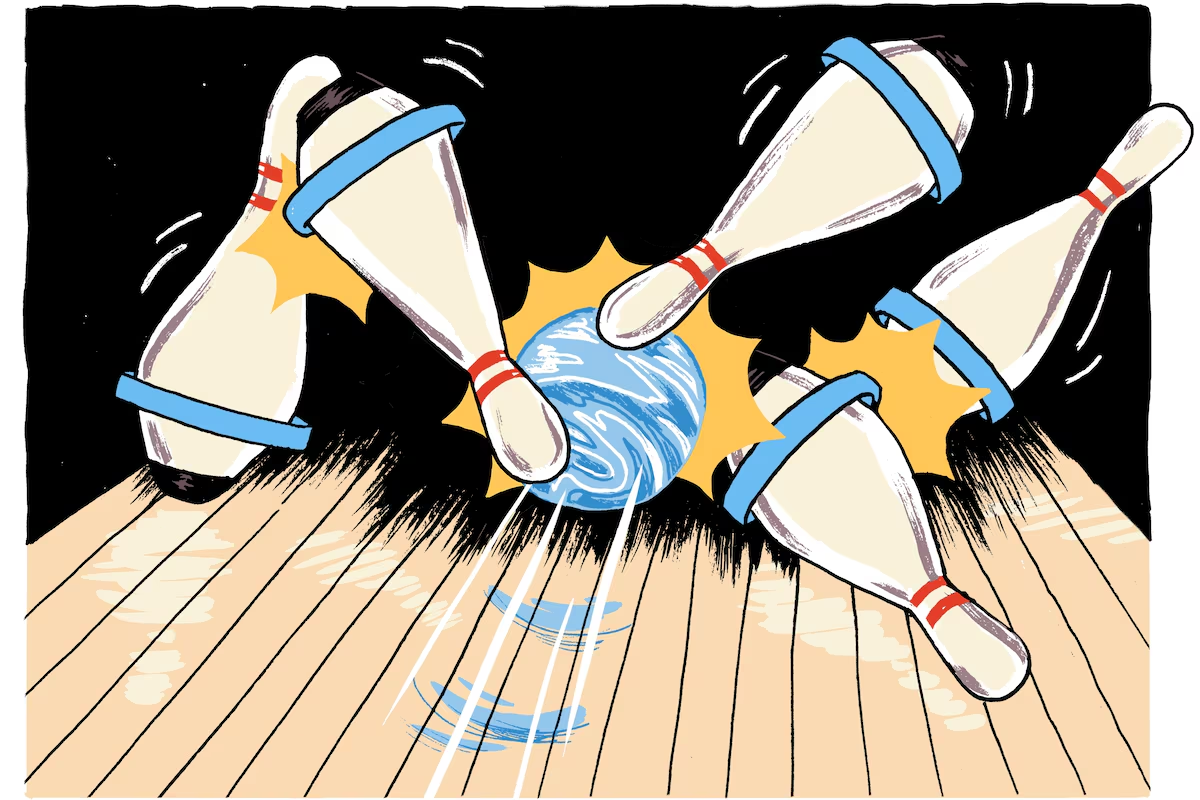

1. We’re going for perfection over here
The manager was busy and distracted when one of his employees tapped him on the shoulder. It was the second day of the national youth five-pin bowling championships at Dakota Lanes in Winnipeg, and the place was alive with the thud of balls and clatter of pins.
“Hey,” the kid said. Something in his voice caught his boss’s attention. “We’re going for perfection over here.”
Justin Keen looked over to where 17-year-old Logan Newton stood surrounded by a gathering crowd.
Five, six, seven strikes in a row – that happened at Dakota Lanes with some frequency. Impressive, but not uncommon for competitive bowlers.
Eight strikes was different.
And at nine strikes, word was burning through the alley: Logan Newton is going for a perfect game.
Other lanes grew quiet as people left their games to watch. Even as a spectator, Justin was trembling and nervous. He’d been bowling his whole life, and he knew how rare and difficult it was to bowl 12 strikes in a row – how overwhelming the mounting pressure could be.
“I’m sitting back here thinking, ‘Is he okay? Is he going to break down?’” Justin says. “Some people, the emotions can overrun you. You never know what’s going to happen.”
Logan Newton had thrown nine strikes in a row.
Just three more strikes to a perfect game.

2. Five pins are better than 10
If you aren’t a bowler, what you may be picturing right now – dense pyramid of pins, finger holes drilled into a big black ball – isn’t what we’re talking about. That’s 10-pin, and it’s American.
Five-pin bowling is our sport. Invented, played and loved almost exclusively in Canada.
Five-pin bowling uses smaller balls and pins, broader spacing and a different score structure. It was invented by flamboyant Toronto sportsman (and pageant judge) Tommy Ryan, who introduced it at his swank Toronto Bowling Club in 1909 after deciding 10-pin bowling was “too slow and uninteresting.”
Open this photo in gallery:
Tommy Ryan’s five-pin version of the game of bowling has largely stayed within Canada since he developed it in the 1900s.The Globe and Mail
Perfect games are common in 10-pin. The ball is so big, there are so many pins clustered so closely together. The United States Bowling Congress estimates tens of thousands of perfect 10-pin games rolled every year, with the odds of an average bowler throwing a perfect game in league play about one in 11,500.
Meanwhile, a champion five-pin bowler could go their whole lives without a perfect game. The Canadian 5 Pin Bowlers’ Association records about a dozen a year.
“I’ve won everything. I’ve won TSN. I’ve won CBC. I won over $100,000, but I’ve never thrown a perfect game,” says Cameron Boon, with a rueful chuckle. He’s a veteran Manitoba bowler who also owns and runs Polo Park Bowling Centre in Winnipeg with his brother.
“It’s got to be 99 per cent will never throw a perfect game in their life.”
In 62 years and a quarter-million matches, there had only ever been one perfect game in Youth Bowl Canada’s national competition, thrown by 16-year-old Jenna Lamoureux in Calgary a decade ago.
But on this spring afternoon in Winnipeg, Erin Newton saw clearly how it could happen. Logan was throwing every ball in the same spot with the same momentum and the same pace and the same movement. Everything was just there.
It was around Logan’s ninth strike of the game that Erin realized he had a real chance.
“Oh my goodness,” she thought. “This could happen.”

3. Chuck balls
It was, perhaps, inevitable that Logan Newton would end up at that place, on that day, with all those strikes. In a way, you could say his whole life had been leading to such a moment.
His grandparents met bowling, and his family has been bowling ever since. His grandfather was a national level bowler, his grandmother and mother have both competed and won at national competitions, and he and his brothers grew up at Rossmere Lanes, the Winnipeg bowling centre owned by their father, Jamie Newton, who is also an accomplished bowler and Logan’s coach.
“When dad’s at work, what do you do?” Logan says. “Chuck balls.”
Open this photo in gallery:
The popularity of five-pin bowling has ebbed and flowed through the years. It’s been threatened both by changing social habits and by the pervasive influence of 10-pin, an easier and in some ways more dramatic game (all those pins flying!), which is the dominant form of bowling around the world.
But competitive five-pin bowling has a dedicated and tight-knit community around Canada. New players are drawn by a game that’s accessible to almost anyone of any age and ability, but also challenging enough to keep the attention of competitive players for decades.
Part of the challenge of five-pin bowling is that, on paper, it should be easy. The external variables are relatively minor, with only slight variations to account for in the slickness of the lane, the ball, the shoes. In theory, all you have to do to get a strike is roll the ball straight down the lane and hit the headpin slightly off-centre.
And yet, as anyone who has attempted to do that, and instead seen their ball careen into the gutter, knows, it isn’t even close to that simple.
And that’s just one strike.
Throwing 12 strikes in a row is a matter of skill and luck combined: The skill to hit the side of the headpin 12 times. The luck to have all the pins fall every time and not leave a pin wobbling in the corner.
“The first time I had nine strikes in a row I was 20 years old, and I got the perfect game,” says Geoff Born, another national champion five-pin bowler in Winnipeg. He’s thrown the first nine strikes nearly a dozen times since then, but never had a second perfect game.
“I’m still trying,” he says. “I’m 63 now, so that’s 43 years.”
Open this photo in gallery:
Logan has been particularly inspired by the women bowlers in his life, especially his mother and grandmother. He’d also spent the year bowling with a woman named Sandi Anderson, who he’d invited to join his Monday night league team, because he admired how she seemed to be able to handle the pressure and throw a strike whenever she needed one.
“A perfect game doesn’t sound that crazy because it’s just right down the middle every time,” Logan says. “But of course, it’s mental as well.”
Sandi had taught him the value of the routine, the discipline of doing the exact same thing. The same shot over and over again.
“It goes into your head, so just being cool and collected,” he says. “Especially as a teenager, it can be hard to do sometimes, but just learning from how she did it and my mom did it, just trying to go back to a routine.”

4. Just go back to routine
Going into his 11th ball, Logan wasn’t paying much attention to what was happening around him.
He didn’t fully notice how many people were crowded in, couldn’t hear the shouting and clapping, didn’t see the phones recording. He was paying attention only to his teammate and his dad, trying to stay calm and keep the moment light. They had a running joke about a perfect game, and here it was, within reach.
The 10th strike put Logan over 400 points for the first time in his life, and secured him a pot of money for a scholarship. After that, he told himself he’d be happy, no matter what. His grandfather had rolled two perfect games, but his parents and grandmother never had, despite being excellent national-level bowlers.
His mother always told him, “You can’t get frustrated or get super upset, as long as you do what you can to the top of your abilities. That’s all you can hope for, right? You can get a bad break. You can’t control where a pin is going to fly. And of course, there’s going to be some days where you get a little lucky.”
And some days when you don’t.
Last year, after a competition in Calgary, Logan spent months thinking about whether he wanted to continue competitive bowling at all, or whether he should focus on his baseball. But he started practising again.
He sent the 11th ball hurtling down the lane. Another strike.
He just needed one more.
But where was his ball? It wasn’t sliding out of the ball return. Logan and his dad gestured to Dakota Lanes’ staff that the ball was caught. People in the crowd anxiously called “Ball!” to get the game moving again.
Logan wondered if he should use another ball. He didn’t want to change the rhythm of the game. His dad stopped him.
“No, no, no. You’ve been using that ball. Wait until the ball’s back,” he said. “The ball isn’t ready to be bowled yet.”

5. Ain’t no thing
When it was ready to be bowled, Logan’s ball came rolling back to where he waited on Lane 15. Now it was time. Rinse and repeat, his father told him. Just keep doing the same thing. Don’t get in your head about it. It’s just one more strike.
People clapped and called out.
“Your time buddy, your time.”
“Let’s go”
“Show me one!”
“You got this!”
“Ain’t no thing”
Walk up, grab the ball. Keep everything the same. Logan’s hands were getting sweaty. He picked up his ball and wiped it with a towel. Don’t chuck it in the gutter. Don’t faceplant on the lane.
Logan found his spot on the approach and slid one foot back and forth, feeling its slip beneath his shoe. He wore a bright yellow and black shirt, with his name in sprawling script across the back.
Then three steps, left, right, left, slide. Quick and smooth. Arm straight back, reaching straight through to release the ball. Exactly how his grandma told him to do it when he was a kid, exactly how he’d been trying to do it ever since.
It felt good the moment it left his hand.
Logan dropped down to one knee and watched as his ball rolled down the lane, straight and true. Everyone was screaming before it even hit the pins.
A note: Jana G. Pruden is an award-winning five-pin bowler. She is also a total word nerd, and structured this piece so that the word count of each section numerically symbolizes the point values of each pin in a five-pin bowling frame.