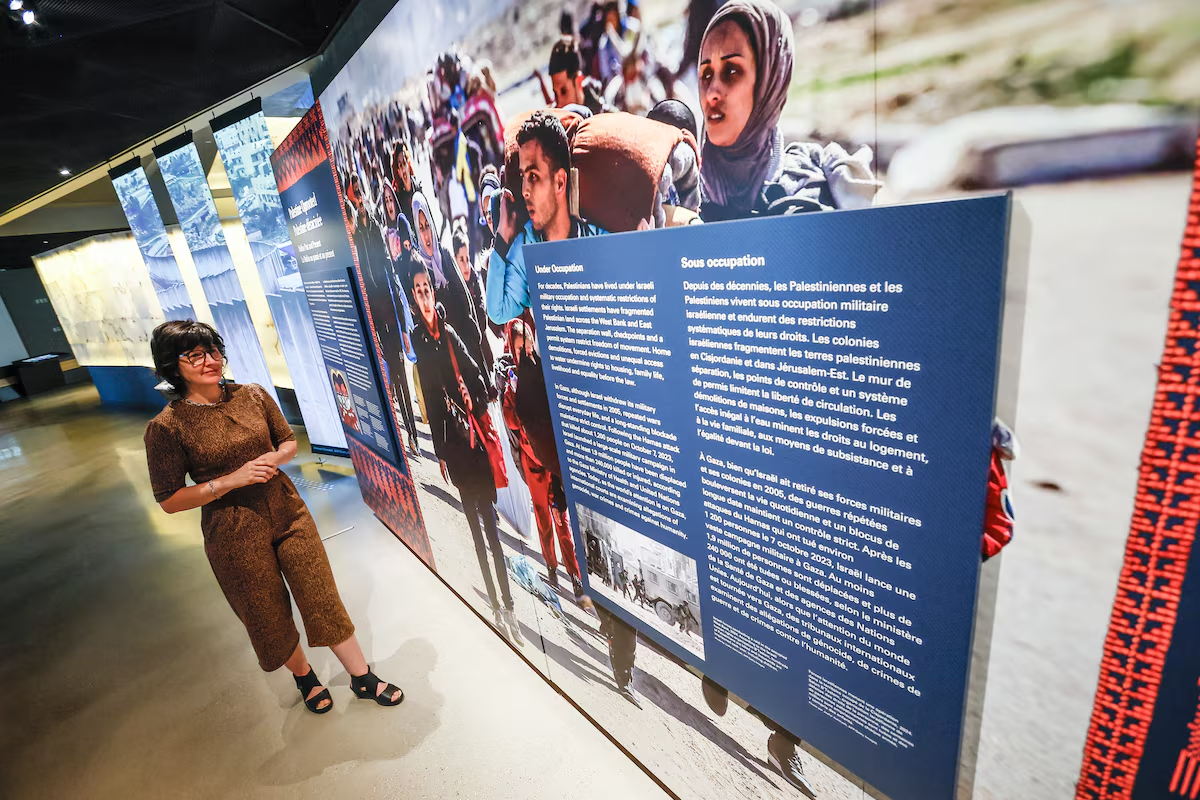

Open this photo in gallery:
Isabelle Masson, curator, views the new exhibit, Palestine Uprooted – Nakba Past and Present, that she created at the Canadian Museum for Human Rights in Winnipeg, on Friday.John Woods/The Canadian Press
Standing in front of three displays occupying two walls at the Canadian Museum for Human Rights, curator Isabelle Masson says she has been taken aback by the vehement opposition to her new exhibit on Palestinian displacement.
“Nobody – none of those criticizing it – has ever even been able to see our exhibit yet,” she told The Globe and Mail on Friday, ahead of this weekend’s public opening of Palestine Uprooted: Nakba Past and Present at the Winnipeg-based museum.
Examining the period beginning in 1947, when hundreds of thousands of Palestinian Arabs were displaced from what is now Israel, the Nakba exhibit has raised the ire of several prominent Jewish groups since its announcement in late November.
While critics have argued that the exhibit would not appropriately cover the history of Israel’s creation, organizers pointed out that the museum has for years highlighted the mass displacement of Jews from Arab lands at another gallery on the second floor.
Opinion: The Canadian Museum for Human Rights is right to portray the stories of displaced Palestinians
Last year, the Jewish Heritage Centre of Western Canada immediately condemned plans for the museum’s exhibit, stating that it is ending its future partnerships, such as those for galleries about the Holocaust. In mid-May, Tel Aviv-based organization Shurat HaDin threatened to take legal action against the federal museum, alleging that the exhibit promotes a “one-sided narrative” that could fuel antisemitism in violation of Canadian law.
Then, Mark Berlin, a trustee on the museum’s board, resigned in protest this past Monday, telling The Globe in an interview that “there’s the Palestinian Nakba and the Jewish Nakba, and the fact is that these are not severable.” In an opinion piece he co-wrote for The Globe, Mr. Berlin called the display “curation by omission.” Philanthropist Gail Asper, whose family helped found the museum, also expressed her fears about a lack of historical context.
But pointing to the roughly 12-metre-long exhibit, which will remain on display for at least two years, Ms. Masson said she only has one request for anyone in opposition: “Please come here and see it for yourself before you criticize it.”
Tucked in a corner on the fifth floor of the seven-level museum, the mixed-media display uses photographs, videos, poetry, paintings and everyday objects to relay an account of Palestinian-Canadians affected by the Nakba, meaning “catastrophe” in Arabic.
It describes the Nakba as an “ongoing process” within the modern-day war in the Middle East. “Today, as the world’s attention is on Gaza, international courts are examining allegations of genocide,” reads one panel of the display.
Israel has been at war with Hamas since Oct. 7, 2023, when the militant group launched a surprise attack, killing around 1,200 people.
Israel’s retaliatory offensive has killed more than 72,000 Palestinians as of last month, according to UN officials, and displaced about 90 per cent of Gaza’s population, causing a humanitarian crisis.
Israel has faced significant criticism of its tactics, but it has rejected allegations that it is committing genocide in Gaza.
Featuring text in English, French and Arabic, the exhibit projects images of Palestinian women and children amidst bombing in Gaza, and pictures of protests in other parts of the world. They are overlain with poetry and written passages from lauded Palestinian author Mahmoud Darwish.
“As you return home, to your home, think of others / (do not forget the people of the tents),” reads a flyer featuring one of Mr. Darwish’s poems, encouraging visitors to take a copy and share with others.
Open this photo in gallery:
A memory box with artifacts in the new exhibit, Palestine Uprooted – Nakba Past and Present, at the Canadian Museum for Human Rights in Winnipeg, on Friday.John Woods/The Canadian Press
The motif of a tatreez, a traditional form of Palestinian cross-stitch embroidery, curves from one wall to the next. It is emblematic of the “beautiful resilience” of Palestinian culture, Ms. Masson said.
One panel includes a print of artist Malak Mattar’s 2020 acrylic work Bound Together in Gaza, paying homage to Guernica, Picasso’s oil masterpiece about civilians suffering during war. The exhibit has also loaned Rajie Cook’s 2002 sculpture Curfews and Closures from the Arab American National Museum in Michigan, comprising of a keffiyeh contained in a bird cage, atop the chipped legs of a human figurine.
“We’ve been working on this for the last four years,” Ms. Masson said. “What we really want is for this to educate people and start an important conversation, and we hope lots of people come by for that this weekend.”
Noah Shack, chief executive of the Centre for Israel and Jewish Affairs, said in a statement, that Saturday’s opening will have “serious real-world consequences.”
“Earlier this month, Prime Minister Mark Carney warned against importing foreign conflicts into Canada and cautioned that when our social compact fails one community, it ultimately fails all Canadians,” he said, urging Ottawa to hold the museum’s leadership “accountable for its egregious mishandling of this exhibit.”
But some other Jewish groups expressed their support. “The exhibition is remarkable in how it brings attendees into the feel, sense, and realities of Palestinian lives,” said a joint statement from Independent Jewish Voices Canada, United Jewish People’s Order and the Jewish Faculty Network.
Palestinian-Canadian Fouad Sahyoun, 82, flew from Montreal for the show’s opening; a video interview with him is part of the exhibit.
“In 1948, there was no social media, no television. We are seeing the same thing today that me and my family saw then: bombardment, demolition, displacement, harassment, humiliation. But now everyone can see it,” he said. “There is no better time than now for people to see this story and see all of these truths.”
The museum’s CEO, Isha Khan, said efforts to shut down the exhibit have been “relentless.”
“I truly feel that much of it is grounded in genuine fear and concern, and represents how many people in the Jewish community are feeling,” she said.
“But it has always been our concern to proceed responsibly. And I’m proud of our team for doing that work.”