
Open this photo in gallery:
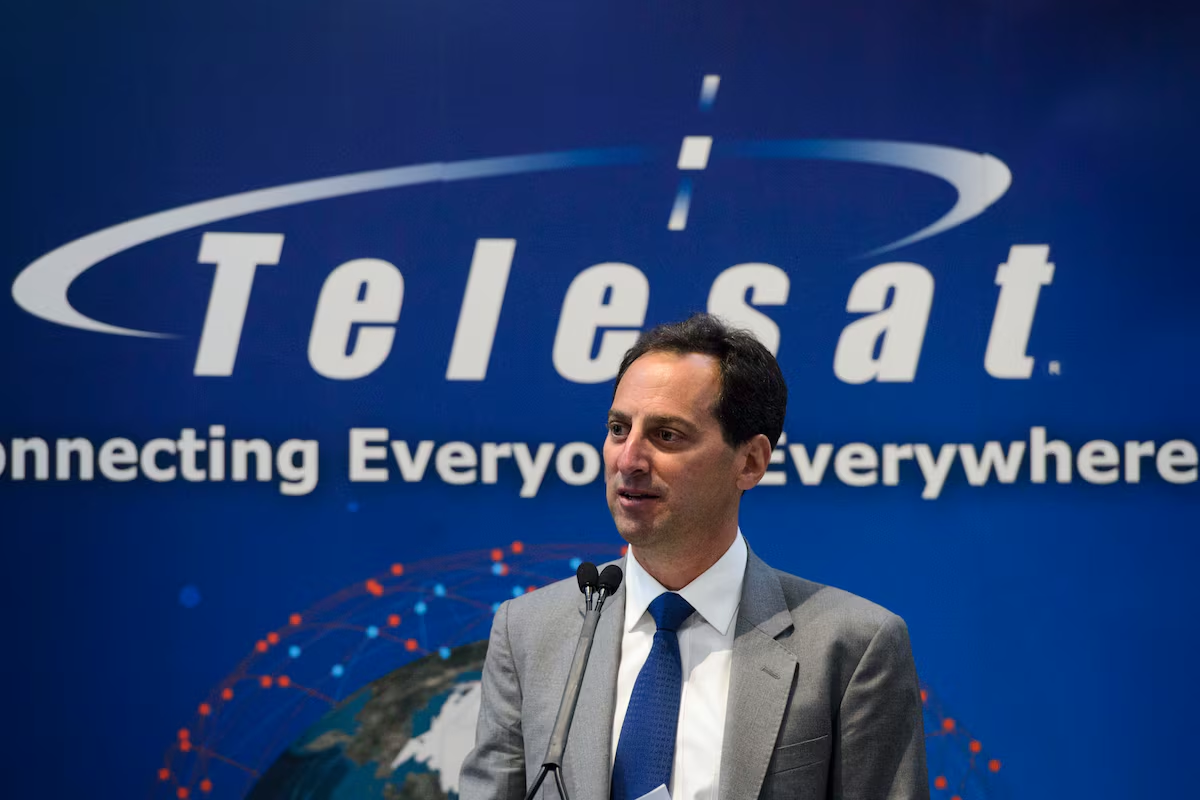
Telesat CEO Dan Goldberg speaks at a press conference in Ottawa, July 24, 2019. Speaking with analysts in August, he said it was ‘not the case at all’ that the company was considering filing for Chapter 11 bankruptcy in the U.S.Sean Kilpatrick/The Canadian Press
One of the Canadian companies that Prime Minister Mark Carney advertised to foreign investors at last week’s investment summit is three months away from a debt deadline with American creditors and could default on those loans if it can’t reach an agreement.
Telesat Corp., a satellite manufacturer that was promoted in the Canada Investment Summit prospectus circulated among major global funds, has approximately US$1.71-billion in debt connected to one of its subsidiaries coming due Dec. 6, with another US$438-million of debt maturing in 2027.
The debt is linked to the company’s subsidiary for its geostationary satellites, Telesat GEO, its older business division which has seen declines in recent years as customers move to newer technology. Telesat is now building its new low-Earth-orbit (LEO) constellation, Lightspeed.
In its most recent financial filings, Telesat said its consolidated cash flows and resources alone “are not expected to be sufficient to meet Telesat GEO debt maturity obligations as they come due.”
The lenders – including Silver Point Capital, Sound Point Capital Management, LP and GoldenTree Asset Management – put forward a formal refinancing proposal in August, but the parties have not yet come to an agreement, according to a source with knowledge of the matter. The Globe and Mail is not naming that source as they were not authorized to speak publicly about the proposal.
The lenders are proposing a recapitalization plan that would provide them 100 per cent of their principal through new debt including equity related to the LEO constellation as collateral and cash from new junior capital.
Opinion: Carney’s investment summit attracted ‘all the right people.’ Will it bear fruit?
No deal has yet been finalized. Finding a middle ground may prove a challenge, as Telesat and its creditors are already wrapped up in legal battles in American and Canadian courts.
Creditors are alleging that Telesat illegally moved the value of what they have described as its “crown-jewel asset” out of their reach ahead of looming debt-repayment deadlines. Telesat shifted 62 per cent of the equity of that asset – its low-Earth-orbit satellite business, Lightspeed – into a new entity, Telesat LEO, last year.
In a statement Tuesday, Telesat chief financial officer Donald Tremblay said the company’s goal remains to arrive at a “consensual plan for addressing the upcoming debt maturities at Telesat GEO,” and that Telesat has “a number of options available to us,” but did not name those options.
If Telesat and the creditors cannot come to a deal, Telesat could default on its debt – a scenario that ATB Cormark Capital Markets analyst David McFadgen says he believes “is not an unlikely event.”
“We believe that a lot of investors believe that a debt deal is a foregone conclusion, and we don’t hold that view. We believe that investors should prepare themselves for such an event,” he said.
The company’s debt is trading at distressed levels, suggesting investors believe there’s a possibility they won’t be paid back in full. Telesat shares, however, have been a solid performer recently, up more than 70 per cent this year, helped in part by a recent contract awarded by the federal government to provide broadband connectivity in the Arctic for the Canadian military.
As of June 30, Telesat had approximately $383-million of cash and cash equivalents of which $160-million was held within Telesat GEO, the company said in financial documents. In August, a subsidiary of its GEO business borrowed US$120-million from an outside lender, providing a further source of liquidity.
What could happen if Telesat and its creditors fail to come to a deal? In other circumstances, a company unable to pay debt may consider filing for bankruptcy. But in this instance, a complicating factor is the Telesat Canada Reorganization and Divestiture Act, which was introduced in 1991 when Telesat was converted from a Crown corporation to a private entity.
That act says that “in no case shall the affairs of Telesat be wound up unless authorized by an Act of Parliament.” However, it’s unclear what that would mean for a subsidiary of the company, or a U.S.-based filing. On Tuesday, Telesat said it has “no comment on the interpretation or application of legislation, which is ultimately the province of the courts.”
Speaking with analysts in August, Telesat chief executive officer Dan Goldberg said it was “not the case at all” that the company was considering filing for Chapter 11 bankruptcy in the U.S.
Another alternative could be to enter into a forbearance agreement, a legal agreement under which a lender agrees to temporarily pause or reduce interest payments while agreeing not to take legal action. In exchange, forbearance agreements sometimes include deal-sweeteners for the lenders, such as equity payments.
At the Canada Investment Summit last week, Telesat was advertised as an opportunity to invest $5.2-billion, with the stated financing objective of offering a minority equity stake of the company or its Lightspeed program.
Production of the 225 satellites that will form part of Lightspeed is under way, and the company is expecting it will reach global commercial availability in the first quarter of 2028.