
Listen to this article
Estimated 4 minutes
The audio version of this article is generated by AI-based technology. Mispronunciations can occur. We are working with our partners to continually review and improve the results.
The Manitoba government paid $4 million to three First Nations men who were wrongfully convicted in a Winnipeg murder more than 50 years ago, a recently released financial document says.
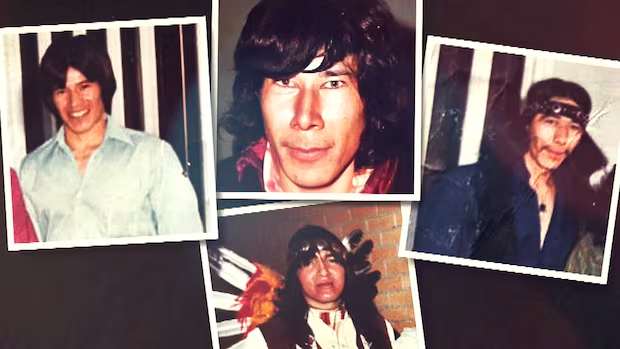
Brian Anderson, Allan Woodhouse and Clarence Woodhouse were convicted in the 1973 killing of Ting Fong Chan, a 40-year-old father of two who was stabbed and beaten to death near a downtown Winnipeg construction site as he walked home one night after his shift at the Beachcomber restaurant.
Though concerns about the men’s innocence were raised early on, it took decades for their names to be cleared: Anderson and Allan Woodhouse in 2023 and Clarence Woodhouse in 2024.
The judge who exonerated them said the case was “infected” by systemic racism, from the police investigation to the trial.
The update on the province’s payment to the men was revealed in the Manitoba’s government’s most recent list of vendor payments over $50,000.
It comes after the City of Winnipeg announced last year that it was proposing a $7-million payment toward a global settlement to compensate the three men. Council later agreed with that recommendation.
Spokesperson David Driedger said the city moved “as quickly as possible” to conclude the settlement proceedings and hopes it “brings some closure to” the people involved.
WATCH | City proposes $7M settlement in wrongful convictions:
City of Winnipeg proposes $7M settlement in wrongful convictions
The city is recommending a payment to compensate Allan Woodhouse, Brian Anderson and Clarence Woodhouse, who were wrongfully convicted for a 1973 murder. All three men have filed lawsuits against the City of Winnipeg, the province of Manitoba and the federal government over their wrongful convictions.
“We cannot speak to the specifics of the global settlement beyond what was previously shared with Council,” Driedger said in an email.
The men’s lawsuits also included the federal government. However, it’s still unclear what Ottawa paid.
“To respect the confidentiality provisions of the settlement agreement, the Department of Justice Canada will not be providing specific figures,” a spokesperson said.
“We can, however, confirm that the matter was settled to the satisfaction of all parties.”
Clarence Woodhouse’s brother, Russell Woodhouse, was also convicted in the case. A new appeal for him is still underway, after he died in 2011.
The men, who ranged in age from 17 to 21, according to newspaper coverage at the time, were rounded up by police largely because of eyewitness accounts after Chan’s killing that mentioned Indigenous people.
They were all from Pinaymootang First Nation, in Manitoba’s Interlake area.
The men were convicted in Chan’s death based mostly on confessions written in fluent English that police said they got from the young men — even though some of them barely spoke the language. All said they had been forced or tricked into signing the admissions of guilt by officers who assaulted them.
The case was prosecuted by George Dangerfield, who was the Crown attorney in four other wrongful conviction cases.
‘No amount of money’ will replace time lost: chief
Chief Cornell McLean, chairman of the Interlake Reserves Tribal Council, said while he was happy to hear the men reached a settlement, “no amount of money will ever replace the time that they spent in custody” and away from their families.
“Because you can’t turn back time on that, right?” he said in an interview.
McLean said he thinks much has changed since the wrongful conviction case, which was marked by racism and “lazy police work,” including within the Winnipeg Police Service.
“Every time you see something in the news about the Winnipeg police, whether it’s positive or negative, I think the positives are outweighing the negatives today, which is good to see, you know, in Manitoba.”
A spokesperson for the Southern Chiefs’ Organization said in an email the case is “a reminder of the need to confront and eliminate systemic racism within all areas of the justice system and prevent other First Nations people from experiencing the same injustice.”
James Lockyer, a founding director at Innocence Canada, the non-profit organization behind the exonerations in the case, declined to comment on the update.