
Open this photo in gallery:
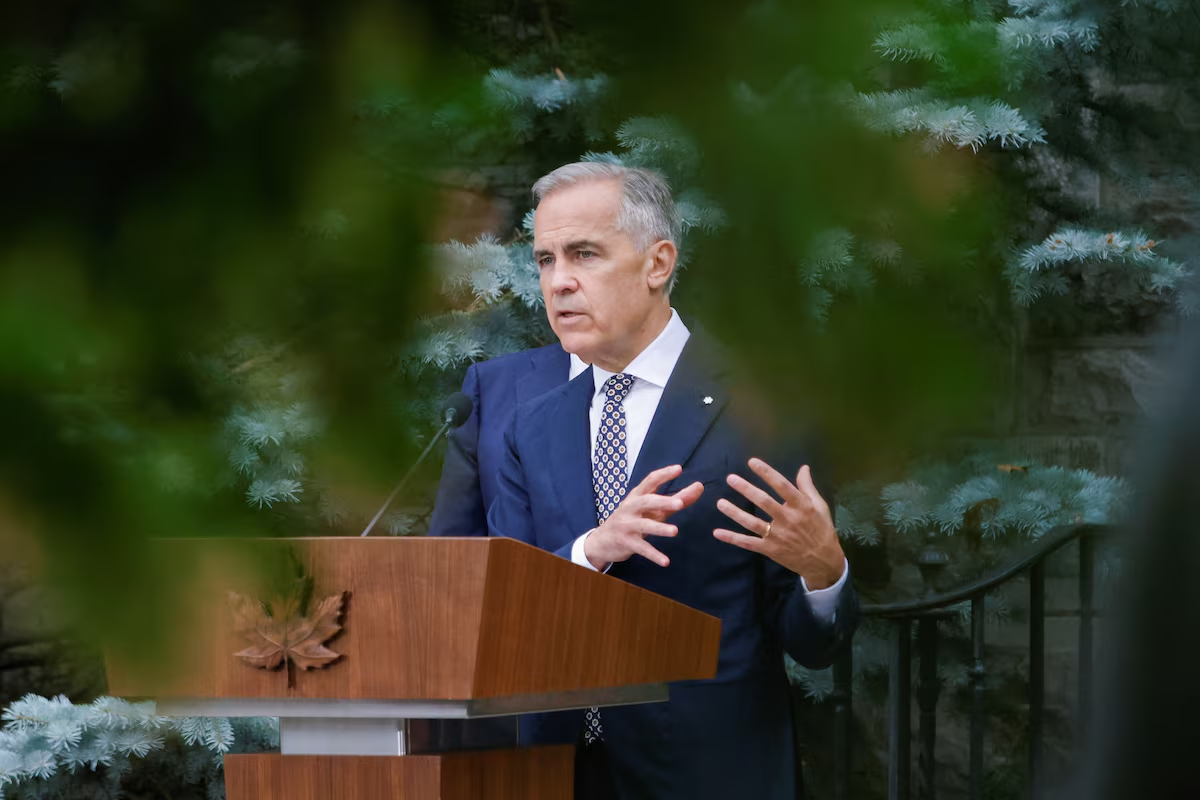
Speaking to reporters in Ottawa on Friday, Prime Minister Mark Carney declined to share his personal thoughts on the prospect of expanding MAID access for patients with mental illness.Patrick Doyle/Reuters
An expansion of the country’s medical assistance in dying law is ultimately a government decision, not his personal one, Prime Minister Mark Carney said on Friday.
Mr. Carney has not publicly shared his views about MAID. He was asked by a reporter to comment on his perspective about expanding access for patients with mental illness. He declined to offer an individual reflection.
“That will be a government decision. However, there has been a report following a great deal of reflection and testimony,” he said in French at a press conference to announce future plans for the official residence of the prime minister.
“I believe that is significant. But it’s not a personal matter. It’s a question of the rights of Canadians, and the evidence is medical – based on expert advice.”
This fall, Mr. Carney’s government faces a critical decision on how to respond to a recent parliamentary committee report that called for MAID to be barred for patients with mental illness.
The committee recommended that Ottawa amend the Criminal Code “to indefinitely exclude persons whose sole underlying medical condition is a mental illness from eligibility for medical assistance in dying.”
Committee recommends Ottawa not extend MAID to people whose sole condition is mental illness
However, four senators issued a dissenting report and called the committee process “fundamentally flawed,” “highly irregular” and “biased.” They want the question of MAID eligibility referred to the Supreme Court of Canada.
In May, The Globe and Mail reported, according to three sources, that the government was open to drafting a bill to extend an exemption for patients with mental illness past its current expiry date of March, 2027, should the joint committee recommend doing so. The Globe did not identify the sources, who were not authorized to speak publicly on the government’s plans.
How Ottawa proceeds will mark a key moment in the debate over whether patients whose underlying condition is a mental illness should be able to die with the aid of a health care provider.
Some view it as unfinished business a decade after MAID first became legal, while others fear such an expansion would increase the risk of premature death for patients with existing vulnerabilities who should receive additional supports.
A decade ago, in June, 2016, MAID became legal for Canadians whose deaths were deemed “reasonably foreseeable.”
In depth: The faces of MAID
In 2021, the law was updated after a Quebec court decision allowed patients with incurable conditions to seek to end their lives. It was determined that patients whose sole underlying medical condition is mental illness would not be immediately eligible. A two-year temporary exclusion was put in place to allow more time for study.
The federal government has since twice delayed implementing MAID for mental illness. This spring, political pressure has mounted on Mr. Carney’s government to intervene.
In April, the Archbishop of Toronto wrote directly to Mr. Carney, a Catholic, and other MPs to request that they consider measures to restrict the expansion of MAID and instead prioritize investments in palliative care, mental-health supports and resources for marginalized and isolated individuals.
Advocates, including Dying With Dignity Canada, see the ability of someone suffering from mental illness to obtain MAID as a constitutional Charter right.
In August, 2024, the organization filed a lawsuit against Ottawa, alongside Toronto resident Claire Brosseau. Ms. Brosseau, now 49, has lived with Bipolar 1, a form of bipolar disorder, for 35 years. She wants to end her life through the help of a medical provider.
The lawsuit remains before the courts.
With a report from Bill Curry in Ottawa